


A majority of Taiwanese investors remain optimistic about local equities despite heightened market volatility, a joint survey released yesterday by Line Bank Taiwan Ltd (連線商業銀行) and JPMorgan Asset Management’s Taiwan unit showed.
About 58 percent of respondents expressed a positive outlook on Taiwanese stocks, saying they intend to increase holdings even as geopolitical tensions in the Middle East have clouded the local market.
The TAIEX yesterday slid 821.38 points, or 2.45 percent, to 32,722.5, as foreign institutional investors sold a net of NT$83.92 billion (US$2.61 billion) of shares and proprietary traders trimmed holdings by NT$31.11 billion, Taiwan Stock Exchange data showed.
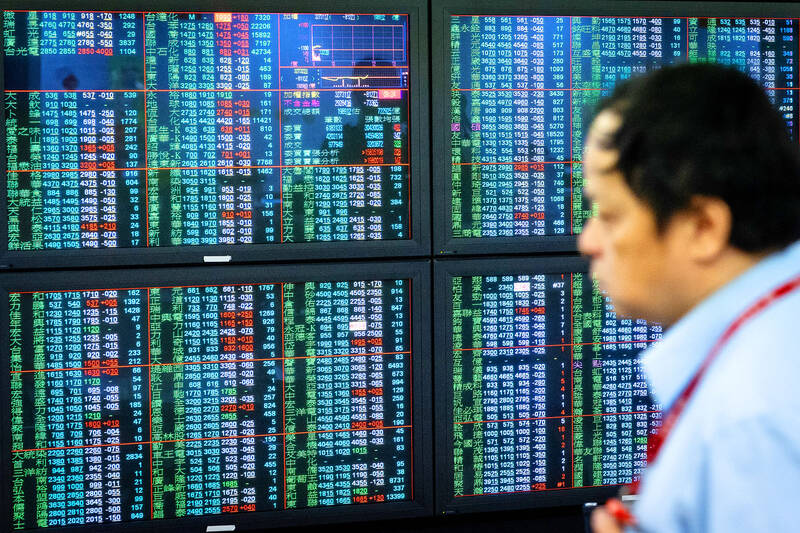
Photo: CNA
The survey also highlighted sustained momentum in exchange-traded funds (ETFs) among retail participants.
The number of Taiwan ETF beneficiaries surged by about 597,000 this month, with a significant portion of inflows directed toward actively managed ETFs, Taiwan Depository and Clearing Corp (台灣集保) data showed.
About 55 percent of investors said they have incorporated actively managed ETFs into their portfolios, underscoring growing acceptance of the products as an investment tool, the survey showed.
Investor appetite appears to cut across experience levels. Among respondents with more than five years of experience investing in local shares, nearly 69.7 percent said they plan to actively expand their positions.
Even among investors with no prior experience in local stocks, 43.3 percent said they would consider making small investments, suggesting that the TAIEX’s rally above 30,000 points has attracted new market participants.
Despite the optimism, the survey highlighted barriers discouraging participation in newly issued ETFs, particularly among younger investors.
About 74.4 percent of respondents younger than 29 cited cumbersome administrative procedures as the main obstacle preventing them from subscribing to new ETF offerings — nearly double the proportion who pointed to fees as a deterrent.
Across all age groups, the most frequently cited concern was transaction and remittance costs, mentioned by 38 percent of respondents. Another 35 percent said they are unable to visit brokerage offices in person because of work commitments.
Other complaints included excessive paperwork after subscriptions, limited access to certain ETF offerings through regular brokerage accounts, and the need to complete additional bank transfers after placing subscription orders.
About 30 to 33 percent of respondents said the hurdles highlight the need for a more streamlined subscription process.
The findings suggest Taiwan’s increasingly digital-savvy investors are pushing financial institutions to simplify investment procedures while broadening access to new financial products.
After several years flying high as Asia’s best Nvidia Corp proxy, Taiwan Semiconductor Manufacturing Co (TSMC, 台積電) is increasingly vying with other artificial intelligence (AI) stocks for investor attention. Stock traders are chasing a wider array of beneficiaries as mainstream usage of AI creates demand for hardware beyond the most-advanced chips TSMC makes for Nvidia. Subthemes from the deepening memory crunch to advances in robotics are also luring bids. At the same time, investment caps on single stocks are pushing funds to diversify, while retail investors long familiar with TSMC through its US depositary receipts are being offered a broader set of

Netherlands-based semiconductor equipment supplier ASML Holding NV yesterday said that it is planning to hire an additional 1,000 people in Taiwan this year in response to growing demand from clients. ASML had previously planned to recruit 600 people this year, but that the plan has been adjusted upward, ASML vice president and ASML Taiwan general manager Grace Wang (汪佳慧) told reporters. ASML has a workforce of more than 4,500 in Taiwan, accounting for about 10 percent of its global total, Wang said. This year’s recruitment campaign would focus on adding people in the customer support, manufacturing and supply chain domains to assist ASML
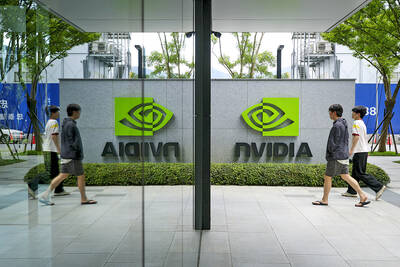
UNDER MICROSCOPE: Taiwan detained three people who allegedly conspired to buy servers in Taiwan and export them using fraudulent documentation, prosecutors said Nvidia Corp chief executive officer Jensen Huang (黃仁勳) on Saturday urged Super Micro Computer Inc to tighten up on compliance after Taiwan detained three people this week for allegedly making fraudulent declarations about artificial intelligence (AI) servers made by its US partner. The development marked the nation’s first crackdown on semiconductor smuggling, which grew after the US slapped restrictions on exports of high-end chips such as Nvidia AI accelerators to China. Nvidia is “rigorous” in explaining regulations to all of its partners, Huang told reporters after arriving in Taipei. “Ultimately Super Micro has to run their own company,” he said in response to

Nvidia Corp yesterday announced that CEO Jensen Huang (黃仁勳) would attend an employee meeting in Taipei tomorrow to celebrate the launch of the company’s Taiwan headquarters project. Huang would attend a gathering at the site of Nvidia’s planned headquarters in Beitou Shilin Technology Park (北投士林科技園區), the company said in a statement. After arriving in Taiwan on Saturday last week, Huang told reporters that he plans to meet with Quanta Computer Inc (廣達) chairman Barry Lam (林百里) and Taiwan Semiconductor Manufacturing Co (TSMC, 台積電) chairman C.C. Wei (魏哲家), and would attend the groundbreaking ceremony for Nvidia’s Taiwan headquarters tomorrow. Nvidia has not yet applied


 RSS
RSS