


The European Central Bank (ECB) would need to consider hiking interest rates as soon as next month if price pressures build further due to the Iran war, ECB Governing Council member Joachim Nagel said yesterday.
“As things currently stand, it is conceivable that the medium-term inflation outlook could deteriorate and inflation expectations could rise on a sustained basis, meaning that a more restrictive monetary-policy stance would probably be necessary,” Nagel said.
The Bundesbank president added that “more reliable data on this is already expected to be available by the next meeting of the ECB Governing Council in six weeks.”
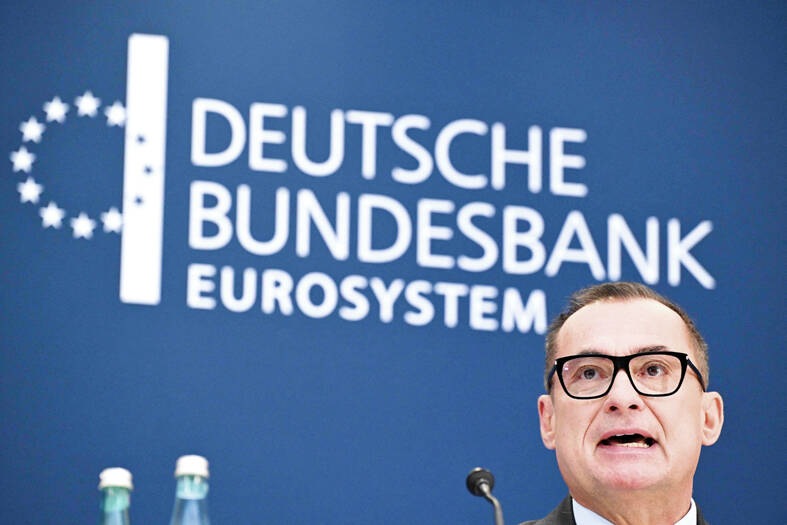
Photo: CNA
Nagel recalled the last spike in prices, fanned by Russia’s invasion of Ukraine in 2022, saying that experience “will play an important role in this context” — even if the ECB today “finds itself in a better starting position.”
The remarks highlight the growing alarm as soaring energy prices due to the conflict in the Middle East threaten to drive inflation higher while dragging down economic expansion.
EU leaders, who met on Thursday in Brussels for a summit attended by ECB President Christine Lagarde, are bracing for a years-long energy supply crunch after Iran crippled a vital Qatar gas plant.
“If production capacities themselves are destroyed, there will be a much more lasting impact from this war,” French President Emmanuel Macron said.
While the ECB kept rates unchanged for a sixth meeting this week, officials would be ready to raise borrowing costs on April 30 should fallout from the war push inflation too far above target, people familiar with the situation said.
New ECB projections showed consumer prices would advance by 2.6 percent in the euro area this year — far more than previously thought. In an extreme scenario in which disruptions to oil and natural gas supplies persist until late this year, inflation would peak at 6.3 percent in the first quarter of next year, it said.
Nevertheless, Lagarde insisted that she and her colleagues are “well positioned and well equipped to deal with the development of a major shock that is unfolding.”
They are determined to stabilize inflation at 2 percent, she said.
The ECB’s meeting took place just hours after the conflict in the Middle East escalated, with Iranian missiles damaging the world’s largest liquefied natural gas export plant in Qatar, inflicting damage that could take years to fix.
Such developments put policymakers in a tricky spot: They say they would not allow a repeat of the record surge in inflation in 2022 and 2023 and pledge to act decisively.
However, costlier energy simultaneously risks derailing the region’s economic recovery.
Nagel — who called Thursday’s decision “appropriate” — put the emphasis on prices and called the current situation “challenging.”
“The further development of the conflict will have a major impact on medium-term inflation,” he said, adding that the ECB’s future decisions would “depend on this.”
He stressed that ECB rate setters “will maintain a prudent monetary policy stance and act with the necessary resolve. Our primary mandate is price stability. Everyone benefits from this.”
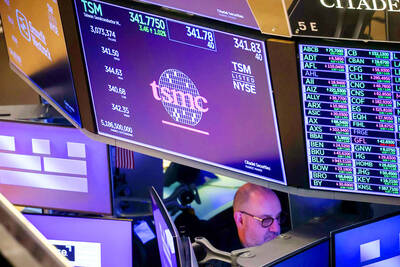
STRONG INTEREST: Analysts have pointed to optimism in TSMC’s growth prospects in the artificial intelligence era as the cause of the rising number of shareholders The number of people holding shares of chipmaker Taiwan Semiconductor Manufacturing Co (TSMC, 台積電) hit a new high last week despite a decline in its stock price, the Taiwan Depository and Clearing Corp (TDCC, 台灣集保) said. The number of TSMC shareholders rose to 2.46 million as of Friday, up 75,536 from a week earlier, TDCC data showed. The stock price fell 1.34 percent during the same week to close at NT$1,840 (US$57.55). The decline in TSMC’s share price resulted from volatility in global tech stocks, driven by rising international crude oil prices as the war against Iran continues. Dealers said
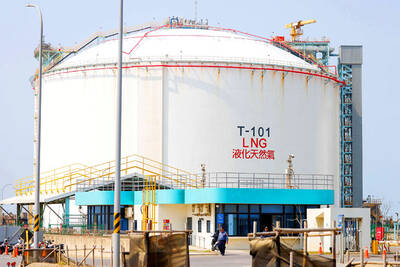
Taiwan’s natural gas supply remains stable through the end of May, despite rising concerns about potential disruptions to Qatari liquefied natural gas (LNG) supplies due to escalating conflicts in the Middle East, the Ministry of Economic Affairs said yesterday. The ministry in a statement said that Taiwan has completed preparations for natural gas supply and shipping schedules through the end of May. It has also made plans to increase natural gas imports from regions outside the Middle East in June to ensure a stable supply, it added. Taiwan sources natural gas from 14 countries and is not solely dependent on the Middle East,
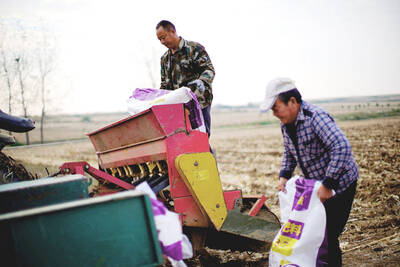
China is clamping down on fertilizer exports to protect its domestic market, industry sources said, putting an additional strain on global markets that were already grappling with shortages caused by the US-Israeli war on Iran. China is among the largest fertilizer exporters — shipping more than US$13 billion of it last year — and it has a history of controlling exports to keep prices low for farmers. Shipments through the war-blocked Strait of Hormuz account for about one-third of the sea-borne supply. This month, Beijing banned exports of nitrogen-potassium fertilizer blends and certain phosphate varieties, sources said. The ban, which has not
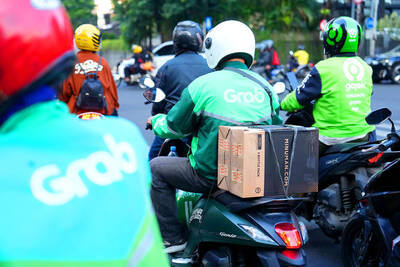
Grab Holdings Ltd agreed to buy Delivery Hero SE’s Foodpanda operations in Taiwan for US$600 million, a deal that marks its first foray outside of its Southeast Asian base. The cash acquisition will allow Grab to expand into 21 cities across Taiwan, the Singapore-based ride-hailing and delivery company said in a statement yesterday. Grab expects the transaction to be completed in the second half, subject to regulatory approvals. The purchase will give Grab a presence on the island of about 23 million people, helping it to expand beyond its intensely competitive home market. Grab has seen growth slow dramatically as it takes


 RSS
RSS