


Engineering Co (凌群電腦) showcased an artificial intelligence (AI) architecture that supports “virtual human and physical robot” collaboration at the Smart City Summit & Expo on Tuesday, highlighting the company’s capabilities for integrating AI, robotics and various workloads.
The architecture comes as generative AI is evolving from a supporting tool into a new type of “employee” that can be trained, managed and work with humans, Syscom president James Liu (劉瑞隆) said at the event at Taipei Nangang Exhibition Center’s Hall 2.
“Within the next five years, a company with 80 employees could have more than 30 virtual workers operating alongside 40 to 50 human staff, fundamentally reshaping business operations,” Liu said.
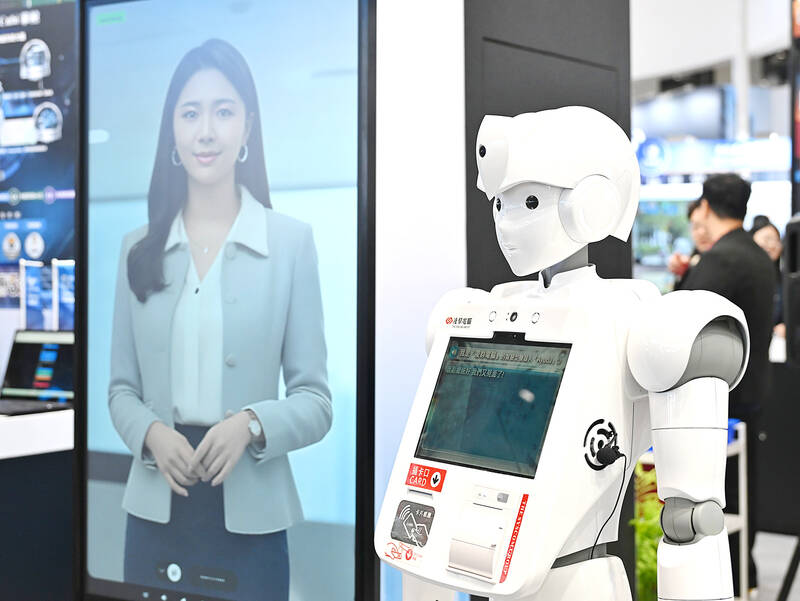
Photo: Chen Yi-kuan, Taipei Times
Under the architecture, a “physical worker” — the company’s service robot Ayuda — is integrated with a “virtual avatar” — the company’s self-developed Cubi system — to perform various tasks for enterprises, he said, adding that the company is targeting labor-replacement opportunities in sectors such as retail, catering, transportation and healthcare.
For robot development, Syscom is focusing on wheeled service robots, as bipedal humanoid robots are costly and less viable for mass adoption at this stage, Liu said.
The company would continue investing in research and development while waiting for technology and costs to mature before expanding further into humanoid robotics, he said.
Overall, Syscom’s role is that of a system integrator combining AI models, hardware and application scenarios, rather than focusing on standalone hardware manufacturing, Liu said.
In Taiwan, the company has entered the retail sector through a collaboration with Carrefour Taiwan to develop e-commerce systems and smart shopping services that integrate recipe recommendations, product search, inventory management and payment functions into a single interface, he said.
Regarding overseas expansion, the company has established operations in Thailand and Japan, while using its US subsidiary for global sales, Liu said. Japan is the primary market for the company’s robotics business, where it works with local partners to build distribution and service networks, he added.
Looking ahead, Syscom would focus on building technological advantages rather than pursuing short-term shipment growth, Liu said. The company’s strategy is to position early and scale up as the market matures, while adopting a dual-track product approach that emphasizes performance for high-end products and cost efficiency for entry-level offerings, he said.

SECOND-RATE: Models distilled from US products do not perform the same as the original and undo measures that ensure the systems are neutral, the US’ cable said The US Department of State has ordered a global push to bring attention to what it said are widespread efforts by Chinese companies, including artificial intelligence (AI) start-up DeepSeek (深度求索), to steal intellectual property from US AI labs, according to a diplomatic cable. The cable, dated Friday and sent to diplomatic and consular posts around the world, instructs diplomatic staff to speak to their foreign counterparts about “concerns over adversaries’ extraction and distillation of US AI models.” Distillation is the process of training smaller AI models using output from larger, more expensive ones to lower the costs of training a powerful new

Singapore-based ride-hailing and delivery giant Grab Holdings’ planned acquisition of Foodpanda’s Taiwan operations has yet to enter the formal review stage, as regulators await supplementary documents, the Fair Trade Commission (FTC) said yesterday. Acting FTC Chairman Chen Chih-min (陳志民) told the legislature’s Economics Committee that although Grab submitted its application on March 27, the case has not been officially accepted because required materials remain incomplete. Once the filing is finalized, the FTC would launch a formal probe into the deal, focusing on issues such as cross-shareholding and potential restrictions on market competition, Chen told lawmakers. Grab last month announced that it would acquire
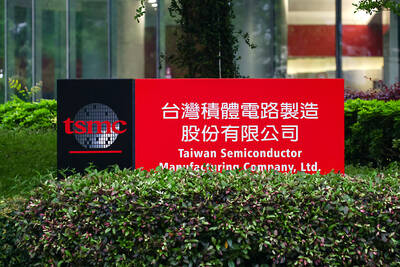
Shares of Taiwan Semiconductor Manufacturing Co (TSMC, 台積電) have repeatedly hit new highs, but an equity analyst said the stock’s valuation remains within a reasonable range and any pullback would likely be technical. The contract chipmaker’s historical price-to-earnings (P/E) ratio has ranged between 20 and 30, Cathay Futures Consultant Co (國泰證期) analyst Tsai Ming-han (蔡明翰) told Central News Agency. With market consensus projecting that TSMC would post earnings per share of about NT$100 (US$3.17) this year, supported by strong global demand for artificial intelligence (AI) applications, and the stock currently trading at a P/E ratio of below 25, Tsai said the valuation
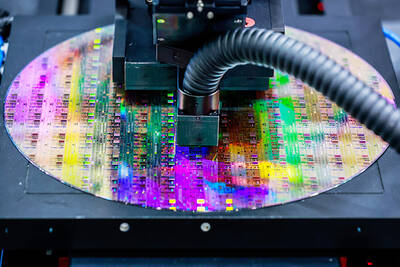
The artificial intelligence (AI) boom has triggered a seismic reshuffling of global equity markets, with Taiwan and South Korea muscling past European nations one by one. With its stock market now valued at nearly US$4.3 trillion, Taiwan surpassed the UK, Europe’s biggest market, earlier this month, data compiled by Bloomberg showed. South Korea is about US$140 billion away from doing the same. The tech-heavy Asian markets have shot past Germany and France in the past seven months. The shift is largely down to massive gains in shares of three companies that provide essential hardware for AI: Taiwan Semiconductor Manufacturing Co (TSMC, 台積電),


 RSS
RSS