


India plans to unveil a more than 1 trillion rupee (US$10.8 billion) fund aimed at bolstering domestic chipmaking, advancing its bid to become a global manufacturing hub.
The fund — which would provide subsidies for chip design projects, manufacturing equipment and supply chain development — might be launched in two to three months, people familiar with the matter said, asking not to be named as the plan is not yet public.
The plan is still under discussion and might change.

Photo: EPA
Indian Prime Minister Narendra Modi is trying to accelerate India’s chip campaign, which is in early stages with just a handful of major projects under way.
US memorychip maker Micron Technology Inc is establishing an assembly facility in Gujarat state, while Indian conglomerate Tata Group is building a semiconductor fabrication plant in Modi’s home state of Gujarat, along with a separate chip packaging unit.
India’s push, although smaller in scale, is similar to the US$52 billion US Chips and Science Act that funds local chipmaking capacity.
The country is hoping to woo major chipmakers to the world’s most populous country with its engineering and design talent, as well as subsidies, in much the same way it has helped Apple Inc expand in the region.
While India’s early projects are focusing on less-sophisticated chips, it has ambitions to move up the value chain to more advanced semiconductors.
New Delhi has set its sights on catching up with leading producers such as Taiwan, South Korea and the US, as the country aims to develop chipmaking capabilities comparable to major global leaders by 2032, Indian Minister for Electronics and Information Technology Ashwini Vaishnaw said in November last year.
Separately, Japan has set a new sales target for domestically produced microchips, with the country aiming for an eightfold increase by 2040 compared with 2020 levels.
Japan holds less than 10 percent of the global chip market, but Tokyo is investing heavily in new factories in a bid to change that.
In a strategy meeting on Tuesday, Japanese Prime Minister Takaichi Sanae’s administration said that it aims to boost sales of Japan-made chips to ¥15 trillion (US$95 billion) by 2030, and ¥40 trillion by 2040.
The 2040 target compares with sales of about ¥5 trillion in 2020, Japanese Ministry of Economy, Trade and Industry data showed.
Newly founded Japanese chipmaker Rapidus Corp is building a plant in the country to make cutting-edge 2-nanometer chips, with mass production slated for next year.
Taiwan Semiconductor Manufacturing Co (台積電), the world’s biggest contract chipmaker, last month said that it would produce advanced 3 nanometer semiconductors at a factory under construction in Japan.
Additional reporting by AFP

Taichung reported the steepest fall in completed home prices among the six special municipalities in the first quarter of this year, data compiled by Taiwan Realty Co (台灣房屋) showed yesterday. From January through last month, the average transaction price for completed homes in Taichung fell 8 percent from a year earlier to NT$299,000 (US$9,483) per ping (3.3m²), said Taiwan Realty, which compiled the data based on the government’s price registration platform. The decline could be attributed to many home buyers choosing relatively affordable used homes to live in themselves, instead of newly built homes in the city’s prime property market, Taiwan Realty
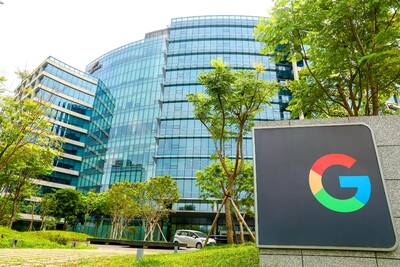
The government yesterday approved applications by Alphabet Inc’s Google to invest NT$27.08 billion (US$859.98 million) in Taiwan, the Ministry of Economic Affairs said in a statement. The Department of Investment Review approved two investments proposed by Google, with much of the funds to be used for data processing and electronic information supply services, as well as inventory procurement businesses in the semiconductor field, the ministry said. It marks the second consecutive year that Google has applied to increase its investment in Taiwan. Google plans to infuse NT$25.34 billion into Charter Investments Ltd (特許投資顧問) through its Singapore-based subsidiary Fructan Holdings Singapore Pte Ltd, and

JET JUICE: The war on Iran’s secondary effects have seen fuel prices skyrocket, knocking flight schedules down to earth in return as airlines struggle with costs Airline passengers should brace for more irritation in the next few months as carriers worldwide cancel flights and ground planes to cope with stratospheric increases in jet-fuel prices. Dutch flag carrier KLM is the latest company to cut its schedule, saying on Thursday that it would scrap 80 return flights at Amsterdam’s Schiphol Airport in the coming month. That puts it in the same league as United Airlines Holdings Inc, Deutsche Lufthansa AG and Cathay Pacific Airways Ltd, which have all pruned itineraries to mitigate costs. Global capacity for next month has been reduced by about 3 percentage points, with all

FORESEEABLE CONSEQUENCES: New technology always comes with new innovations by the iniquitous in exploiting users for financial gain or more nefarious ends Artificial intelligence (AI) “agents” say they can save users time and energy by automating tasks, but the growing power of systems such as OpenClaw is putting cybersecurity experts on edge. Powered by a wave of hype, OpenClaw today says it has more than three million users worldwide. The system allows users to create so-called agents, tools based on a large language model (LLM) such as OpenAI’s ChatGPT or Anthropic PBC’s Claude, that can carry out online tasks. “We’ve moved from an AI you could talk with via a chatbot to an agentic AI, which can take action... the threat and the risks are


 RSS
RSS