


Innolux Corp (群創) yesterday said it would sell a panel module assembly facility in Tainan to chip testing and packaging service provider ChipMOS Technologies Inc (南茂科技) for NT$880 million (US$27.65 million), the latest turnaround efforts made by the flat panel maker through asset rejuvenation.
ChipMOS clinched the deal as it is seeking to expand capacity significantly this year to satisfy rapidly growing customer demand for memory chips and logic chips used in AI-related devices amid the latest memory chip supercycle and the artificial intelligence boom.
The disposal of Innolux’s module plant would “inject fresh capital into the company’s operations and help drive future growth momentum,” the company said in a regulatory filing.

Photo: CNA
The company said it expects to book NT$659 million in disposal gains.
Innolux is looking to improve its profitability by optimizing its product portfolio and converting capacity for panel-level chip packaging services, as it faces an increasingly challenging market dominated by Chinese rivals.
The company’s board of directors had authorized chairman Jim Hung (洪進揚) to seek potential buyers for Fab 2 and Fab 5 and help restructure the company. Innolux closed Fab5 fab, a large-scale 5-generation fab, in summer last year in preparation for potential disposal.
Local media speculated the potential buyers of Fab 5 could be US-based Micron Technology Inc or Taiwan Semiconductor Manufacturing Co (TSMC, 台積電), but Micron was removed from the shortlist after it in January agreed to buy a fab in Miaoli County from Powerchip Semiconductor Manufacturing Corp (力積電) for US$1.8 billion.
Innolux said it swung into a loss of NT$19 million in the final quarter of last year, compared with profits of NT$67 million in the previous quarter and NT$9.03 billion a year earlier.
Non-operating income shrank to NT$56 million last quarter from NT$1.36 billion in the previous quarter and NT$14.5 billion a year earlier after selling a 5.5-generation plant to TSMC.
Last year as a whole, Innolux’s revenue increased 4.7 percent to NT$226.72 billion from NT$216.51 billion in 2024.
The flat panel display business accounted for 65 percent of total revenue last year, the company said.
While operating losses decreased to NT$4.16 billion last year from NT$7.92 billion in 2024, the company’s net profit last year still plunged about 96 percent to NT$250 million from NT$6.47 billion in 2024.
Earnings per share dropped to NT$0.03 from NT$0.76, it said.
Innolux expects non-display product shipments this quarter to grow 27 to 28 percent from last quarter, with shipments of commercial displays projected to increase by a low-single-digit percentage and shipments of displays used in consumer electronics likely to decline by a low-single-digit percentage, the company said.
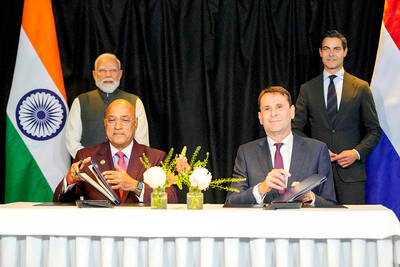
NEW MARKET: The partnership opens up India to the Dutch company, which already has a strong hold in the semiconductor market of South Korea, Taiwan and China ASML Holding NV entered into a partnership agreement with Tata Electronics Pvt Ltd aimed at ramping up India’s goal to develop domestic chip-manufacturing capabilities. The Dutch company’s technology would help power Tata Electronics’ planned 300 millimeter (mm) semiconductor foundry in Gujarat, according to a joint statement from the two companies on Saturday. The signing of a memorandum of understanding coincides with a visit by Indian Prime Minister Narendra Modi to the Netherlands, which is looking to deepen bilateral relations with New Delhi. ASML, whose top customers include Taiwan Semiconductor Manufacturing Co (台積電) and Samsung Electronics Co, makes lithography machines that can print
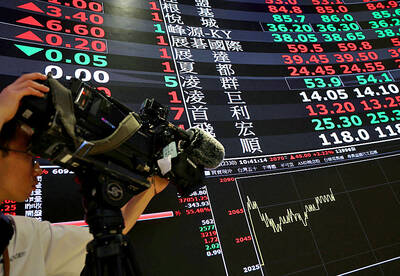
After several years flying high as Asia’s best Nvidia Corp proxy, Taiwan Semiconductor Manufacturing Co (TSMC, 台積電) is increasingly vying with other artificial intelligence (AI) stocks for investor attention. Stock traders are chasing a wider array of beneficiaries as mainstream usage of AI creates demand for hardware beyond the most-advanced chips TSMC makes for Nvidia. Subthemes from the deepening memory crunch to advances in robotics are also luring bids. At the same time, investment caps on single stocks are pushing funds to diversify, while retail investors long familiar with TSMC through its US depositary receipts are being offered a broader set of

TECH RELIANCE: Growth is increasingly reflecting an unequal K-shaped distribution, where technology sectors outperform and other industries struggle, an expert said Standard Chartered Bank has significantly raised its forecast for Taiwan’s economic growth to 9.5 percent this year, up from 7.6 percent previously, citing surging artificial intelligence (AI) demand driving exports, semiconductor production and investment. The upgrade reflects a sustained AI supercycle that continues to fuel demand for advanced chips and technology infrastructure, which form the backbone of Taiwan’s exports, the bank said in a report this week. “We raise our 2026 growth forecast to reflect a much stronger-than-expected first-quarter GDP figure,” Standard Chartered senior economist for greater China and Asia Tommy Wu (胡東安) said in the report. Driven largely by a 35.3 percent

Two of Taiwan’s international carriers, Starlux Airlines Co (星宇航空) and EVA Airways Corp (長榮航空), have retained the five-star airline rating awarded by international airline review organization Skytrax. Starlux was awarded the distinction for a second consecutive year, while EVA Air received it for the 11th straight year, Skytrax said in statements released yesterday and on Thursday last week, respectively. The five-star rating is considered one of the airline industry's highest honors and is awarded following professional audits of airline product and frontline service standards, Skytrax said. The ratings are based on in-depth assessments using unified global quality standards rather than customer review scores


 RSS
RSS