


The Bank of England (BOE) is planning to war-game the potential economic and financial impact of a full-blown artificial intelligence (AI) shock amid fears that the technology would cost vast numbers of jobs and cut through a swathe of businesses.
The British central bank would also consider whether to incorporate the assessments into its broader banking stress tests to capture a possible surge in household and company loan defaults, and the damage inflicted on lenders, a person familiar with the matter said.
Concerns about the economic threat posed by AI have rocketed after Anthropic chief executive officer Dario Amodei said that AI “could displace half of all entry-level white collar jobs in the next one to five years.”
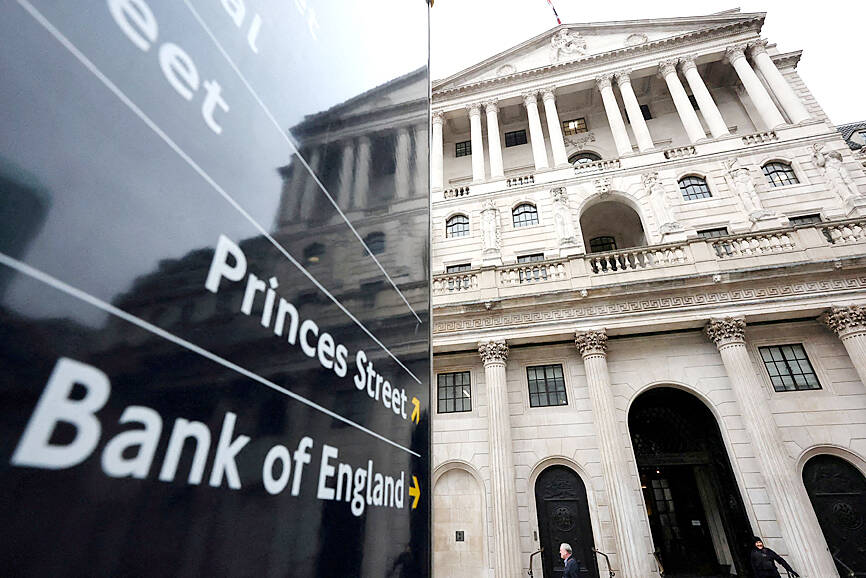
Photo: Reuters
A dystopian scenario published last month by Citrini Research sparked a brief market selloff, and fears of a jobs bloodbath intensified when financial technology firm Block Inc slashed its workforce by almost a half citing AI — with cofounder Jack Dorsey warning other firms would inevitably follow.
In the UK, the British Office for Budget Responsibility this week calculated AI-led “technological displacement” could result in an additional 500,000 unemployed, no extra economic growth and £9 billion (US$12.08 billion) more in government borrowing a year.
The BOE has warned about the financial consequences of a collapse in the AI stock valuations and is keeping a close eye on the use of AI within the financial sector, but has made little comment on the potential for wider economic disruption.
The person said the BOE would consider the macroeconomic and core financial market consequences of AI adoption under various scenarios, adding that those would feed into the normal process of deciding on commercial bank stress testing scenarios.
A BOE spokesperson declined to comment.
National Institute of Economic and Social Research director David Aikman said the bank should be running a series of AI exploratory scenarios to prepare for the worst, having done similar planning on climate change and Brexit in the past.
While the BOE is unlikely to have the tools to address an AI economic shock, it has the expertise and the resources to do the macroeconomic modeling for the British Treasury, which has many more policy options at its disposal, he said.
“Scenario planning would be of enormous value. It could help the government think about how it would respond,” Aikman said.
In January, British Minister of State for Investment Jason Stockwood told the Financial Times that the British government has discussed introducing a universal basic income for industries hit by AI.
University College London economics professor Wendy Carlin also urged the BOE to start war-gaming AI-led economic risks.
It was “a sensible thing for them to be doing,” she said.
The bank currently runs banking stress tests once every two years to see how resilient the system is against extreme risks.
Speaking at an event held by Elgin Advisory and the Society for Professional Economists on Friday, Ken Rogoff, Harvard University economics professor and former IMF chief economist, said US tariffs were a “head fake, making you look at something else when it’s not the big show going on” compared with “the job losses, the existential threats” of AI.
At the same event, BOE chief economist Huw Pill said the bank does not have the tools to rescue the economy from an AI catastrophe.
“What you’re really talking about is a world where, on average, people are better off, but there’s much greater inequality. Monetary policy has to deal with the aggregate,” he said, referring to its main remit of keeping inflation at 2 percent.
The government has “many other policies,” he added.
BOE Governor Andrew Bailey, an economic historian, compared AI to the Industrial Revolution and said it was likely to displace jobs.
“We need to be prepared for that,” he told the BBC in December last year.

Taichung reported the steepest fall in completed home prices among the six special municipalities in the first quarter of this year, data compiled by Taiwan Realty Co (台灣房屋) showed yesterday. From January through last month, the average transaction price for completed homes in Taichung fell 8 percent from a year earlier to NT$299,000 (US$9,483) per ping (3.3m²), said Taiwan Realty, which compiled the data based on the government’s price registration platform. The decline could be attributed to many home buyers choosing relatively affordable used homes to live in themselves, instead of newly built homes in the city’s prime property market, Taiwan Realty
The government yesterday approved applications by Alphabet Inc’s Google to invest NT$27.08 billion (US$859.98 million) in Taiwan, the Ministry of Economic Affairs said in a statement. The Department of Investment Review approved two investments proposed by Google, with much of the funds to be used for data processing and electronic information supply services, as well as inventory procurement businesses in the semiconductor field, the ministry said. It marks the second consecutive year that Google has applied to increase its investment in Taiwan. Google plans to infuse NT$25.34 billion into Charter Investments Ltd (特許投資顧問) through its Singapore-based subsidiary Fructan Holdings Singapore Pte Ltd, and

JET JUICE: The war on Iran’s secondary effects have seen fuel prices skyrocket, knocking flight schedules down to earth in return as airlines struggle with costs Airline passengers should brace for more irritation in the next few months as carriers worldwide cancel flights and ground planes to cope with stratospheric increases in jet-fuel prices. Dutch flag carrier KLM is the latest company to cut its schedule, saying on Thursday that it would scrap 80 return flights at Amsterdam’s Schiphol Airport in the coming month. That puts it in the same league as United Airlines Holdings Inc, Deutsche Lufthansa AG and Cathay Pacific Airways Ltd, which have all pruned itineraries to mitigate costs. Global capacity for next month has been reduced by about 3 percentage points, with all

The US said it plans to help build a first-of-its-kind industrial hub in the Philippines to boost production of inputs crucial to US supply chains. The 4,000-acre hub is intended to be “a purpose-built platform for allied manufacturing” and “an investment acceleration hub where the specific industrial activities are shaped by market demand,” the US Department of State said on Thursday. The project — touted as an “economic security zone” — would be within the Luzon Economic Corridor, a flagship economic project backed by the US and Japan on the main Philippine island. The project was also described as “the first artificial intelligence


 RSS
RSS