


German companies remain broadly optimistic about Taiwan’s economic outlook despite sentiment that the economy would normalize following the nation’s robust economic expansion last year, a business confidence survey released yesterday by the German Trade Office Taipei showed.
The results point to resilient confidence in Taiwan as a business destination, with bilateral trade rising 6 percent to US$21.7 billion, German Trade Office Taipei Chief Representative and Executive Director Eva Langerbeck said.
Nearly 90 percent of respondents expect Taiwan’s economy to remain stable or improve this year after GDP expanded 8.68 percent last year, she said.
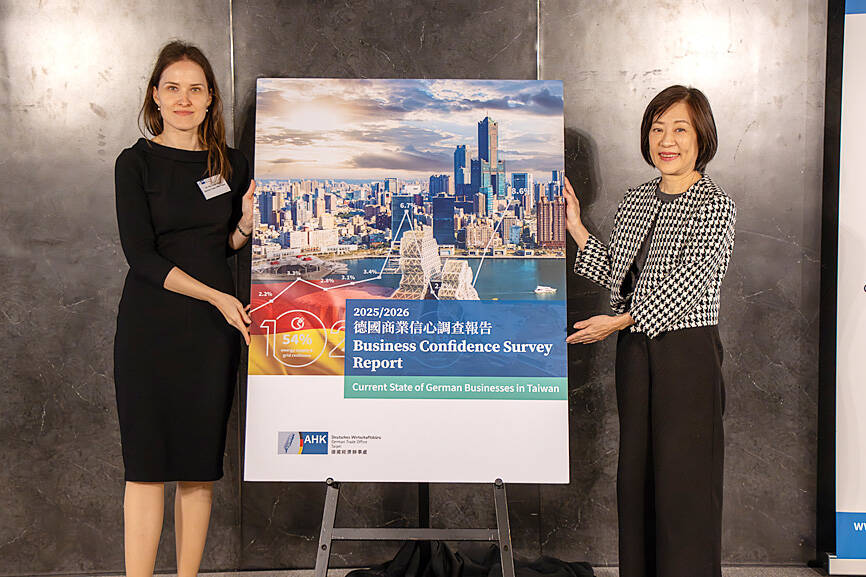
Photo courtesy of German Trade Office Taipei
German firms operating in Taiwan reported solid business performance last year, although overall satisfaction fell to a five-year low. About 52.1 percent of respondents said they were satisfied with their company’s performance.
The relatively subdued sentiment contrasts with strong operating results, as about 65.7 percent of companies said they met or exceeded their business targets, the third-best result in the past eight years.
Almost 41 percent of respondents reported revenue growth, while 40 percent said they achieved higher profit margins and 37.1 percent outperformed their respective markets. The strongest results were recorded in the machinery and electronics sectors.
A global boom in artificial intelligence (AI) has also created opportunities, with about 54.2 percent of firms saying they benefited from the surge, particularly in automation and semiconductor-related activities.
External risks nevertheless remain a major concern. About 61.1 percent of respondents cited global economic growth as the biggest challenge, followed by cross-strait relations and Taiwan’s domestic economic outlook.
Concerns over potential disruptions from tensions across the Taiwan Strait have eased. Only 26.8 percent of respondents said they expect cross-strait tensions to affect their operations.
Trade policies from the US remain another source of pressure. About 75.3 percent of respondents said US tariffs and trade measures have affected their businesses, mainly through weaker demand, and increased planning and cost pressures.
Investment activity among German companies in Taiwan remained largely stable, with half of respondents saying they carried out their investment plans on schedule, mostly unchanged from a year earlier.
However, 11.1 percent reported reducing or halting investments last year, up from the previous year, suggesting growing caution.
Looking ahead, investment appetite appears set to soften further. Only 30.6 percent of companies said they plan new investments in Taiwan over the next two years, while a similar share said they remain undecided.
Despite the uncertainty, long-term commitment to Taiwan remains strong, with about 94.4 percent of respondents saying they have no plans to relocate their investments elsewhere.
Semiconductors and AI were identified as the most promising growth sectors, cited by 94.4 percent of respondents. Energy and resources, as well as aerospace and security, were also seen as areas of opportunity.
The survey was conducted between November last year and January.

NEW IDENTITY: Known for its software, India has expanded into hardware, with its semiconductor industry growing from US$38bn in 2023 to US$45bn to US$50bn India on Saturday inaugurated its first semiconductor assembly and test facility, a milestone in the government’s push to reduce dependence on foreign chipmakers and stake a claim in a sector dominated by China. Indian Prime Minister Narendra Modi opened US firm Micron Technology Inc’s semiconductor assembly, test and packaging unit in his home state of Gujarat, hailing the “dawn of a new era” for India’s technology ambitions. “When young Indians look back in the future, they will see this decade as the turning point in our tech future,” Modi told the event, which was broadcast on his YouTube channel. The plant would convert

‘SEISMIC SHIFT’: The researcher forecast there would be about 1.1 billion mobile shipments this year, down from 1.26 billion the prior year and erasing years of gains The global smartphone market is expected to contract 12.9 percent this year due to the unprecedented memorychip shortage, marking “a crisis like no other,” researcher International Data Corp (IDC) said. The new forecast, a dramatic revision down from earlier estimates, gives the latest accounting of the ongoing memory crunch that is affecting every corner of the electronics industry. The demand for advanced memory to power artificial intelligence (AI) tasks has drained global supply until well into next year and jeopardizes the business model of many smartphone makers. IDC forecast about 1.1 billion mobile shipments this year, down from 1.26 billion the prior
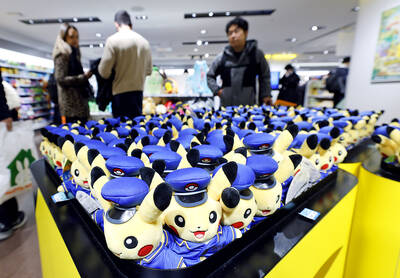
People stand in a Pokemon store in Tokyo on Thursday. One of the world highest-grossing franchises is celebrated its 30th anniversary yesterday.

Zimbabwe’s ban on raw lithium exports is forcing Chinese miners to rethink their strategy, speeding up plans to process the metal locally instead of shipping it to China’s vast rechargeable battery industry. The country is Africa’s largest lithium producer and has one of the world’s largest reserves, according to the US Geological Survey (USGS). Zimbabwe already banned the export of lithium ore in 2022 and last year announced it would halt exports of lithium concentrates from January next year. However, on Wednesday it imposed the ban with immediate effect, leaving unclear what the lithium mining sector would do in the


 RSS
RSS