


Taiwan’s foreign exchange reserves hit a record US$605.487 billion last month, rising for three consecutive months and up US$1.03 billion from the previous month, the central bank reported yesterday.
February is typically a peak month for investment income, which helped boost the central bank’s foreign exchange reserves, Department of Foreign Exchange Director-General Eugene Tsai (蔡炯民) said.
However, gains were partly offset by the central bank’s intervention in response to market volatility following US President Donald Trump’s announcement of Kevin Warsh as his nominee to succeed US Federal Reserve Chair Jerome Powell, whose term ends in May.
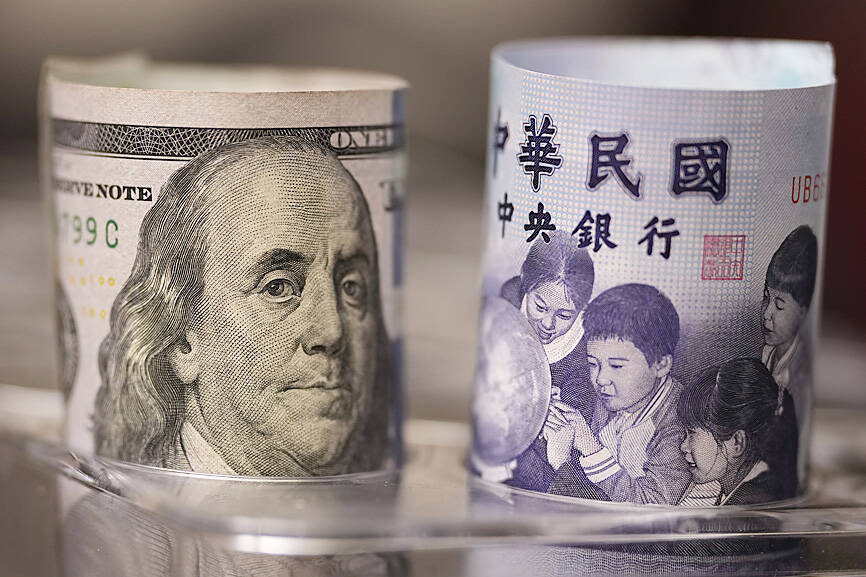
Photo: CNA
Movements among other major currencies also affected foreign exchange reserves after the portfolio of non-US dollar assets was converted into the US currency, Tsai said.
The US dollar index rose 0.64 percent last month, while most major non-US currencies weakened, with the British pound falling 1.43 percent, the yen losing 1.27 percent and the euro down 0.86 percent. In contrast, the yuan appreciated 1.63 percent, the central bank said.
Meanwhile, foreign investors’ holdings of Taiwanese stocks, bonds and New Taiwan dollar-denominated deposits reached US$1.47 trillion last month, equivalent to about 243 percent of Taiwan’s foreign exchange reserves.
Both figures are the highest on record and up from US$1.297 trillion and a ratio of 215 percent in the previous month, central bank data showed.
Foreign investors remitted about US$11.5 billion into Taiwan’s market last month, mainly around the Lunar New Year holiday, Tsai said.
After about US$7 billion in profit repatriation, net capital inflows totaled about US$4.5 billion.
The war in the Middle East has triggered greater fluctuations in global financial markets this week, with the TAIEX plunging from about 35,000 points to just more than 32,000 points in three sessions.
At the same time, the NT dollar also fell as much as NT$0.444 against the US dollar from Monday to Wednesday, Tsai said.
The market volatility was mainly driven by risk aversion, but “the biggest shock should have ended,” as investors are gradually returning focus to fundamentals, he said.
Unless geopolitical conflicts escalate further, the probability of similar sharp fluctuations occurring again in the short term is relatively low, he added.
Tsai also confirmed that the central bank had stepped in to smooth volatility over the past three days, but he emphasized that exchange rates are determined by market supply and demand, as well as global political and economic developments.
However, “the central bank’s intervention itself is a signal” to stabilize the market, he added.

NEW IDENTITY: Known for its software, India has expanded into hardware, with its semiconductor industry growing from US$38bn in 2023 to US$45bn to US$50bn India on Saturday inaugurated its first semiconductor assembly and test facility, a milestone in the government’s push to reduce dependence on foreign chipmakers and stake a claim in a sector dominated by China. Indian Prime Minister Narendra Modi opened US firm Micron Technology Inc’s semiconductor assembly, test and packaging unit in his home state of Gujarat, hailing the “dawn of a new era” for India’s technology ambitions. “When young Indians look back in the future, they will see this decade as the turning point in our tech future,” Modi told the event, which was broadcast on his YouTube channel. The plant would convert

‘SEISMIC SHIFT’: The researcher forecast there would be about 1.1 billion mobile shipments this year, down from 1.26 billion the prior year and erasing years of gains The global smartphone market is expected to contract 12.9 percent this year due to the unprecedented memorychip shortage, marking “a crisis like no other,” researcher International Data Corp (IDC) said. The new forecast, a dramatic revision down from earlier estimates, gives the latest accounting of the ongoing memory crunch that is affecting every corner of the electronics industry. The demand for advanced memory to power artificial intelligence (AI) tasks has drained global supply until well into next year and jeopardizes the business model of many smartphone makers. IDC forecast about 1.1 billion mobile shipments this year, down from 1.26 billion the prior
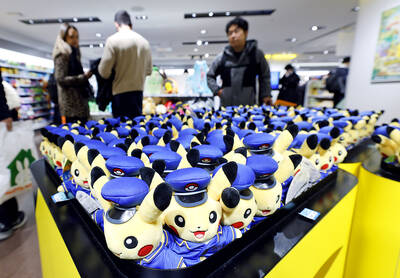
People stand in a Pokemon store in Tokyo on Thursday. One of the world highest-grossing franchises is celebrated its 30th anniversary yesterday.

Zimbabwe’s ban on raw lithium exports is forcing Chinese miners to rethink their strategy, speeding up plans to process the metal locally instead of shipping it to China’s vast rechargeable battery industry. The country is Africa’s largest lithium producer and has one of the world’s largest reserves, according to the US Geological Survey (USGS). Zimbabwe already banned the export of lithium ore in 2022 and last year announced it would halt exports of lithium concentrates from January next year. However, on Wednesday it imposed the ban with immediate effect, leaving unclear what the lithium mining sector would do in the


 RSS
RSS