


Yulon Nissan Motor Co (裕隆日產), the Taiwanese distributor of Infiniti vehicles, said yesterday that it would trim NT$300,000 (US$9,465) off the price of a limited number of QX60 2.0t sport utility vehicles (SUVs) following Taiwan’s decision to lower tariffs on US-made passenger cars.
The promotion applies to 30 seven-seat SUVs, including 15 units each of the Fashion and Flagship trims, the company said.
The Fashion edition will be reduced from NT$2.68 million to NT$2.38 million, while the Flagship edition will drop from NT$2.85 million to NT$2.55 million, Yulon Nissan said.
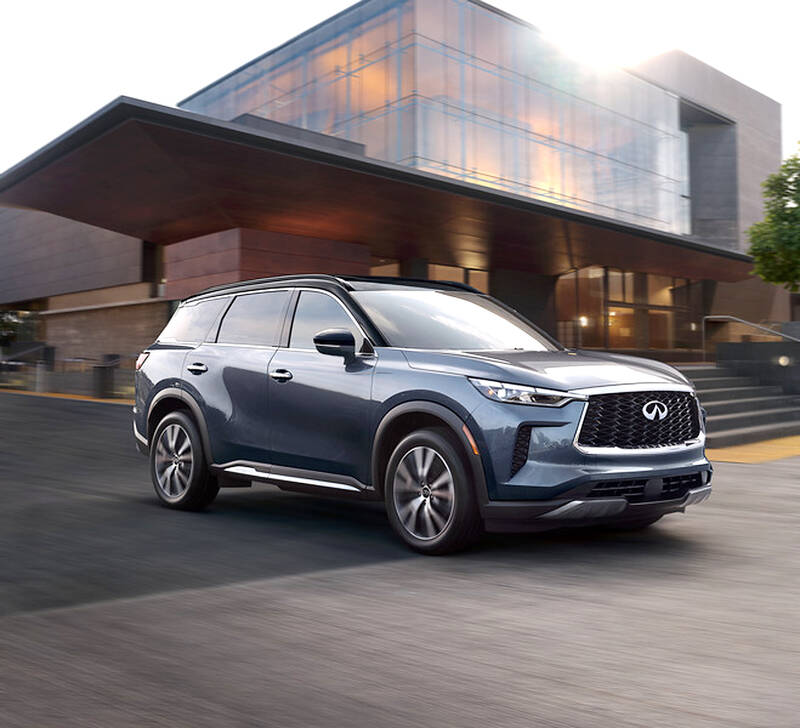
Photo courtesy of Yulon Nissan Motor Co
Other automakers have also signaled plans to adjust pricing.
Mercedes-Benz Taiwan Ltd (台灣賓士) said it would lower suggested retail prices for US-built models such as the GLE, GLE Coupe, GLS as well as the electric EQE SUV and EQS SUV, once the government finalizes implementation rules.
BMW AG’s Taiwan distributor, Pan German Motors Ltd (汎德永業), likewise said it would reduce prices for US-produced X-series models, including the X3, X5, X6 and X7, in line with the new trade measures.
According to market data, Japan accounted for 42 percent of Taiwan’s imported vehicle market last year, followed by Germany at 26 percent, while the US and South Korea each made up 6 percent.
Vehicles made in Japan, Germany and the US together represented more than 70 percent of total imports.
Taiwan imported about 12,000 vehicles from the US last year, mainly high-end electric and gasoline-powered cars. Major US-sourced brands include Tesla, Toyota, Ford, Mercedes-Benz and BMW.
The price cuts come after Taiwan and the US signed the Agreement on Reciprocal Trade (ART) on Feb. 13, which includes a commitment to eliminate tariffs on US-made passenger vehicles.
The government said it is in active communication with Washington to ensure Taiwan secures the preferential treatment outlined in the ART after the US Supreme Court ruled US President Donald Trump’s "reciprocal" tariffs unconstitutional on Feb. 20.

Taichung reported the steepest fall in completed home prices among the six special municipalities in the first quarter of this year, data compiled by Taiwan Realty Co (台灣房屋) showed yesterday. From January through last month, the average transaction price for completed homes in Taichung fell 8 percent from a year earlier to NT$299,000 (US$9,483) per ping (3.3m²), said Taiwan Realty, which compiled the data based on the government’s price registration platform. The decline could be attributed to many home buyers choosing relatively affordable used homes to live in themselves, instead of newly built homes in the city’s prime property market, Taiwan Realty
The government yesterday approved applications by Alphabet Inc’s Google to invest NT$27.08 billion (US$859.98 million) in Taiwan, the Ministry of Economic Affairs said in a statement. The Department of Investment Review approved two investments proposed by Google, with much of the funds to be used for data processing and electronic information supply services, as well as inventory procurement businesses in the semiconductor field, the ministry said. It marks the second consecutive year that Google has applied to increase its investment in Taiwan. Google plans to infuse NT$25.34 billion into Charter Investments Ltd (特許投資顧問) through its Singapore-based subsidiary Fructan Holdings Singapore Pte Ltd, and

Micron Technology Inc is a driving force pushing the US Congress to pass legislation that would put new export restrictions on equipment its Chinese competitors use to make their chips, according to people familiar with the matter. A US House of Representatives panel yesterday was to vote on the “MATCH Act,” a bill designed to close gaps in restrictions on chipmaking equipment. It would also pressure foreign companies that sell equipment to Chinese chipmaking facilities to align with export curbs on US companies like Lam Research Corp and Applied Materials Inc. The bill targets facilities operated by China’s ChangXin Memory Technologies Inc

Singapore-based ride-hailing and delivery giant Grab Holdings’ planned acquisition of Foodpanda’s Taiwan operations has yet to enter the formal review stage, as regulators await supplementary documents, the Fair Trade Commission (FTC) said yesterday. Acting FTC Chairman Chen Chih-min (陳志民) told the legislature’s Economics Committee that although Grab submitted its application on March 27, the case has not been officially accepted because required materials remain incomplete. Once the filing is finalized, the FTC would launch a formal probe into the deal, focusing on issues such as cross-shareholding and potential restrictions on market competition, Chen told lawmakers. Grab last month announced that it would acquire


 RSS
RSS