


Acer Gaming Inc (宏碁遊戲), the gaming console and PC game distribution arm of Acer Inc (宏碁), yesterday said it expects revenue to grow each quarter this year and annual sales to surpass last year’s total, on the back of new title launches and distribution channel expansion.
Acer Gaming, which is about 70 percent owned by Acer, reported revenue of NT$5.52 billion (US$174.63 million) last year, up 28.4 percent year-on-year.
Game distribution in Taiwan accounted for about 50 percent of the company’s total revenue, followed by the Philippines at 10 percent, Hong Kong at 8 percent and Singapore at 5 percent, while game art outsourcing unit Winking Corp (唯晶) contributed the remaining 27 percent, Acer Gaming president James Hsu (徐挺洋) said at a business presentation event in Taipei.
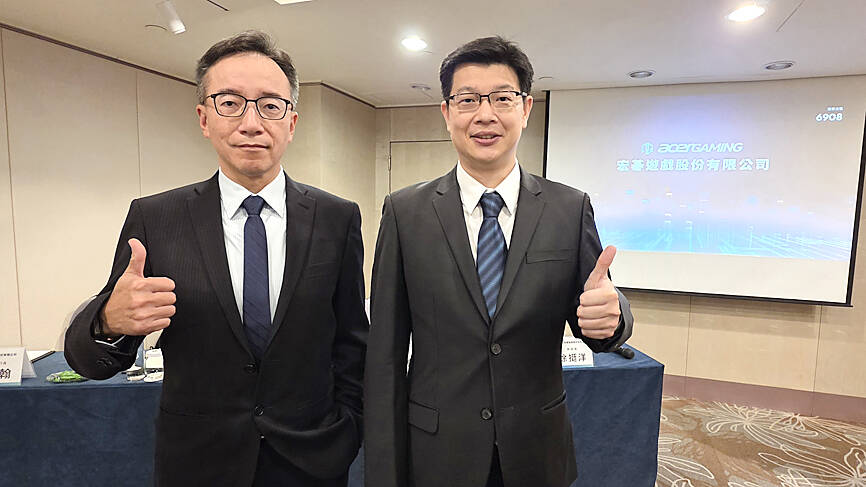
Photo: Chang Hui-wen, Taipei Times
Acer Gaming has been the exclusive sales agent for Sony Group Corp’s PlayStation 5 in Taiwan since 2020, with its focus gradually shifting from hardware sales to expanding the overall player base and driving growth in related software and merchandise, Hsu said.
The company has also served as a PlayStation sales agent in the Philippines, Hong Kong and Singapore since 2022 and plans to expand into additional markets, he said.
In its game distribution segment, hardware accounted for about 80 percent of total revenue, while software contributed the remaining 20 percent, he added.
Acer Gaming is confident about its business prospects, driven by increasing economies of scale, rising gaming software revenue and improved earnings from game art outsourcing, Hsu said.
The recent surge in memory prices has not affected the company’s operations, as it has not received any notice from suppliers about console price increases and has not seen significant front-loading of orders, he said.
The console and PC markets differ in structure, with console platforms typically having a smaller player base and longer product cycles, and more centralized inventory planning and pricing giving them more pricing power, he added.
Acer Gaming plans to make its debut on the Taiwan Innovation Board before the end of this month at the earliest at NT$40 per share.
Separately, Winking CEO Johnny Jan (詹承翰) said the company is evaluating about 10 more potential acquisition targets after completing three deals over the past two years.
Winking is optimistic about its performance this year after securing US$48.6 million in art services contracts, of which about US$34.6 million would be booked this fiscal year, he said.
Europe and the US are its biggest markets, accounting for about 30 percent of its total revenue, he added.
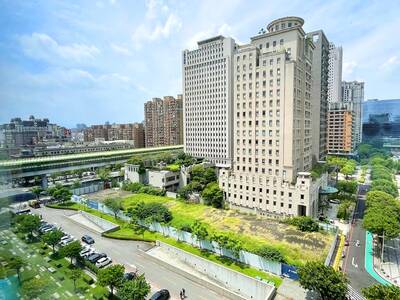
Taichung reported the steepest fall in completed home prices among the six special municipalities in the first quarter of this year, data compiled by Taiwan Realty Co (台灣房屋) showed yesterday. From January through last month, the average transaction price for completed homes in Taichung fell 8 percent from a year earlier to NT$299,000 (US$9,483) per ping (3.3m²), said Taiwan Realty, which compiled the data based on the government’s price registration platform. The decline could be attributed to many home buyers choosing relatively affordable used homes to live in themselves, instead of newly built homes in the city’s prime property market, Taiwan Realty
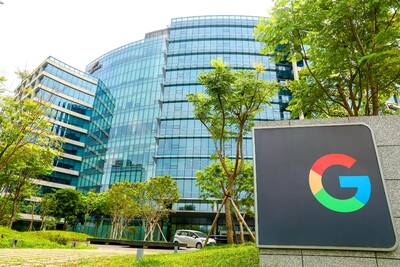
The government yesterday approved applications by Alphabet Inc’s Google to invest NT$27.08 billion (US$859.98 million) in Taiwan, the Ministry of Economic Affairs said in a statement. The Department of Investment Review approved two investments proposed by Google, with much of the funds to be used for data processing and electronic information supply services, as well as inventory procurement businesses in the semiconductor field, the ministry said. It marks the second consecutive year that Google has applied to increase its investment in Taiwan. Google plans to infuse NT$25.34 billion into Charter Investments Ltd (特許投資顧問) through its Singapore-based subsidiary Fructan Holdings Singapore Pte Ltd, and
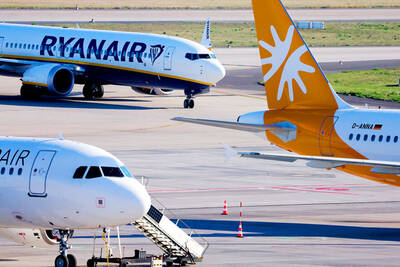
JET JUICE: The war on Iran’s secondary effects have seen fuel prices skyrocket, knocking flight schedules down to earth in return as airlines struggle with costs Airline passengers should brace for more irritation in the next few months as carriers worldwide cancel flights and ground planes to cope with stratospheric increases in jet-fuel prices. Dutch flag carrier KLM is the latest company to cut its schedule, saying on Thursday that it would scrap 80 return flights at Amsterdam’s Schiphol Airport in the coming month. That puts it in the same league as United Airlines Holdings Inc, Deutsche Lufthansa AG and Cathay Pacific Airways Ltd, which have all pruned itineraries to mitigate costs. Global capacity for next month has been reduced by about 3 percentage points, with all

The US said it plans to help build a first-of-its-kind industrial hub in the Philippines to boost production of inputs crucial to US supply chains. The 4,000-acre hub is intended to be “a purpose-built platform for allied manufacturing” and “an investment acceleration hub where the specific industrial activities are shaped by market demand,” the US Department of State said on Thursday. The project — touted as an “economic security zone” — would be within the Luzon Economic Corridor, a flagship economic project backed by the US and Japan on the main Philippine island. The project was also described as “the first artificial intelligence


 RSS
RSS