


Taiwan’s manufacturing sector roared ahead last month, posting its most vigorous improvement in more than four years, as buoyant global demand for semiconductors and artificial intelligence (AI) applications fueled sharp gains in output and new orders, S&P Global said in a report yesterday.
The S&P Global Taiwan Manufacturing Purchasing Managers’ Index (PMI) climbed to 55.2 from 51.7 in January, extending the expansion streak to a third consecutive month.
The latest reading marked the most pronounced upturn since December 2021, signaling a broad-based improvement in operating conditions across the sector.
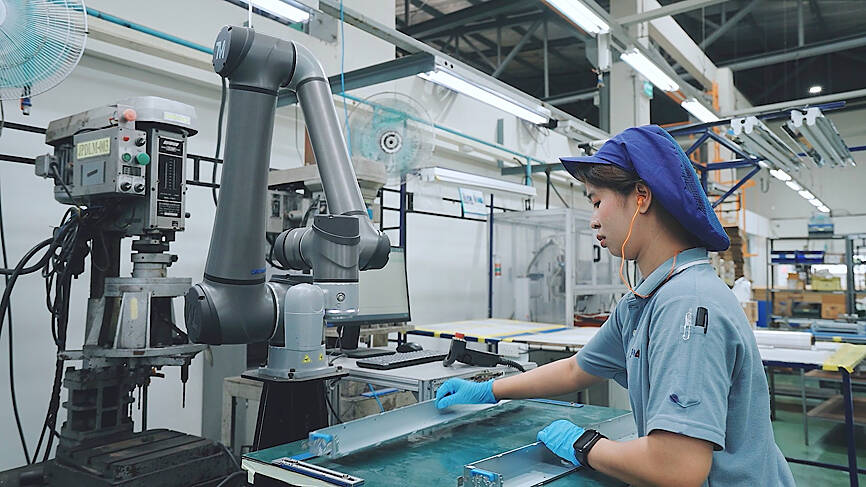
Photo courtesy of Techman Robot Inc
“With demand for semiconductors and AI-related technology ramping up worldwide, the momentum is likely to support the sector’s business in the months ahead,” S&P Global Market Intelligence economics associate director Annabel Fiddes said in a statement.
The improvement was underpinned by a surge in new business, with total new orders increasing at the fastest pace since July 2021, supported by firmer demand at home and abroad, S&P Global said.
Export orders expanded at the quickest rate in just over four years, with manufacturers reporting stronger sales to Europe, Japan, China and the US, it said.
Robust orders prompted firms to ramp up production at the sharpest pace since the middle of 2021.
To cope with rising workloads, companies accelerated purchasing activity, which recorded its steepest increase since November 2021, it said.
Input inventories rose at the fastest rate in four years, while stocks of finished goods expanded at the quickest pace since May 2011, reflecting growing confidence that demand would be sustained in the near term, it said.
However, the rapid rebound in activity placed fresh strain on supply chains.
Supplier delivery times lengthened at a faster pace last month, as vendors struggled to keep up with stronger demand and were reported to hold insufficient inventories, S&P Global said.
Price pressures also intensified. Average input costs climbed at the sharpest pace since April 2022 amid widespread increases in raw material prices, it said.
Manufacturers passed on part of the burden to customers, raising selling prices for a fifth consecutive month at the fastest rate since the middle of 2022, it said.
Despite buoyant output and orders, hiring remained measured. Employment rose only modestly, although the increase was the strongest in nearly three-and-a-half years, it said.
As demand outpaced workforce growth, backlogs accumulated at the quickest rate since August 2021, it added.
Manufacturers grew more optimistic about the 12-month outlook, with sentiment reaching its highest level since May 2024, buoyed by expectations that global demand — particularly for semiconductors and AI-related technologies — would remain supportive, S&P Global said.


Taiwanese firms have increased investment in the Philippines in recent years as Manila’s ties with Washington deepen and global supply chains continue to shift away from China, an expert at the Chung-Hua Institution for Economic Research (CIER, 中華經濟研究院) said yesterday. The Philippines had not been among Taiwanese investors’ top choices in Southeast Asia, CIER Taiwan ASEAN Studies Center director Kristy Hsu (徐遵慈) said at a seminar in Taipei. However, Taiwan’s investment in the country has grown significantly since the COVID-19 pandemic, reaching US $257 million last year, a high in recent years, she said. Although Taiwan’s total investment in the Philippines still lags

Intel Corp regards Taiwan Semiconductor Manufacturing Co (TSMC, 台積電) as a longstanding partner, as the US chipmaker would continue outsourcing production of advanced chips to TSMC, Intel chief executive officer Lip-Bu Tan (陳立武) said yesterday. “I don’t look at people as competitors. I look at the collaboration... Nvidia is also, you know, a good friend,” Tan told a news conference following his keynote speech at the Computex trade show in Taipei. “It’s a very trusted partnership for us... We are a big, top customer for them, and we’re going to continue doing that,” he said, referring to TSMC, the world’s largest foundry

Hon Hai Precision Industry Co (鴻海精密) yesterday said it would work with US chipmaker Intel Corp to jointly develop and deploy next-generation artificial intelligence (AI) infrastructure and intelligent computing platforms in a move to capture booming demand for AI computing systems. Hon Hai, also known as Foxconn Technology Group (富士康), said in a statement that the partnership would combine its global manufacturing scale, system integration expertise and AI data center deployment capabilities with Intel’s strengths in processor architecture, silicon technologies and software ecosystem. The companies said they plan to work on equipment used in AI data centers, including server racks powered by

Artificial intelligence (AI) agents would supplant smartphones as the center of people’s digital lives, fundamentally reshaping personal devices and driving a major computing upgrade cycle, Qualcomm Inc CEO Cristiano Amon said yesterday. In his keynote speech for this year’s Computex trade show in Taipei, Amon said that the rise of "agentic AI" — AI systems capable of reasoning, planning and carrying out tasks autonomously — would transform how people interact with technology across phones, PCs, vehicles and wearable devices. Describing the technology as the next major evolution in computing, Amon said that "2026 is the year of agents.” For decades, smartphones have sat


 RSS
RSS