


A law regulating artificial intelligence (AI) yesterday went into effect in Vietnam, making it the first country in Southeast Asia with a comprehensive framework on the booming technology.
Passed by the Vietnamese National Assembly in December last year, the law focuses on the risks posed by generative AI, requiring human oversight and control along the lines of the EU’s landmark AI Act.
Many nations are moving to address the dangers of chatbots and image generators — from misinformation to online abuse and copyright violations — but few have enacted legislation.

Photo: AFP
The legislation “paves the way for Vietnam to deeply integrate with international standards while maintaining digital sovereignty,” the government said in a December report.
It requires companies to clearly label AI-generated content such as deepfakes that cannot readily be differentiated from reality.
It also requires them to disclose to customers when they are interacting with an artificial rather than human agent.
The law applies to developers as well as providers and deployers of the technology, whether they are Vietnamese organizations or foreign entities operating in the country.
The nation has set ambitious double-digit percentage growth targets for the next five years, with expansion of the digital economy a key part of its development strategy.
AI and the data economy are “pillars” of a “more sustainable and smarter new development” model, Vietnamese Prime Minister Pham Minh Chinh was quoted as saying on Wednesday last week on the government’s Web site.
Under the law, the government would establish a national AI computing center, improved data resources and large language models in Vietnamese.
So far only a handful of countries have implemented far-reaching regulatory frameworks on AI.
The US, home to ChatGPT maker OpenAI, chip titan Nvidia Corp and tech giants like Google, is not keen on enacting new rules, with US Vice President J.D. Vance warning that “excessive regulation” could stifle innovation in the key sector.
The EU in 2024 initiated what it calls “the world’s first comprehensive AI law” and is gradually phasing in a set of rules that would become completely applicable next year.
South Korea in January became the first country to have an AI law take full effect, requiring companies to tell users when products use generative AI. It also says companies must clearly label content, including deepfakes, that cannot readily be differentiated from reality.
Places such as Taiwan and Japan are taking a lighter touch on AI regulation, shying away from penalties in favor of voluntary guidelines promoting innovation, while China — racing to challenge US dominance in the technology — has its own complex and evolving set of guardrails.
Many other countries, from Brazil to the United Arab Emirates, are implementing AI frameworks that could be divided into risk-based rules such as the EU’, or pro-innovation guidelines.
At an AI summit hosted by New Delhi last month, 91 countries and international organizations called for “secure, trustworthy and robust” AI.
However, their declaration, signed by the US and China, was criticized by AI safety campaigners for being too generic to protect the public.
An expert UN panel has also been established to work toward “science-led governance” of the technology, UN Secretary-General Antonio Guterres has said.
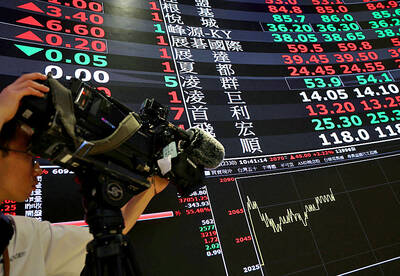
After several years flying high as Asia’s best Nvidia Corp proxy, Taiwan Semiconductor Manufacturing Co (TSMC, 台積電) is increasingly vying with other artificial intelligence (AI) stocks for investor attention. Stock traders are chasing a wider array of beneficiaries as mainstream usage of AI creates demand for hardware beyond the most-advanced chips TSMC makes for Nvidia. Subthemes from the deepening memory crunch to advances in robotics are also luring bids. At the same time, investment caps on single stocks are pushing funds to diversify, while retail investors long familiar with TSMC through its US depositary receipts are being offered a broader set of
UNDER MICROSCOPE: Taiwan detained three people who allegedly conspired to buy servers in Taiwan and export them using fraudulent documentation, prosecutors said Nvidia Corp chief executive officer Jensen Huang (黃仁勳) on Saturday urged Super Micro Computer Inc to tighten up on compliance after Taiwan detained three people this week for allegedly making fraudulent declarations about artificial intelligence (AI) servers made by its US partner. The development marked the nation’s first crackdown on semiconductor smuggling, which grew after the US slapped restrictions on exports of high-end chips such as Nvidia AI accelerators to China. Nvidia is “rigorous” in explaining regulations to all of its partners, Huang told reporters after arriving in Taipei. “Ultimately Super Micro has to run their own company,” he said in response to
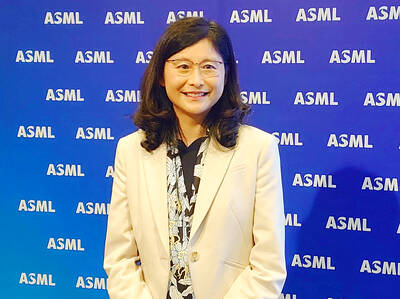
Netherlands-based semiconductor equipment supplier ASML Holding NV yesterday said that it is planning to hire an additional 1,000 people in Taiwan this year in response to growing demand from clients. ASML had previously planned to recruit 600 people this year, but that the plan has been adjusted upward, ASML vice president and ASML Taiwan general manager Grace Wang (汪佳慧) told reporters. ASML has a workforce of more than 4,500 in Taiwan, accounting for about 10 percent of its global total, Wang said. This year’s recruitment campaign would focus on adding people in the customer support, manufacturing and supply chain domains to assist ASML
TECH RELIANCE: Growth is increasingly reflecting an unequal K-shaped distribution, where technology sectors outperform and other industries struggle, an expert said Standard Chartered Bank has significantly raised its forecast for Taiwan’s economic growth to 9.5 percent this year, up from 7.6 percent previously, citing surging artificial intelligence (AI) demand driving exports, semiconductor production and investment. The upgrade reflects a sustained AI supercycle that continues to fuel demand for advanced chips and technology infrastructure, which form the backbone of Taiwan’s exports, the bank said in a report this week. “We raise our 2026 growth forecast to reflect a much stronger-than-expected first-quarter GDP figure,” Standard Chartered senior economist for greater China and Asia Tommy Wu (胡東安) said in the report. Driven largely by a 35.3 percent


 RSS
RSS