


Nvidia Corp has yet to sell any of its H200 chips to China two months after US President Donald Trump’s decision to allow shipments of the artificial intelligence (AI) processors to the world’s second-largest economy, US Department of Commerce Assistant Secretary for Export Enforcement David Peters said on Tuesday.
Peters told the US House of Representatives Foreign Affairs Committee that the US was boosting efforts to crack down on smuggling of advanced semiconductors used in AI.
US Representative Sydney Kamlager-Dove asked how many H200s have been approved for sale to China, to which he said: “My understanding is that so far, none.”
Photo: Reuters
While Peters does not directly participate in the licensing process, his comments on H200s offer a rare window into the workings of the department’s Bureau of Industry and Security, which oversees required US approvals for exports of sensitive technology.
His testimony came as investors await Nvidia’s earnings release, when the company might outline progress toward regaining access to the lucrative Chinese market.
Trump in December last year moved to allow Nvidia to sell H200s to select Chinese customers, but formal rules for the process, published last month by the bureau, have imposed conditions that make it harder to earn the green light.
More broadly, Peters said that there is a stringent approach to cracking down on companies that are contravening export control rules.
He highlighted a US$252 million settlement earlier this month between the US and Applied Materials Inc, which he said reached the statutory ceiling and was the largest in bureau history.
Underscoring this approach, Peters also said he would be open to increasing the statute of limitations to 10 years and lifting enforcement penalties to potentially more than four times the value of unlawful transactions.
“The message to everyone paying attention should be: Follow the law or face the consequences,” Peters said.
He also answered a question from US Representative Bill Huizenga on semiconductor smuggling specifically, calling it a top enforcement priority.
“There is chip smuggling,” Peters said. “It is going on.”
When asked specifically about potential Nvidia violations related to the company’s work with engineers at Chinese AI start-up DeepSeek (深度求索), Peters declined to comment, but said that the bureau would “enforce without regard to who the violator may be.”
After several years flying high as Asia’s best Nvidia Corp proxy, Taiwan Semiconductor Manufacturing Co (TSMC, 台積電) is increasingly vying with other artificial intelligence (AI) stocks for investor attention. Stock traders are chasing a wider array of beneficiaries as mainstream usage of AI creates demand for hardware beyond the most-advanced chips TSMC makes for Nvidia. Subthemes from the deepening memory crunch to advances in robotics are also luring bids. At the same time, investment caps on single stocks are pushing funds to diversify, while retail investors long familiar with TSMC through its US depositary receipts are being offered a broader set of
UNDER MICROSCOPE: Taiwan detained three people who allegedly conspired to buy servers in Taiwan and export them using fraudulent documentation, prosecutors said Nvidia Corp chief executive officer Jensen Huang (黃仁勳) on Saturday urged Super Micro Computer Inc to tighten up on compliance after Taiwan detained three people this week for allegedly making fraudulent declarations about artificial intelligence (AI) servers made by its US partner. The development marked the nation’s first crackdown on semiconductor smuggling, which grew after the US slapped restrictions on exports of high-end chips such as Nvidia AI accelerators to China. Nvidia is “rigorous” in explaining regulations to all of its partners, Huang told reporters after arriving in Taipei. “Ultimately Super Micro has to run their own company,” he said in response to
TECH RELIANCE: Growth is increasingly reflecting an unequal K-shaped distribution, where technology sectors outperform and other industries struggle, an expert said Standard Chartered Bank has significantly raised its forecast for Taiwan’s economic growth to 9.5 percent this year, up from 7.6 percent previously, citing surging artificial intelligence (AI) demand driving exports, semiconductor production and investment. The upgrade reflects a sustained AI supercycle that continues to fuel demand for advanced chips and technology infrastructure, which form the backbone of Taiwan’s exports, the bank said in a report this week. “We raise our 2026 growth forecast to reflect a much stronger-than-expected first-quarter GDP figure,” Standard Chartered senior economist for greater China and Asia Tommy Wu (胡東安) said in the report. Driven largely by a 35.3 percent
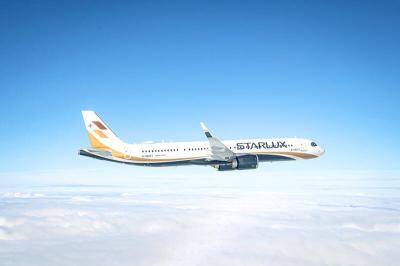
Two of Taiwan’s international carriers, Starlux Airlines Co (星宇航空) and EVA Airways Corp (長榮航空), have retained the five-star airline rating awarded by international airline review organization Skytrax. Starlux was awarded the distinction for a second consecutive year, while EVA Air received it for the 11th straight year, Skytrax said in statements released yesterday and on Thursday last week, respectively. The five-star rating is considered one of the airline industry's highest honors and is awarded following professional audits of airline product and frontline service standards, Skytrax said. The ratings are based on in-depth assessments using unified global quality standards rather than customer review scores


 RSS
RSS