


The European Central Bank (ECB) is delving into the risks faced by banks in the region from the artificial intelligence (AI) industry, amid heightened concern over hidden credit exposures and financial sector disruption.
The Frankfurt-based central bank is asking a small number of individual lenders for more details on their lending to areas including data centers, people familiar with the effort said.
It is also running targeted workshops to identify how banks are using generative AI, said the people, who asked not to be named.
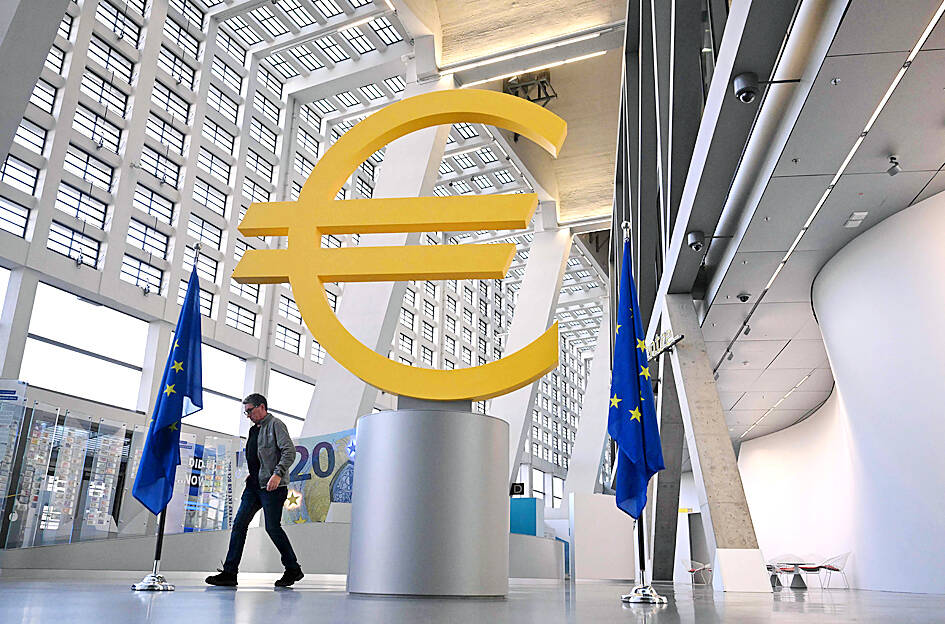
Photo: AFP
Increased attention by the ECB to AI risks underlines how global regulators are aware of the potential for the technology to upend the banking sector, from transforming the business of investment advice to managing its historic need for financing. Banks and private credit firms globally have been pouring trillions of dollars into the AI buildout, which spans development companies to data centers and energy supply.
The workshops focus on aspects such as business models, governance and risk management.
At least one lender understood the ECB’s attention to signal the need for caution on lending to sectors such as data centers, one of the people said.
The ECB last year said the way banks use AI applications would be a priority for its bank supervisors from this year to 2028 and that it would run workshops on the topic.
More broadly, the ECB and other authorities have expanded efforts to ask banks about their dependence on technology companies, other people familiar with the matter said.
That includes questions about what they would do if a cloud service provider or data center was no longer available at short notice, the people added.
Data recovery and backups are especially relevant here, they said.
AI adoption would expose European lenders to even greater systemic threats from their reliance on foreign tech giants, the Netherlands’ top financial regulator said last year.
Another banker said their firm is working on mapping its exposures to AI firms.
That is complex, because they have to consider not only loans to AI firms and data centers, but also other links such as those to their electricity suppliers, they said.
This month, stocks of firms offering wealth management services sold off as investors worried that large parts of the industry could be automated in the future.
Other companies, including those in insurance and software, have seen their shares plummet this month due to speculation around the perceived threat AI poses.
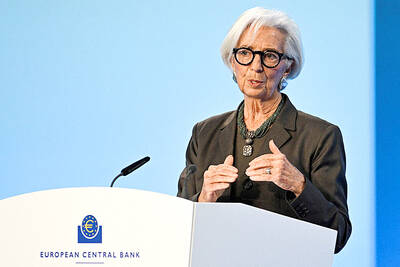
European Central Bank (ECB) President Christine Lagarde is expected to step down from her role before her eight-year term ends in October next year, the Financial Times reported. Lagarde wants to leave before the French presidential election in April next year, which would allow French President Emmanuel Macron and German Chancellor Friedrich Merz to find her replacement together, the report said, citing an unidentified person familiar with her thoughts on the matter. It is not clear yet when she might exit, the report said. “President Lagarde is totally focused on her mission and has not taken any decision regarding the end of
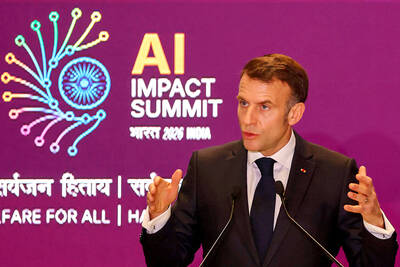
French President Emmanuel Macron told a global artificial intelligence (AI) summit in India yesterday he was determined to ensure safe oversight of the fast-evolving technology. The EU has led the way for global regulation with its Artificial Intelligence Act, which was adopted in 2024 and is coming into force in phases. “We are determined to continue to shape the rules of the game... with our allies such as India,” Macron said in New Delhi. “Europe is not blindly focused on regulation — Europe is a space for innovation and investment, but it is a safe space.” The AI Impact Summit is the fourth
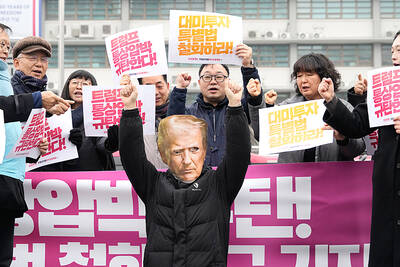
CONFUSION: Taiwan, Japan and other big exporters are cautiously monitoring the situation, while analysts said more Trump responses ate likely after his loss in court US trading partners in Asia started weighing fresh uncertainties yesterday after President Donald Trump vowed to impose a new tariff on imports, hours after the Supreme Court struck down many of the sweeping levies he used to launch a global trade war. The court’s ruling invalidated a number of tariffs that the Trump administration had imposed on Asian export powerhouses from China and South Korea to Japan and Taiwan, the world’s largest chip maker and a key player in tech supply chains. Within hours, Trump said he would impose a new 10 percent duty on US imports from all countries starting on
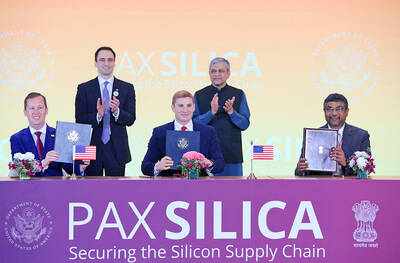
STRATEGIC ALLIANCE: The initiative is aimed at protecting semiconductor supply chain resilience to reduce dependence on China-dominated manufacturing hubs India yesterday joined a US-led initiative to strengthen technology cooperation among strategic allies in a move that underscores the nations’ warming ties after a brief strain over New Delhi’s unabated purchase of discounted Russian oil. The decision aligns India closely with Washington’s efforts to build secure supply chains for semiconductors, advanced manufacturing and critical technologies at a time when geopolitical competition with China is intensifying. It also signals a reset in relations following friction over energy trade and tariffs. Nations that have joined the Pax Silica framework include Japan, South Korea, the UK and Israel. “Pax Silica will be a group of nations


 RSS
RSS