


Senior US officials said US President Donald Trump’s tariff defeat at the US Supreme Court would not unravel deals negotiated with its partners as they sought to defend the administration’s assertive trade policies.
Those deals — which the administration made with partners including China, the EU, Japan and South Korea — remain in place, US Trade Representative Jamieson Greer said on Sunday.
He sought to separate those arrangements from the planned 15 percent global tariff Trump announced on Saturday.
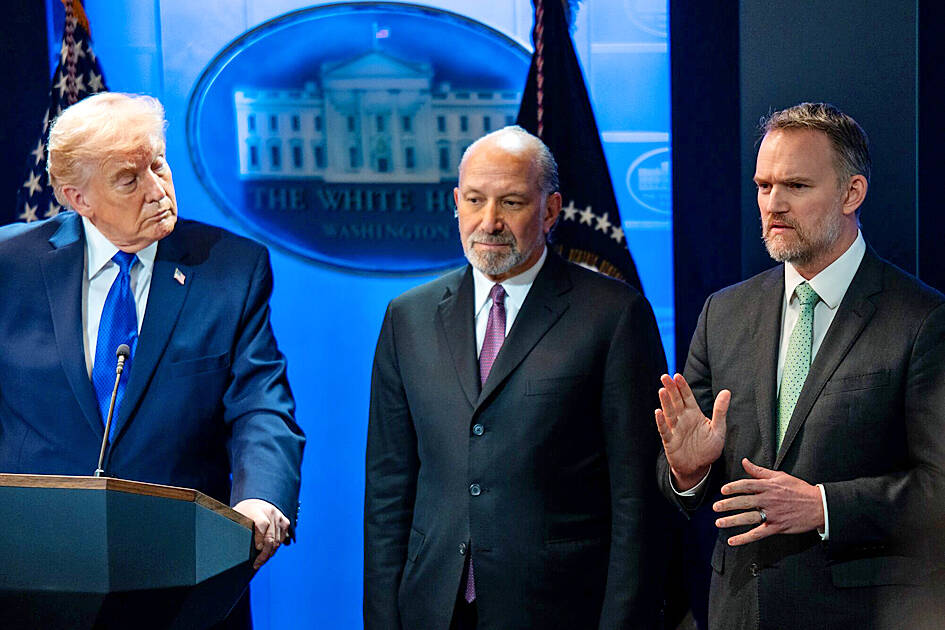
Photo: Bloomberg
“We want them to understand these deals are going to be good deals,” Greer said. “We’re going to stand by them. We expect our partners to stand by them.”
Friction over the renewed uncertainty spilled out Sunday as the European Parliament’s trade chief said he would propose freezing the EU’s ratification of a trade deal with the US until the Trump administration clarifies its policy. In New Delhi, officials cited similar reasons for India postponing talks in the US this week on finalizing an interim trade deal.
Greer suggested that alternative US trade tools, including those involving investigations of other countries’ trade practices, would give the US leverage.
“We have tariffs like this already in place on China, we have open investigations already,” he said, adding that he spoke with his EU counterpart over the weekend and would be talking with officials of other key US trading partners to reassure them.
“Rest assured, I’ve been speaking to these folks as well,” Greer said. “I’ve been telling them for a year — whether we won or lost, we were going to have tariffs, the president’s policy was going to continue.”
“That’s why they signed these deals even while the litigation was pending,” he said.
The European Commission, the EU’s executive arm in Brussels, said it wants “full clarity” on the Trump administration’s next steps.
“A deal is a deal,” the bloc’s executive arm said, adding that it expects the US to honor its commitments under a trade deal signed in August last year.
European Central Bank President Christine Lagarde said it is “critically important” for global trade to “have clarity” from the US administration.
“I hope it’s going to be clarified, and it’s going to be sufficiently thought through so that we don’t have, again, more challenges and the proposals will be in compliance with the constitution, in compliance with the law,” Lagarde said.
US Secretary of the Treasury Scott Bessent said the US was in contact with its foreign trading partners “and they like the tariff deals.”
“So you know, they’re not going to be changed,” he said.
Greer signaled that US trade partners should not count on tariff relief based on the Supreme Court ruling.
He said the 15 percent global tariff that Trump announced on Saturday is “roughly equivalent to the types of tariffs that we had in place” under the International Emergency Economic Powers Act — the tool that the court ruled Trump could not use for tariffs.
“The reality is, we want to maintain the policy we have, have as much continuity as possible,” Greer said.
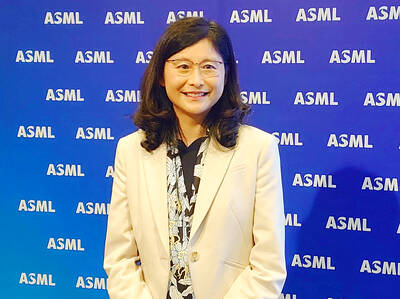
Netherlands-based semiconductor equipment supplier ASML Holding NV yesterday said that it is planning to hire an additional 1,000 people in Taiwan this year in response to growing demand from clients. ASML had previously planned to recruit 600 people this year, but that the plan has been adjusted upward, ASML vice president and ASML Taiwan general manager Grace Wang (汪佳慧) told reporters. ASML has a workforce of more than 4,500 in Taiwan, accounting for about 10 percent of its global total, Wang said. This year’s recruitment campaign would focus on adding people in the customer support, manufacturing and supply chain domains to assist ASML
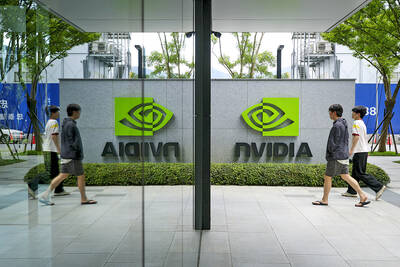
UNDER MICROSCOPE: Taiwan detained three people who allegedly conspired to buy servers in Taiwan and export them using fraudulent documentation, prosecutors said Nvidia Corp chief executive officer Jensen Huang (黃仁勳) on Saturday urged Super Micro Computer Inc to tighten up on compliance after Taiwan detained three people this week for allegedly making fraudulent declarations about artificial intelligence (AI) servers made by its US partner. The development marked the nation’s first crackdown on semiconductor smuggling, which grew after the US slapped restrictions on exports of high-end chips such as Nvidia AI accelerators to China. Nvidia is “rigorous” in explaining regulations to all of its partners, Huang told reporters after arriving in Taipei. “Ultimately Super Micro has to run their own company,” he said in response to
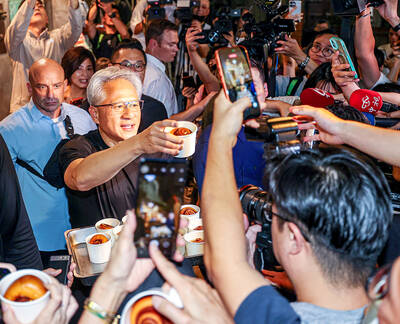
Nvidia Corp yesterday announced that CEO Jensen Huang (黃仁勳) would attend an employee meeting in Taipei tomorrow to celebrate the launch of the company’s Taiwan headquarters project. Huang would attend a gathering at the site of Nvidia’s planned headquarters in Beitou Shilin Technology Park (北投士林科技園區), the company said in a statement. After arriving in Taiwan on Saturday last week, Huang told reporters that he plans to meet with Quanta Computer Inc (廣達) chairman Barry Lam (林百里) and Taiwan Semiconductor Manufacturing Co (TSMC, 台積電) chairman C.C. Wei (魏哲家), and would attend the groundbreaking ceremony for Nvidia’s Taiwan headquarters tomorrow. Nvidia has not yet applied
Huawei Technologies Co (華為) said it has come up with a new pathway to shorten its gap with industry leader Taiwan Semiconductor Manufacturing Co (TSMC, 台積電), potentially achieving a breakthrough in making advanced semiconductors without cutting-edge equipment. Right now there is about a five-year gap between what TSMC is capable of and what Huawei, together with its manufacturing partner Semiconductor Manufacturing International Corp (中芯), can produce. Huawei is to start making 1.4-nanometer chips by 2031 with its own “LogicFolding” technology, Huawei semiconductor chief He Tingbo (何庭波) said in a rare public appearance during a chip conference yesterday, while TSMC has


 RSS
RSS