


US markets are gripped by the “AI scare trade,” with investors selling software firms and wealth managers on concern that rapid advances in artificial intelligence (AI) would erode established business models.
In China, the mood is far more upbeat. Instead of worrying about disruption, investors are chasing perceived winners, drawn by AI’s growth prospects and its potential to drive cost savings for end users.
Local firms that have released new models or upgraded existing ones are investor favorites. MiniMax Group Inc (稀宇科技) and Knowledge Atlas Technology JSC Ltd (智譜華章科技) — better known as Zhipu — are the most notable examples, with their stock price more than doubling this month.
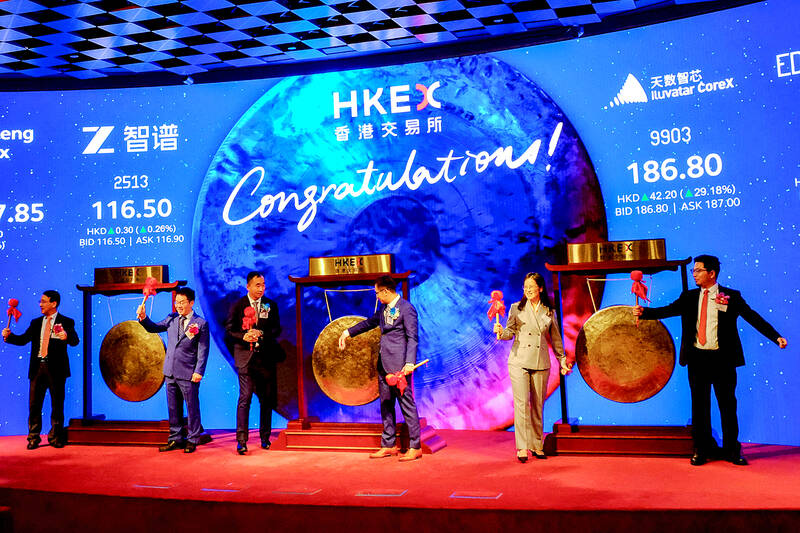
Photo: AFP
Bullish ratings from Wall Street banks including Morgan Stanley are fueling the optimism as pure AI plays lure investors away from traditional Internet giants.
“China has been relatively insulated from the AI scare trade because the market is still focused on what AI can aid rather than what it can take away from incumbents,” Saxo Markets chief investment strategist Charu Chanana said in Singapore. “In the US, there’s anxiety about rich profit pools getting competed away, while China is still about penetration.”
One key reason for the divergence in investor focus is China’s relatively insulated competitive landscape, where regulatory constraints and geopolitical tensions limit foreign participation by AI-related companies.
“The divergence between China market participants and global investors reflects how structurally distinct China’s AI landscape is,” Allspring Global Investments Holdings LLC portfolio manager Gary Tan said in Singapore.
Foreign large language models (LLMs) “have limited access to the domestic market, giving local model makers a clear run,” he said.
MiniMax and Zhipu are also winning favor with investors because of a dearth of listed global companies that build LLMs. Both stocks debuted in Hong Kong last month and Zhipu shares have since climbed 524 percent, while MiniMax stock is up 488 percent.
Other recently debuted Chinese AI-related stocks have also done well in the upswing. Among chip designers, Biren Technology Co (壁仞科技) shares are up more than 80 percent since their Jan. 2 listing, while Montage Technology Co’s (瀾起科技) stock has surged more than 98 percent since it started trading on Feb. 9.
The Chinese firms are also riding a halo effect, with fresh private funding rounds for the two pioneers pointing to ever-rising valuations — OpenAI is close to raising more than US$100 billion in new funds at a valuation that could exceed US$850 billion, while Anthropic PBC earlier this month raised US$30 billion at a US$380 billion valuation.
New models and the fundraising numbers have helped drive a re-rating, Jefferies Financial Group Inc analysts wrote in a Feb. 13 note. “There is upside to China AI valuations.”
Some market watchers caution that the re-rating might prove difficult to sustain if earnings growth fails to keep pace with investor optimism.
There is also concern that in focusing on AI champions, investors might be overlooking a more uncomfortable reality: disruption risks that could have implications for a variety of sectors, and thereby hurt corporate earnings across the broader market.
For now, each new AI development is being viewed by Chinese investors as a catalyst not only for the developers, but also for the users of the new tools.
Zhipu released the latest iteration of its LLM, GLM-5, which surpassed a rival offering from Moonshot AI Technology Co (月之暗面) unveiled just weeks ago to claim the top spot among open-source models worldwide on benchmarking site Artificial Analysis.
That is the highest ranking a Chinese AI lab has ever achieved, according to the Jefferies note.
Some of the excitement is linked to DeepSeek (深度求索), the company that kicked off a global frenzy over China’s fast-rising AI industry. The firm is expected to release its next-generation model soon, which could boost the entire sector. There is also expectation that the cost competitiveness of Chinese AI models, such as those developed by DeepSeek, could accelerate user adoption.

Netherlands-based semiconductor equipment supplier ASML Holding NV yesterday said that it is planning to hire an additional 1,000 people in Taiwan this year in response to growing demand from clients. ASML had previously planned to recruit 600 people this year, but that the plan has been adjusted upward, ASML vice president and ASML Taiwan general manager Grace Wang (汪佳慧) told reporters. ASML has a workforce of more than 4,500 in Taiwan, accounting for about 10 percent of its global total, Wang said. This year’s recruitment campaign would focus on adding people in the customer support, manufacturing and supply chain domains to assist ASML

UNDER MICROSCOPE: Taiwan detained three people who allegedly conspired to buy servers in Taiwan and export them using fraudulent documentation, prosecutors said Nvidia Corp chief executive officer Jensen Huang (黃仁勳) on Saturday urged Super Micro Computer Inc to tighten up on compliance after Taiwan detained three people this week for allegedly making fraudulent declarations about artificial intelligence (AI) servers made by its US partner. The development marked the nation’s first crackdown on semiconductor smuggling, which grew after the US slapped restrictions on exports of high-end chips such as Nvidia AI accelerators to China. Nvidia is “rigorous” in explaining regulations to all of its partners, Huang told reporters after arriving in Taipei. “Ultimately Super Micro has to run their own company,” he said in response to

Nvidia Corp yesterday announced that CEO Jensen Huang (黃仁勳) would attend an employee meeting in Taipei tomorrow to celebrate the launch of the company’s Taiwan headquarters project. Huang would attend a gathering at the site of Nvidia’s planned headquarters in Beitou Shilin Technology Park (北投士林科技園區), the company said in a statement. After arriving in Taiwan on Saturday last week, Huang told reporters that he plans to meet with Quanta Computer Inc (廣達) chairman Barry Lam (林百里) and Taiwan Semiconductor Manufacturing Co (TSMC, 台積電) chairman C.C. Wei (魏哲家), and would attend the groundbreaking ceremony for Nvidia’s Taiwan headquarters tomorrow. Nvidia has not yet applied
Huawei Technologies Co (華為) said it has come up with a new pathway to shorten its gap with industry leader Taiwan Semiconductor Manufacturing Co (TSMC, 台積電), potentially achieving a breakthrough in making advanced semiconductors without cutting-edge equipment. Right now there is about a five-year gap between what TSMC is capable of and what Huawei, together with its manufacturing partner Semiconductor Manufacturing International Corp (中芯), can produce. Huawei is to start making 1.4-nanometer chips by 2031 with its own “LogicFolding” technology, Huawei semiconductor chief He Tingbo (何庭波) said in a rare public appearance during a chip conference yesterday, while TSMC has


 RSS
RSS