


British entrepreneurship appears to be on the rise, with tens of thousands of new businesses popping up. The problem, for workers, is that these start-ups are increasingly using artificial intelligence (AI) and freelancers instead of taking on permanent staff.
New firms launched in the UK last year generated an average of 2.7 jobs each, around one fewer than when records began in 2017, according to a Bloomberg analysis of official data. Total employment created by new enterprises fell 16 percent to the lowest level on record.
That is despite Britons starting new firms at the fastest pace in two years, during the fourth quarter of last year.
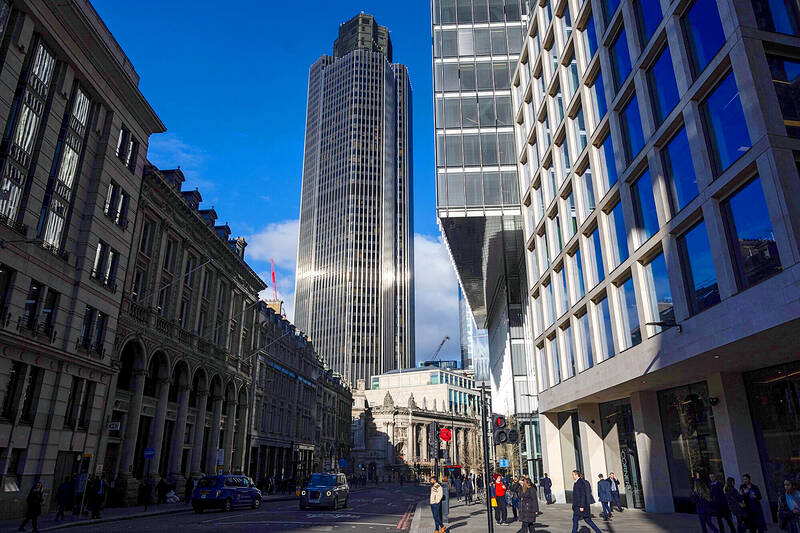
Photo: Bloomberg
“It’s scary to hire people, the minimum wage is so high and there’s so many additional protections,” said Rachael Twumasi-Corson, an entrepreneur from London who is set to launch a new company later this year. “I would much rather have a team, celebrate wins and figure out ways to solve problems together, but at the moment, my team is ChatGPT and Gemini.”
Business groups say the UK’s Labour government has made it more risky and expensive to hire permanent staff, despite the left-leaning party promising to prioritize economic growth. British Chancellor of the Exchequer Rachel Reeves hiked national insurance, a key payroll tax, last year — and while small businesses are largely exempt, they face higher costs from rising salaries, including sharp increases in the minimum wage.
Entrepreneurs are also concerned about new employment laws, which allow workers to claim unfair dismissal after six months on the job, instead of the current two years, effectively making it harder to fire staff. The proposals will also give workers sick pay rights from day one.
AI technology means that some founders can avoid hiring in the first place. Twumasi-Corson initially wanted to employ a designer and a social media marketing specialist — she even wrote the job descriptions — but ended up relying on contractors and AI chatbots because of the costs. The London Living Wage, an optional rate the entrepreneur cited as a benchmark, has reached £14.80 (US$20) per hour in 2025-2026, a 36 percent increase over the last five years.
That approach is common among new start-ups, according to Timothy Barnes, CEO at the Centre for Entrepreneurs. Founders are starting out with just a small team of specialists, while using AI to reduce the number of people needed to support each specialist, particularly in roles like business development, accounting or marketing. There is also less appetite for human coders in new tech businesses as AI fills the gap.
“Before, the mindset might have been: We’ve got this idea and we’re going to quickly recruit as many people as possible to pursue it,” Entrepreneurs Network research director Eamonn Ives said. “Now start-ups are thinking twice about taking on new hires who they might not be able to keep on if things don’t pan out.”
One in four founders have made fewer administrative hires, and 19 percent recruited fewer juniors in response to AI technological advancements, according to a survey conducted by the Entrepreneurs Network in November last year. Only 2 percent said they increased headcount.
“Newer firms are starting out leaner, more automated, and less labor-intensive,” British Chambers of Commerce research head David Bharier said.
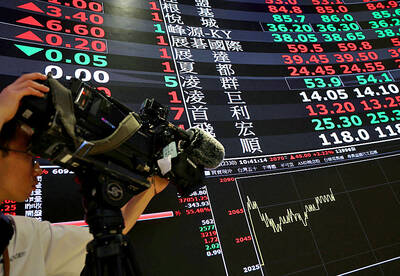
After several years flying high as Asia’s best Nvidia Corp proxy, Taiwan Semiconductor Manufacturing Co (TSMC, 台積電) is increasingly vying with other artificial intelligence (AI) stocks for investor attention. Stock traders are chasing a wider array of beneficiaries as mainstream usage of AI creates demand for hardware beyond the most-advanced chips TSMC makes for Nvidia. Subthemes from the deepening memory crunch to advances in robotics are also luring bids. At the same time, investment caps on single stocks are pushing funds to diversify, while retail investors long familiar with TSMC through its US depositary receipts are being offered a broader set of

UNDER MICROSCOPE: Taiwan detained three people who allegedly conspired to buy servers in Taiwan and export them using fraudulent documentation, prosecutors said Nvidia Corp chief executive officer Jensen Huang (黃仁勳) on Saturday urged Super Micro Computer Inc to tighten up on compliance after Taiwan detained three people this week for allegedly making fraudulent declarations about artificial intelligence (AI) servers made by its US partner. The development marked the nation’s first crackdown on semiconductor smuggling, which grew after the US slapped restrictions on exports of high-end chips such as Nvidia AI accelerators to China. Nvidia is “rigorous” in explaining regulations to all of its partners, Huang told reporters after arriving in Taipei. “Ultimately Super Micro has to run their own company,” he said in response to

TECH RELIANCE: Growth is increasingly reflecting an unequal K-shaped distribution, where technology sectors outperform and other industries struggle, an expert said Standard Chartered Bank has significantly raised its forecast for Taiwan’s economic growth to 9.5 percent this year, up from 7.6 percent previously, citing surging artificial intelligence (AI) demand driving exports, semiconductor production and investment. The upgrade reflects a sustained AI supercycle that continues to fuel demand for advanced chips and technology infrastructure, which form the backbone of Taiwan’s exports, the bank said in a report this week. “We raise our 2026 growth forecast to reflect a much stronger-than-expected first-quarter GDP figure,” Standard Chartered senior economist for greater China and Asia Tommy Wu (胡東安) said in the report. Driven largely by a 35.3 percent
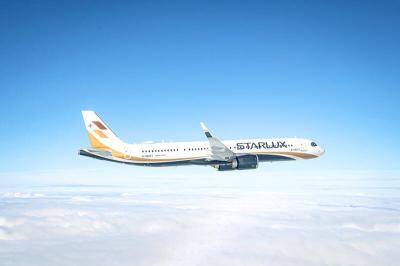
Two of Taiwan’s international carriers, Starlux Airlines Co (星宇航空) and EVA Airways Corp (長榮航空), have retained the five-star airline rating awarded by international airline review organization Skytrax. Starlux was awarded the distinction for a second consecutive year, while EVA Air received it for the 11th straight year, Skytrax said in statements released yesterday and on Thursday last week, respectively. The five-star rating is considered one of the airline industry's highest honors and is awarded following professional audits of airline product and frontline service standards, Skytrax said. The ratings are based on in-depth assessments using unified global quality standards rather than customer review scores


 RSS
RSS