


The IMF faulted China’s economic policies for causing waste at home and damage abroad and called for a reorientation by Beijing to embrace a model based on domestic consumer spending.
“Transitioning to a consumption-led growth model should be the overarching priority,” the IMF’s executive directors said in a statement on Wednesday released alongside the Washington-based lender’s annual review of China’s economy, known as an Article IV consultation.
In that review, IMF staff highlighted China’s large current-account surplus, which has featured “adverse spillovers to trading partners.” Some of that excess stems from exports getting a boost from “real depreciation of the RMB,” the fund said, referring to the inflation-adjusted weakening of the renminbi, also known as the yuan.
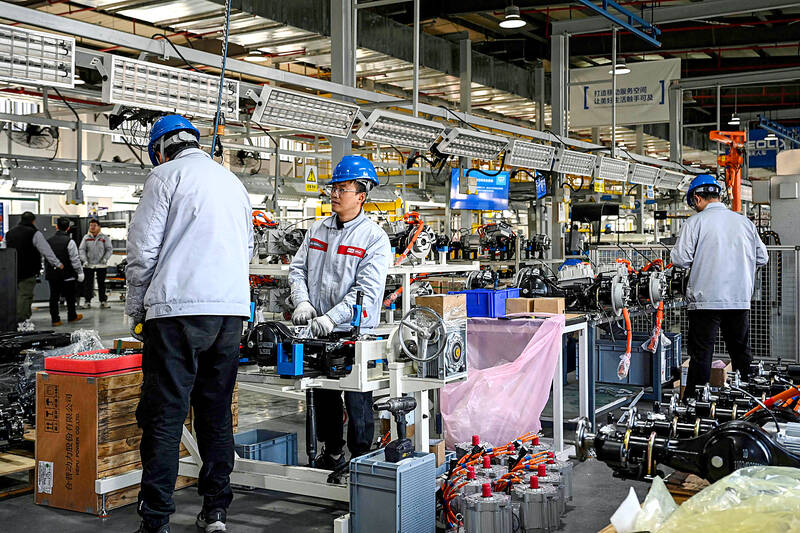
Photo: AFP
China’s representative on the IMF’s executive board, Zhengxin Zhang (張正鑫), took issue with the criticism, saying in a separate statement that China’s export growth last year “was primarily driven by its competitiveness and innovation capacity,” along with front-loading caused by Washington’s trade policy.
The executive board as a whole, however, called for a major shift in China’s policy framework, making its argument just weeks before the annual gathering of the nation’s National People’s Congress — where specific economic targets will be released for this year.
“Reorienting China’s growth model requires significant cultural and economic policy transformation,” the IMF directors said. They “called for a comprehensive and more forceful response that combines increased macroeconomic policy support with structural reforms.”
Along with “more expansionary” measures including fiscal stimulus, the directors said that central government funding to deal with the overhang of unfinished properties in China’s crippled property market “would rebuild consumer confidence.”
After GDP growth of 5 percent last year — a figure that met Beijing’s official target — the IMF sees the expansion slowing to 4.5 percent this year. Many economists anticipate China will next month set this year’s target in a 4.5 percent to 5 percent range.
The IMF’s annual report used the term “external imbalances” more than 10 times, compared with no such mentions in the 2024 edition. The fund estimated China’s current account surplus at 3.3 percent of GDP for last year — more than double the 1.5 percent it had projected in its 2024 annual report. Zhang said the fund’s figure “appeared excessively large.”
The fund forecasts the surplus will narrow over the medium term, to 2.2 percent of China’s GDP in 2030 — still well above an estimated “norm” of 0.9 percent.
The IMF suggested that a weaker yuan, measured in trade-weighted, inflation adjusted terms, had given Chinese goods an advantage overseas, while imports languished amid subdued domestic demand. Staff estimated the yuan was around 16 percent undervalued, with its range stretching from 12.1 percent to 20.7 percent.
IMF executive directors called for “greater exchange rate flexibility,” while Zhang said Beijing’s currency policy is “clear and consistent,” relying on market forces to play “a decisive role.”
China also took issue with IMF staff estimates of the scale and wastefulness of Beijing’s industrial policies.
The fund calculated that the fiscal cost of government measures for priority sectors amounted to about 4 percent of GDP as of 2023. While “international comparison is difficult,” the fund said that EU state aid in 2022 was less than half that figure, at about 1.5 percent.
Staff said that scaling back “unwarranted” industrial policy measures by about 2 percent of GDP over the medium term would boost productivity, reduce mis-allocation of resources and cut fiscal costs.
The fund highlighted that almost a third of growth last year was from net exports. That reliance has “triggered overcapacity concerns, which ultimately can motivate trade actions from partners and put China’s exports at risk,” the report said.
The IMF also expressed serious concern about the continued drop in prices in China and its damage to the economy, with the words “deflation” or “deflationary” appearing more than 60 times in the report.
“Empirical evidence suggests that deflationary pressures are in part related to the demand slump, including from the protracted property sector correction,” the IMF said.

HORMUZ ISSUE: The US president said he expected crude prices to drop at the end of the war, which he called a ‘minor excursion’ that could continue ‘for a little while’ The United Arab Emirates (UAE) and Kuwait started reducing oil production, as the near-closure of the crucial Strait of Hormuz ripples through energy markets and affects global supply. Abu Dhabi National Oil Co (ADNOC) is “managing offshore production levels to address storage requirements,” the company said in a statement, without giving details. Kuwait Petroleum Corp said it was lowering production at its oil fields and refineries after “Iranian threats against safe passage of ships through the Strait of Hormuz.” The war in the Middle East has all but closed Hormuz, the narrow waterway linking the Persian Gulf to the open seas,

RATIONING: The proposal would give the Trump administration ample leverage to negotiate investments in the US as it decides how many chips to give each country US officials are debating a new regulatory framework for exporting artificial intelligence (AI) chips and are considering requiring foreign nations to invest in US AI data centers or security guarantees as a condition for granting exports of 200,000 chips or more, according to a document seen by Reuters. The rules are not yet final and could change. They would be the first attempt to regulate the flow of AI chips to US allies and partners since US President Donald Trump’s administration said it rescinded its predecessor’s so-called AI diffusion rules. Those rules sought to keep a significant amount of AI

Apple Inc increased iPhone production in India by about 53 percent last year and now makes a quarter of its marquee devices there, reflecting the US company’s efforts to avoid tariffs on China. The company assembled about 55 million iPhones in India last year, up from 36 million a year earlier, people familiar with the matter said, asking not to be named because the numbers aren’t public. Apple makes about 220 million to 230 million iPhones a year globally, with India’s share of the total increasing rapidly. Apple has accelerated its expansion in the world’s most populous country in recent years, bolstered

A new worry has been rippling across the stock market lately: Entire businesses, not just their employees, might be thrown out of work. While most economists say fears of an artificial intelligence (AI) job apocalypse are overblown, seismic shifts have happened in the past after big tech breakthroughs. The IT revolution of the 1990s led to a surge in productivity that sped up the US economy for several years. It also rendered companies or even industries largely redundant — from travel agents and stockbrokers to classified advertising and newspapers, or video rental stores. Economists expect AI would deliver higher productivity,


 RSS
RSS