


Indian billionaire Mukesh Ambani’s conglomerate is to plow as much as 10 trillion rupees (US$110 billion) over seven years into artificial intelligence (AI)-related infrastructure, joining the global rush into technology’s fastest-growing arena.
This investment by Reliance Industries Ltd and its telecom unit, Reliance Jio Infocomm Ltd, will also seek to lower the cost of AI, Ambani said at the India AI Impact Summit on Thursday in New Delhi.
“India cannot afford to rent intelligence. Therefore, we will reduce the cost of intelligence as dramatically as we did the cost of data,” Ambani said at the event, referring to Reliance Jio’s disruptive entry in 2016 with cheap data and free calls that recast the sector’s price dynamics.
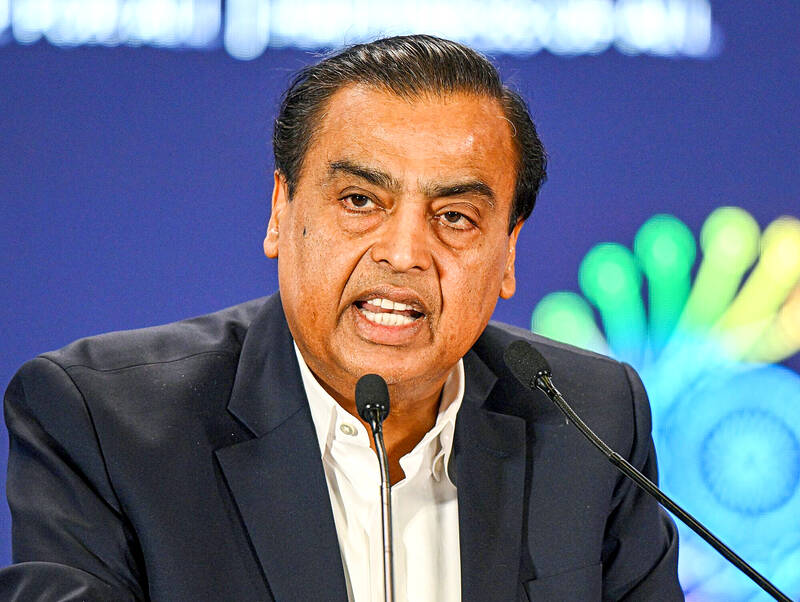
Photo: Bloomberg
The announcement by Asia’s richest person follows a US$100 billion AI investment pledge by compatriot Gautam Adani earlier this week and Tata Group’s plans to partner with OpenAI Inc earlier in the day.
India’s largest conglomerates — long known for aligning their corporate strategy to national priorities — are doubling down as Indian Prime Minister Narendra Modi’s government pitches India as a hub for AI and cloud computing.
India held one of the largest AI conferences this week that has already drawn industry heavyweights, including Alphabet Inc CEO Sundar Pichai and OpenAI CEO Sam Altman. The country expects to attract more than US$200 billion in AI-driven investments over the next two years, mirroring the global trend where trillions are being spent in an unprecedented AI hardware arms race.
“We will prove that AI doesn’t take away jobs. Rather it will create new high-skill opportunities,” Ambani said, assuaging widespread fears that the advent of the AI era will displace workers.
Reliance will work with India’s leading industrial groups to embed AI across manufacturing, logistics, energy, finance, retail, agriculture and healthcare, he added.
Reliance also sketched out other areas in which it is adopting AI. Its JioHotstar plans to introduce a bot based on OpenAI ’s ChatGPT that will recommend content and interact with viewers in multiple local languages on India’s largest streaming platform, according to a separate statement.
The billionaire has bet big on this sector since at least 2024 when he told shareholders that Reliance will aim to provide AI at affordable prices to Indians. In that marathon two-hour speech, he had mentioned AI more than 80 times.
That vision is now taking concrete shape. In November last year, Digital Connexion, a joint venture between Reliance Industries, Brookfield Asset Management Ltd and Digital Realty Trust Inc signed a pact to invest US$11 billion by 2030 to develop a data center in southern India.
Reliance has also begun construction of several data centers in Jamnagar in Gujarat that will house several gigawatts of computing capacity, according to Ambani. Over 120 megawatts of that will come online in the second half of this year.
“This is not a speculative investment for chasing valuation,” he said yesterday about the latest announcement. “This is patient, disciplined, nation building capital.”
Tata Group and its tech services arm, Tata Consultancy Services Ltd (TCS), are partnering with OpenAI in India on AI technologies, including data center infrastructure that could become one of the largest in the country.
One pillar of the agreement will be TCS’ development of a 100 megawatt data center that could be expanded to 1 gigawatt. A 1GW data center typically costs US$35 billion to US$50 billion.
TCS and OpenAI plan to team up to build what are known as agentic solutions for specific industries. Such AI services are able to operate autonomously in certain circumstances, limiting the need for human intervention.
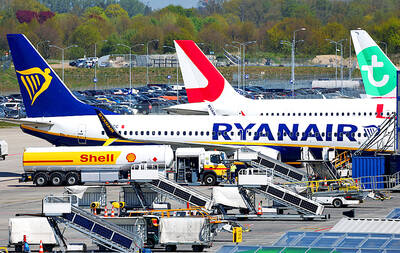
Ryanair, Transavia, Volotea and other low-cost airlines are feeling the financial pain from high jet fuel prices as a result of the Middle East war and are cutting flights. The closure of the Strait of Hormuz has taken a huge chunk of oil supplies off the market, sending the price of jet fuel soaring and triggering fears of shortages that could force airlines to cancel flights. Airlines are not waiting for a lack of supplies to react. “Travel alert: Airlines are cutting thousands of flights right now,” Travel Therapy host Karen Schaler said in an Instagram reel this past weekend.

MANAGING RISKS: Taiwan has secured LNG sufficient to cover 95 percent of electricity demand for next month, UBS said, describing the government’s approach as proactive UBS Group AG has raised its forecast for Taiwan’s economic growth this year to 8 percent, up from 6.9 percent previously, and said expansion could reach as high as 8.6 percent if external energy shocks are avoided. The upgrade reflects a stronger-than-expected first-quarter performance and sustained momentum in artificial intelligence (AI)-driven exports, which UBS said are providing a firm foundation for growth despite geopolitical and energy risks. Taiwan’s GDP expanded 13.69 percent year-on-year in the first quarter, the fastest growth since the second quarter of 1987, the Directorate-General of Budget, Accounting and Statistics (DGBAS) reported on Thursday. On a seasonally

The list of Asian stocks that benefit from business partnership with Nvidia Corp is getting longer, as the region further integrates into the artificial intelligence (AI) chip giant’s business ecosystem. Just in the past week, South Korea’s LG Electronics Inc, Taiwan’s Nanya Technology Corp (南亞科技), as well as China’s Huizhou Desay SV Automotive Co (德賽西威) and Pateo Connect Technology Shanghai Corp (博泰車聯) have become the latest to rally on news of tie-ups, supply-chain participation or product collaboration with the US chip designer. Asian suppliers account for about 90 percent of Nvidia’s production costs, up from about 65 percent last year, data compiled

The Fair Trade Commission’s (FTC) ongoing review of Grab Holdings Ltd’s US$600 million acquisition of Foodpanda Taiwan’s operations, announced on March 23, has taken on fresh urgency as industry experts warn that the transaction could embed significant Chinese cybersecurity vulnerabilities into Taiwan’s digital infrastructure through Grab’s deep ties to autonomous-driving firm WeRide (文遠知行). Less than 16 months after the FTC blocked Uber Eats’ direct attempt to acquire Foodpanda Taiwan — citing potential combined market shares of 80 to 90 percent — the emergence of Grab as the buyer has prompted questions about whether the same competitive harm is simply being rerouted


 RSS
RSS