


In a small town in central Taiwan, a “bank” has redefined the meaning of returns. Measured not in money, but in trees, flowers and restored ecosystems, its returns show that nature can be the most rewarding long-term investment.
“Sowing a single seed is enough to plant hope,” said 60-year-old Kuo Chun-yin (郭俊銀), founder of Bank of Flowers and Trees (花樹銀行).
Nestled at the foot of Bagua Mountain in Changhua County’s Dacun Township (大村), the 0.8 hectare park serves as Kuo’s headquarters for a form of wealth that transcends money — physical well-being of the community and ecological heritage.
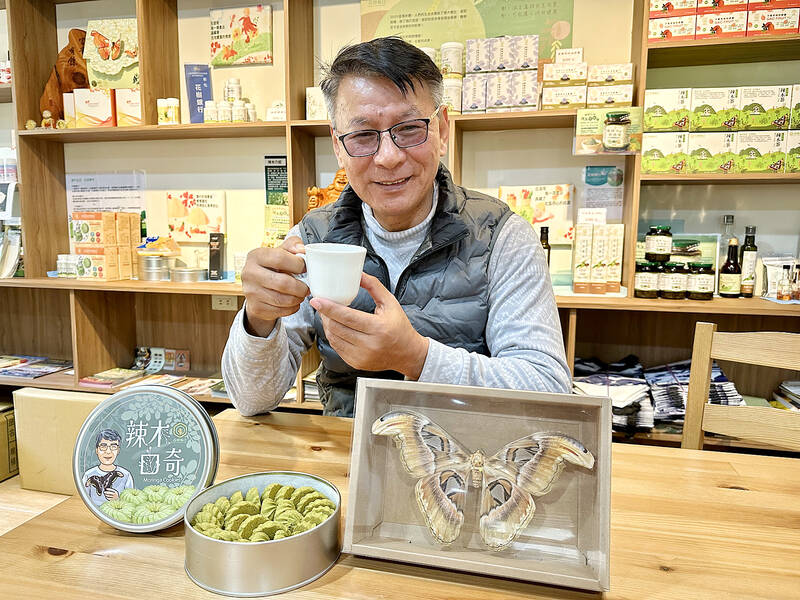
Photo: CNA
“I believe that community-building should start with protecting local plants and seeds, conserving native ecosystems, and promoting healthier ways of eating,” he said.
A wet wipe manufacturer by trade, Kuo embarked on this second calling 25 years ago, believing that lasting change starts when residents take responsibility for their surroundings.
This philosophy crystallized during a 2007 family cycling tour when he witnessed a Buddhist monk silently planting trees along the South Link Highway.
After speaking with the monk about the fleeting nature of human existence, he came to believe that “meaningful change does not require grand achievements” and began planting trees to contribute to society.
The following year, Kuo sought to fix irrigation problems on his father’s farmland, which had fallen into disuse as his father aged, and began planting seedlings.
As the Bank of Flowers and Trees took shape, Kuo introduced a foster system that allows visitors to leave plants in his care for up to three years at no cost, after which they may reclaim the trees or let them remain in the park.
Recalling the project’s early days, Kuo said some friends joked that the site might turn into a “flower and tree graveyard,” as he had little experience caring for plants left by others.
Today, however, the campus of Bank of Flowers and Trees is nearly at full capacity, with over 10,000 trees representing more than 400 species, Kuo said.
The return of the Atlas moth — once common in the area but drastically reduced due to habitat destruction — to the park indicates the success of Kuo’s conservation efforts and shows that the area has achieved true ecological diversity and balance.
The park has always been open to the public free of charge and generated no income. Its operations are sustained by profits from his wet wipe factory, he said.
Over time, Kuo began developing food products from edible plants grown on-site — such as the moringa tree, known for its high carbon-absorption capacity and nutrient- rich “superfood” properties — benefiting the environment as well as human health.
In recent years, Kuo has been “opening branches” in Penghu and Nantou counties, partnering with like-minded communities to replicate the model.
Kuo envisions these offshoot sites as blueprints for a burgeoning nationwide network, where “every household has a garden and greenery.”
“When people experience the healing benefits of nature, they are more willing to take part, enhancing both environmental quality and public health,” Kuo said.

Cairo’s new monorail slices across the city skyline, running above the familiar chaos of blaring horns and aging buses’ exhaust fumes that mark rush hour below. The US$4.5 billion monorail, opened this month, is among Egypt’s most prominent new transport projects, part of a debt-funded infrastructure drive criticized for sapping state finances while bringing limited benefits to most of the country’s 109 million people. “It feels like you’re in a different country,” said Ramy Sayed, a restaurant manager, aboard a driverless Innovia 300 train. “No noise, no traffic, we’re not used to this.” The eastern line runs 56km from the bustling middle-class

Taiwanese firms have increased investment in the Philippines in recent years as Manila’s ties with Washington deepen and global supply chains continue to shift away from China, an expert at the Chung-Hua Institution for Economic Research (CIER, 中華經濟研究院) said yesterday. The Philippines had not been among Taiwanese investors’ top choices in Southeast Asia, CIER Taiwan ASEAN Studies Center director Kristy Hsu (徐遵慈) said at a seminar in Taipei. However, Taiwan’s investment in the country has grown significantly since the COVID-19 pandemic, reaching US $257 million last year, a high in recent years, she said. Although Taiwan’s total investment in the Philippines still lags

Intel Corp regards Taiwan Semiconductor Manufacturing Co (TSMC, 台積電) as a longstanding partner, as the US chipmaker would continue outsourcing production of advanced chips to TSMC, Intel chief executive officer Lip-Bu Tan (陳立武) said yesterday. “I don’t look at people as competitors. I look at the collaboration... Nvidia is also, you know, a good friend,” Tan told a news conference following his keynote speech at the Computex trade show in Taipei. “It’s a very trusted partnership for us... We are a big, top customer for them, and we’re going to continue doing that,” he said, referring to TSMC, the world’s largest foundry

Artificial intelligence (AI) agents would supplant smartphones as the center of people’s digital lives, fundamentally reshaping personal devices and driving a major computing upgrade cycle, Qualcomm Inc CEO Cristiano Amon said yesterday. In his keynote speech for this year’s Computex trade show in Taipei, Amon said that the rise of "agentic AI" — AI systems capable of reasoning, planning and carrying out tasks autonomously — would transform how people interact with technology across phones, PCs, vehicles and wearable devices. Describing the technology as the next major evolution in computing, Amon said that "2026 is the year of agents.” For decades, smartphones have sat


 RSS
RSS