


Gold dropped more than 2 percent yesterday, as holidays in major markets hit liquidity, while a stronger US dollar and easing geopolitical tensions added to the pressure.
Spot gold dropped 1.5 percent to US$4,917.90 per ounce by 8am GMT, after hitting US$4,862 per ounce, its lowest level in more than a week. US gold futures for April delivery lost 2.2 percent to US$4,936.6 per ounce.
“Thin liquidity with the holidays in the last 24 hours, especially in China and Asia, but also obviously in the United States too, means we just lacked a bid in the market,” Capital.com senior market analyst Kyle Rodda said.
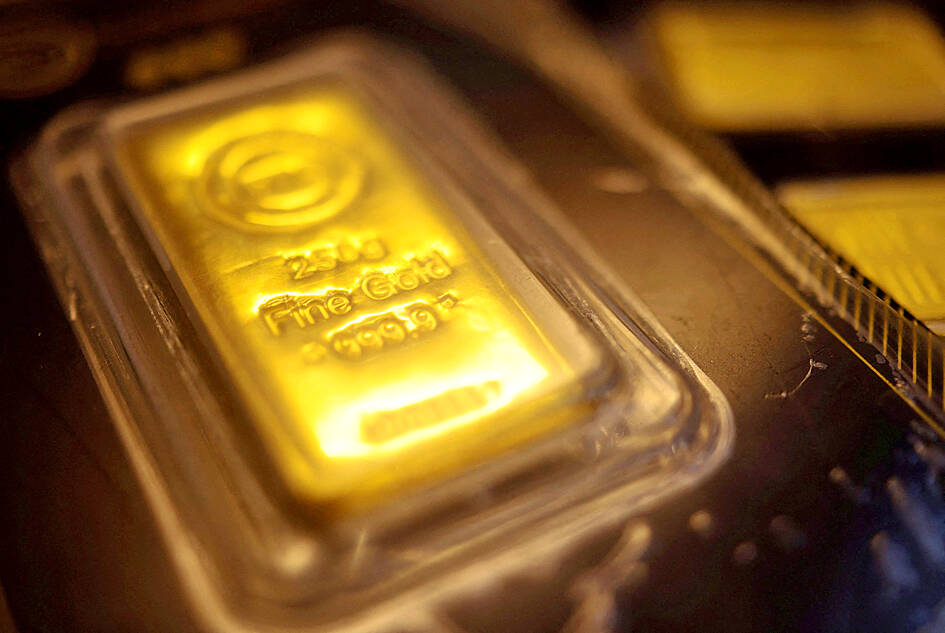
Photo: Reuters
Markets in Taiwan, China, Hong Kong, Singapore and South Korea were closed for the Lunar New Year holiday. US markets were shut on Monday for Presidents’ Day.
Stocks in Tokyo closed down 0.4 percent, Sydney added 0.2 percent and Bangkok rose 0.9 percent. Mumbai was also in the green, while Wellington and Manila slipped.
The US dollar index rose 0.3 percent against a basket of currencies, making greenback-priced bullion more expensive for holders of other currencies.
The minutes of the US Federal Open Market Committee (FOMC) meeting last month, due today, could give investors further clues about the US Federal Reserve’s future monetary policy path.
The market currently expects the first of three interest rate cuts for the year to be in June, according to CME’s FedWatch Tool.
“Now it’s going to be interesting to see what these FOMC minutes say in the sense that the markets want many more rate cuts now than what the Fed said that it would do,” Tastylive financial network’s global macro head Ilya Spivak said.
Non-yielding bullion tends to do well in low-interest-rate environments. On the geopolitical front, US President Donald Trump said on Monday he was to be “indirectly” involved in US-Iran nuclear talks in Geneva yesterday, while Ukrainian and Russian representatives are to meet there this week for US-mediated peace discussions.
“The immediate range top [for gold] is somewhere around US$5,120, but the next real kind of objective here is back to the highs at US$5,600 or so, and then of course, we march to record highs,” Spivak said.
Spot silver fell 2 percent to US$75.05 per ounce, after dropping over 5 percent earlier.
Spot platinum dropped 1.5 percent to US$2,010.72 per ounce, while palladium lost 1.9 percent to US$1,692.
Elsewhere, West Texas Intermediate crude oil cooled after rising more than one percent to near US$64 per barrel, while Brent oil eased slightly to just under US$69.

HORMUZ ISSUE: The US president said he expected crude prices to drop at the end of the war, which he called a ‘minor excursion’ that could continue ‘for a little while’ The United Arab Emirates (UAE) and Kuwait started reducing oil production, as the near-closure of the crucial Strait of Hormuz ripples through energy markets and affects global supply. Abu Dhabi National Oil Co (ADNOC) is “managing offshore production levels to address storage requirements,” the company said in a statement, without giving details. Kuwait Petroleum Corp said it was lowering production at its oil fields and refineries after “Iranian threats against safe passage of ships through the Strait of Hormuz.” The war in the Middle East has all but closed Hormuz, the narrow waterway linking the Persian Gulf to the open seas,

RATIONING: The proposal would give the Trump administration ample leverage to negotiate investments in the US as it decides how many chips to give each country US officials are debating a new regulatory framework for exporting artificial intelligence (AI) chips and are considering requiring foreign nations to invest in US AI data centers or security guarantees as a condition for granting exports of 200,000 chips or more, according to a document seen by Reuters. The rules are not yet final and could change. They would be the first attempt to regulate the flow of AI chips to US allies and partners since US President Donald Trump’s administration said it rescinded its predecessor’s so-called AI diffusion rules. Those rules sought to keep a significant amount of AI

Apple Inc increased iPhone production in India by about 53 percent last year and now makes a quarter of its marquee devices there, reflecting the US company’s efforts to avoid tariffs on China. The company assembled about 55 million iPhones in India last year, up from 36 million a year earlier, people familiar with the matter said, asking not to be named because the numbers aren’t public. Apple makes about 220 million to 230 million iPhones a year globally, with India’s share of the total increasing rapidly. Apple has accelerated its expansion in the world’s most populous country in recent years, bolstered

A new worry has been rippling across the stock market lately: Entire businesses, not just their employees, might be thrown out of work. While most economists say fears of an artificial intelligence (AI) job apocalypse are overblown, seismic shifts have happened in the past after big tech breakthroughs. The IT revolution of the 1990s led to a surge in productivity that sped up the US economy for several years. It also rendered companies or even industries largely redundant — from travel agents and stockbrokers to classified advertising and newspapers, or video rental stores. Economists expect AI would deliver higher productivity,


 RSS
RSS