


Asian markets were subdued yesterday, as the extended Lunar New Year holiday approached and Japan reported lackluster economic growth.
The holiday period meant that trading floors were closed in Shanghai, Seoul and Taipei. Hong Kong and Singapore closed after half-day sessions.
US markets were also closed for Presidents’ Day.
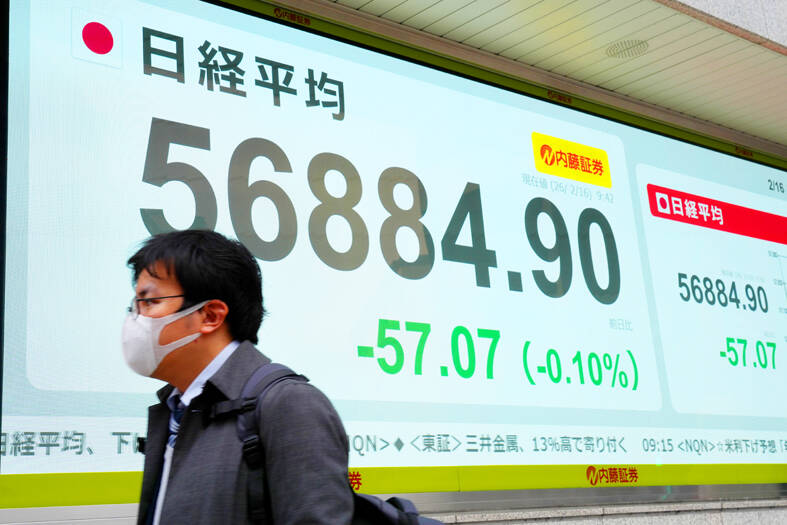
Photo: AP
Limp GDP growth in Japan rattled the post-election high of Japanese Prime Minister Sanae Takaichi following her recent landslide win.
On a quarterly basis, the world’s fourth-biggest economy expanded just 0.1 percent in the final quarter of last year, the Cabinet Office reported.
The figures — which undershot market forecasts of 0.4 percent — add pressure on Takaichi, who made boosting economic growth a key pledge ahead of her landslide victory in the Feb. 8 snap election.
Japan’s economy expanded at an anemic 0.2 percent annual pace last quarter, the data showed, with growth for all of last year at just 1.1 percent.
Tokyo closed 0.2 percent down, while Hong Kong rose 0.5 percent as trading closed early for Lunar New Year. Wellington, Jakarta and Manila posted marginal losses, while Sydney, Mumbai and Bangkok were up. Singapore and Kuala Lumpur were little changed.
Markets showed signs of stabilizing after a tech-led plunge last week, when traders reacted to growing concern about the hundreds of billions spent on artificial intelligence (AI) infrastructure and when, if ever, they might see a return on them.
Investors will keep an eye on artificial intelligence this week as the five-day AI Impact Summit began in New Delhi yesterday, with the likes of OpenAI CEO Sam Altman and Google CEO Sundar Pichai in attendance.
While frenzied demand for generative AI has turbocharged profits and share prices for many technology companies, anxiety is growing over the risks that it poses to society and the environment.
The sense of calm continued from Friday, when government data showed consumer inflation in the US last month cooling slightly more than expected.
Analysts say the figure allows the US central bank to cut interest rates again later this year, but warn that policymakers need to see sustained improvement to do so.
“US inflation data was good. And the initial response in equities reflected that. But the devil was in the details,” Capital.com senior financial market analyst Kyle Rodda said. “Annual headline and core inflation dropped to new lows, with the critical core number falling to the lowest level since March 2021 at 2.4 percent.”
Elsewhere, gold crept above US$5,000 an ounce after Friday’s climb following softer US inflation. Silver was down 0.7 percent.
“Markets have priced in a higher probability of deeper Fed rate cuts this year, driving real yields lower and supporting gold demand,” Standard Chartered PLC said in a note. “We expect gold to remain well-supported.”

The domestic unit of the Chinese-owned, Dutch-headquartered chipmaker Nexperia BV will soon be able to produce semiconductors locally within China, according to two company sources. Nexperia is at the center of a global tug-of-war over critical semiconductor technology, with a Dutch court in February ordering a probe into alleged mismanagement at the company. The geopolitical tussle has disrupted supply chains, with some carmakers reportedly forced to cut production due to chip shortages. Local production would allow Nexperia’s domestic arm, Nexperia Semiconductors (China) Ltd (安世半導體中國), to bypass restrictions in place since October on the supply of silicon wafers — etched with tiny components to

Singapore-based ride-hailing and delivery giant Grab Holdings Ltd has applied for regulatory approval to acquire the Taiwan operations of Germany-based Delivery Hero SE's Foodpanda in a deal valued at about US$600 million. Grab submitted the filing to the Fair Trade Commission on Friday last week, with the transaction subject to regulatory review and approval, the company said in a statement yesterday. Its independent governance structure would help foster a healthy and competitive market in Taiwan if the deal is approved, Grab said. Grab, which is listed on the NASDAQ, said in the filing that US-based Uber Technologies Inc holds about 13 percent of

Taiwan Semiconductor Manufacturing Co (TSMC, 台積電) yesterday received government approval to deploy its advanced 3-nanometer (3nm) process at its second fab currently under construction in Japan, the Ministry of Economic Affairs said in a news release. The ministry green-lit the plan for the facility in Kumamoto, which is scheduled to start installing equipment and come online in 2028 with a monthly production capacity of 15,000 12-inch wafers, the ministry said. The Department of Investment Review in June 2024 authorized a US$5.26 billion investment for the facility, slated to manufacture 6- to 12nm chips, significantly less advanced than 3nm process. At a meeting with

Taiwan’s food delivery market could undergo a major shift if Singapore-based Grab Holdings Ltd completes its planned acquisition of Delivery Hero SE’s Foodpanda business in Taiwan, industry experts said. Grab on Monday last week announced it would acquire Foodpanda’s Taiwan operations for US$600 million. The deal is expected to be finalized in the second half of this year, with Grab aiming to complete user migration to its platform by the first half of next year. A duopoly between Uber Eats and Foodpanda dominates Taiwan’s delivery market, a structure that has remained intact since the Fair Trade Commission (FTC) blocked Uber Technologies Inc’s


 RSS
RSS