


South Korean cryptocurrency exchange Bithumb yesterday said that serious flaws had left its internal system susceptible to potential sabotage and failed to prevent an erroneous transfer of more than US$40 billion in assets last week.
The nation’s second-largest virtual asset exchange said it accidentally gave away about 620,000 bitcoins to customers during a promotional event, instead of 620,000 won (US$428), triggering a 17 percent slump in bitcoin’s price.
Bithumb CEO Lee Jae-won said the giveaway amounted to 15 times the exchange’s holding of 42,000 bitcoins, largely because a lag of about 24 hours in processing transactions delayed updates to the balance of virtual assets.
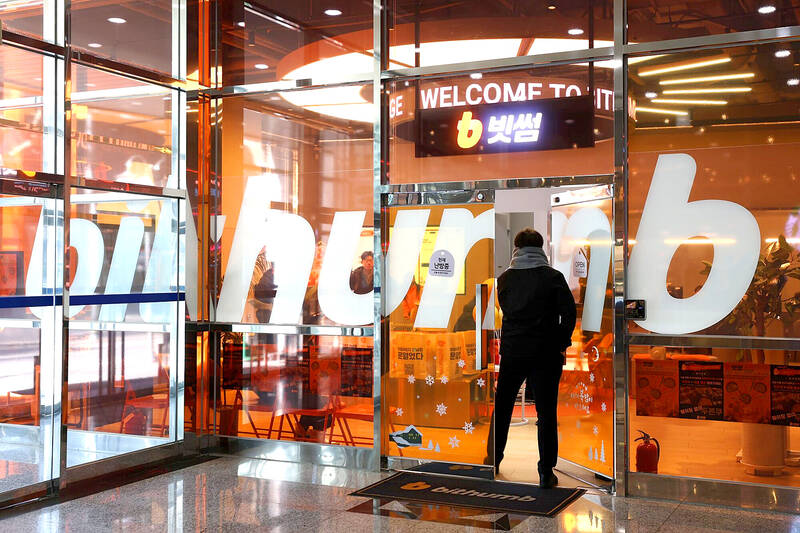
Photo: Bloomberg
“We are acutely aware of the deficiency in internal system control,” Lee told a parliamentary committee hearing on the incident that took place on Friday last week.
The exchange’s policy of checking the volume of currency to be transferred against its actual holdings had failed and the amount was also not earmarked in a separate account to ensure the safety of the transaction, Lee said.
Most of the bitcoins have been retrieved by the exchange, but 1,786 had already been sold within minutes before the exchange froze the accounts of the customers that received them, regulators have said.
The customers who sold them are legally required to return them, they said.
Lawmakers expressed dismay at the failure of government and corporate oversight in the nation’s virtual assets market, which is one of the most active in the world by trading volume.
“Bithumb gave away bitcoin that were not in the company’s possession, and that is what we call naked short selling,” Democratic Party MP Min Byeong-deok said at the hearing, adding that the exchange effectively distributed “ghost bitcoin” in the market.
The episode underscores vulnerabilities in South Korea’s breakneck cryptocurrency boom, where trading on domestic digital-asset exchanges has occasionally outpaced that of the KOSPI and KOSDAQ stock indices — a dynamic rarely seen in other major markets.
The parliamentary grilling highlights growing political concern that operational lapses at major exchanges could undermine confidence in a sector that has become deeply embedded in household investing.
The South Korean Financial Supervisory Service (FSS) launched an investigation into the incident, focusing on compliance systems and risk management at the nation’s second-largest digital-asset platform
FSS Governor Lee Chan-jin said he personally believed the virtual currency market should be subject to the same regulatory oversight as banks and other financial services institutions, but it is not possible under existing laws and regulations.
Additional reporting by Bloomberg

Cairo’s new monorail slices across the city skyline, running above the familiar chaos of blaring horns and aging buses’ exhaust fumes that mark rush hour below. The US$4.5 billion monorail, opened this month, is among Egypt’s most prominent new transport projects, part of a debt-funded infrastructure drive criticized for sapping state finances while bringing limited benefits to most of the country’s 109 million people. “It feels like you’re in a different country,” said Ramy Sayed, a restaurant manager, aboard a driverless Innovia 300 train. “No noise, no traffic, we’re not used to this.” The eastern line runs 56km from the bustling middle-class

Taiwanese firms have increased investment in the Philippines in recent years as Manila’s ties with Washington deepen and global supply chains continue to shift away from China, an expert at the Chung-Hua Institution for Economic Research (CIER, 中華經濟研究院) said yesterday. The Philippines had not been among Taiwanese investors’ top choices in Southeast Asia, CIER Taiwan ASEAN Studies Center director Kristy Hsu (徐遵慈) said at a seminar in Taipei. However, Taiwan’s investment in the country has grown significantly since the COVID-19 pandemic, reaching US $257 million last year, a high in recent years, she said. Although Taiwan’s total investment in the Philippines still lags

Intel Corp regards Taiwan Semiconductor Manufacturing Co (TSMC, 台積電) as a longstanding partner, as the US chipmaker would continue outsourcing production of advanced chips to TSMC, Intel chief executive officer Lip-Bu Tan (陳立武) said yesterday. “I don’t look at people as competitors. I look at the collaboration... Nvidia is also, you know, a good friend,” Tan told a news conference following his keynote speech at the Computex trade show in Taipei. “It’s a very trusted partnership for us... We are a big, top customer for them, and we’re going to continue doing that,” he said, referring to TSMC, the world’s largest foundry

Artificial intelligence (AI) agents would supplant smartphones as the center of people’s digital lives, fundamentally reshaping personal devices and driving a major computing upgrade cycle, Qualcomm Inc CEO Cristiano Amon said yesterday. In his keynote speech for this year’s Computex trade show in Taipei, Amon said that the rise of "agentic AI" — AI systems capable of reasoning, planning and carrying out tasks autonomously — would transform how people interact with technology across phones, PCs, vehicles and wearable devices. Describing the technology as the next major evolution in computing, Amon said that "2026 is the year of agents.” For decades, smartphones have sat


 RSS
RSS