


China’s top chipmaker has warned that breakaway spending on artificial intelligence (AI) chips is bringing forward years of future demand, raising the risk that some data centers could sit idle.
“Companies would love to build 10 years’ worth of data center capacity within one or two years,” Semiconductor Manufacturing International Corp (SMIC, 中芯) cochief executive officer Zhao Haijun (趙海軍) said yesterday on a call with analysts. “As for what exactly these data centers will do, that hasn’t been fully thought through.”
Moody’s Ratings projects that AI-related infrastructure investment would exceed US$3 trillion over the next five years, as developers pour eye-watering sums into data centers to house training and inference chips designed by companies including Nvidia Corp, Advanced Micro Devices Inc and Huawei Technologies Co (華為).
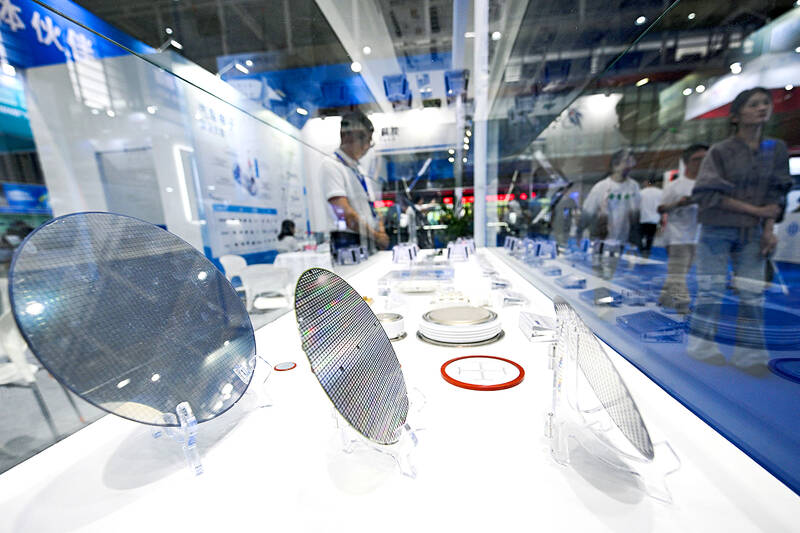
Photo: AFP
This year alone, the combined capital expenditure of Alphabet Inc, Amazon.com Inc, Meta Platforms Inc and Microsoft Corp is on track to reach US$650 billion, driven by their costly AI arms race.
China’s leading AI developers, including Alibaba Group Holding Ltd (阿里巴巴), Tencent Holdings Ltd (騰訊) and ByteDance Ltd (字節跳動), are also investing heavily in AI infrastructure equipped with both Nvidia chips and domestically produced alternatives.
SMIC operates chipmaking plants from Beijing to Shanghai and Shenzhen, but it can only manufacture less advanced AI chips compared with those produced by Nvidia and its contract manufacturer, Taiwan Semiconductor Manufacturing Co (台積電), due to US export restrictions that limit access to cutting-edge equipment.
The surge in spending has also triggered a shortage of high-bandwidth memory (HBM), a critical high-end component that enables advanced AI computing.
The tight supply of HBM could persist for years, as new capacity takes time to build and qualify, Zhao said.
SMIC’s domestic clients, including Huawei and Cambricon Technologies Corp (寒武紀), are aiming for a rapid ramp-up of their silicon production to meet China’s AI needs.
“It’s like building high-speed rail stations and highways — even if there aren’t that many cars today, you still want to complete 10 years’ worth of infrastructure in just two years,” Zhao said.
SMIC on Tuesday reported net profit of US$173 million for the fourth quarter of last year, jumping 60.7 percent from a year earlier and beating analysts’ estimates.
Revenue rose 12.8 percent to US$2.49 billion, also topping forecasts.
Earnings per share were US$0.02, flat year-on-year, gross margin fell to 19.2 percent from 22.6 percent a year earlier and factory utilization remained at 95.7 percent.
The company’s capital spending reached US$8.1 billion last year, up 10.5 percent from 2024. Zhao said he expected SMIC’s capital spending this year to be the same as last year’s levels.
Additional reporting by Reuters

The domestic unit of the Chinese-owned, Dutch-headquartered chipmaker Nexperia BV will soon be able to produce semiconductors locally within China, according to two company sources. Nexperia is at the center of a global tug-of-war over critical semiconductor technology, with a Dutch court in February ordering a probe into alleged mismanagement at the company. The geopolitical tussle has disrupted supply chains, with some carmakers reportedly forced to cut production due to chip shortages. Local production would allow Nexperia’s domestic arm, Nexperia Semiconductors (China) Ltd (安世半導體中國), to bypass restrictions in place since October on the supply of silicon wafers — etched with tiny components to

Singapore-based ride-hailing and delivery giant Grab Holdings Ltd has applied for regulatory approval to acquire the Taiwan operations of Germany-based Delivery Hero SE's Foodpanda in a deal valued at about US$600 million. Grab submitted the filing to the Fair Trade Commission on Friday last week, with the transaction subject to regulatory review and approval, the company said in a statement yesterday. Its independent governance structure would help foster a healthy and competitive market in Taiwan if the deal is approved, Grab said. Grab, which is listed on the NASDAQ, said in the filing that US-based Uber Technologies Inc holds about 13 percent of

Taiwan Semiconductor Manufacturing Co (TSMC, 台積電) yesterday received government approval to deploy its advanced 3-nanometer (3nm) process at its second fab currently under construction in Japan, the Ministry of Economic Affairs said in a news release. The ministry green-lit the plan for the facility in Kumamoto, which is scheduled to start installing equipment and come online in 2028 with a monthly production capacity of 15,000 12-inch wafers, the ministry said. The Department of Investment Review in June 2024 authorized a US$5.26 billion investment for the facility, slated to manufacture 6- to 12nm chips, significantly less advanced than 3nm process. At a meeting with

Taiwan’s food delivery market could undergo a major shift if Singapore-based Grab Holdings Ltd completes its planned acquisition of Delivery Hero SE’s Foodpanda business in Taiwan, industry experts said. Grab on Monday last week announced it would acquire Foodpanda’s Taiwan operations for US$600 million. The deal is expected to be finalized in the second half of this year, with Grab aiming to complete user migration to its platform by the first half of next year. A duopoly between Uber Eats and Foodpanda dominates Taiwan’s delivery market, a structure that has remained intact since the Fair Trade Commission (FTC) blocked Uber Technologies Inc’s


 RSS
RSS