


CPC Corp, Taiwan (台灣中油) and Formosa Petrochemical Corp (台塑石化) are today to lower gasoline prices by NT$0.2 per liter, after international crude oil prices last week snapped a six-week rising streak.
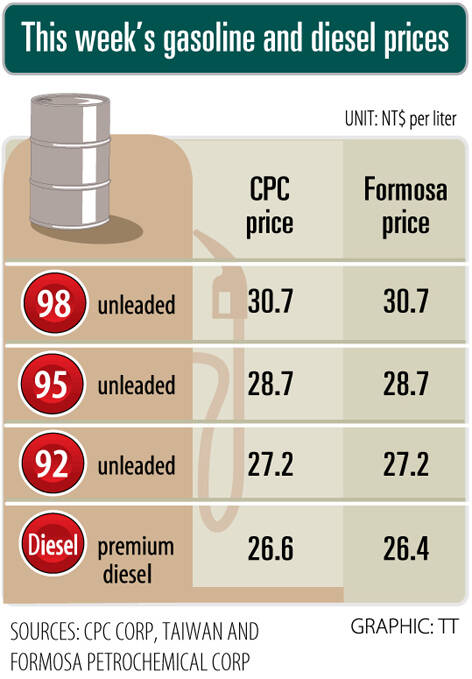
CPC and Formosa gasoline prices are to fall to NT$27.2, NT$28.7 and NT$30.7 per liter for 92, 95 and 98-octane unleaded gasoline respectively, the companies said in separate statements yesterday.
However, the price of premium diesel is to increase NT$0.3 per liter to NT$26.6 per liter at CPC stations and NT$26.4 at Formosa pumps, they said.
The companies’ announcements came as international crude oil prices showed their first weekly decline in more than a month, as traders closely monitor the situation in the Middle East following talks between US and Iranian officials on a potential nuclear deal.
Traders were also closely watching other developments, such as Saudi Arabia cutting the price of its crude oil for Asian buyers for the fourth consecutive month next month and US crude oil stocks falling more than expected last week, the companies added.
Brent crude oil futures — the international oil benchmark — last week fell 1.83 percent to settle at US$68.05 per barrel on the Intercontinental Exchange. West Texas Intermediate crude oil futures — the US oil benchmark — lost 2.55 percent to US$63.55 per barrel on the New York Mercantile Exchange.

NEW IDENTITY: Known for its software, India has expanded into hardware, with its semiconductor industry growing from US$38bn in 2023 to US$45bn to US$50bn India on Saturday inaugurated its first semiconductor assembly and test facility, a milestone in the government’s push to reduce dependence on foreign chipmakers and stake a claim in a sector dominated by China. Indian Prime Minister Narendra Modi opened US firm Micron Technology Inc’s semiconductor assembly, test and packaging unit in his home state of Gujarat, hailing the “dawn of a new era” for India’s technology ambitions. “When young Indians look back in the future, they will see this decade as the turning point in our tech future,” Modi told the event, which was broadcast on his YouTube channel. The plant would convert

‘SEISMIC SHIFT’: The researcher forecast there would be about 1.1 billion mobile shipments this year, down from 1.26 billion the prior year and erasing years of gains The global smartphone market is expected to contract 12.9 percent this year due to the unprecedented memorychip shortage, marking “a crisis like no other,” researcher International Data Corp (IDC) said. The new forecast, a dramatic revision down from earlier estimates, gives the latest accounting of the ongoing memory crunch that is affecting every corner of the electronics industry. The demand for advanced memory to power artificial intelligence (AI) tasks has drained global supply until well into next year and jeopardizes the business model of many smartphone makers. IDC forecast about 1.1 billion mobile shipments this year, down from 1.26 billion the prior

People stand in a Pokemon store in Tokyo on Thursday. One of the world highest-grossing franchises is celebrated its 30th anniversary yesterday.

Zimbabwe’s ban on raw lithium exports is forcing Chinese miners to rethink their strategy, speeding up plans to process the metal locally instead of shipping it to China’s vast rechargeable battery industry. The country is Africa’s largest lithium producer and has one of the world’s largest reserves, according to the US Geological Survey (USGS). Zimbabwe already banned the export of lithium ore in 2022 and last year announced it would halt exports of lithium concentrates from January next year. However, on Wednesday it imposed the ban with immediate effect, leaving unclear what the lithium mining sector would do in the


 RSS
RSS