


Taiwan’s property market posted a sharp year-on-year rebound last month, although analysts cautioned that the apparent surge masked underlying weakness and was largely driven by base effects from last year’s Lunar New Year holiday.
Data released by land administration authorities across Taiwan’s six special municipalities showed residential property transfers totaled 18,237 units last month, down 8.3 percent from December, but up 28.1 percent from a year earlier. All six municipalities recorded annual gains, even as month-on-month declines were seen across the board.
“The year-on-year growth looks strong, but is effectively inflated,” Taiwan Realty Co (台灣房屋) research head Charlene Chang (張旭嵐) said.
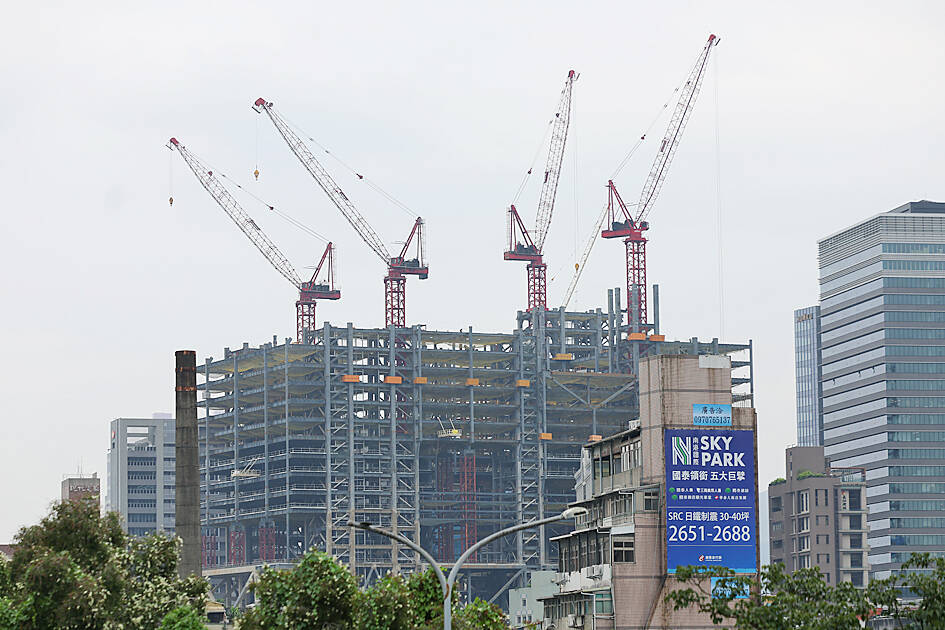
Photo: CNA
Transaction volumes in January last year were depressed by the Lunar New Year, which reduced working days, and delayed property registration and handover procedures, she said.
Among the six special municipalities, New Taipei City recorded the steepest monthly decline, with transactions falling 13.8 percent from December to 4,033 units, although volumes were still 40.6 percent higher than a year earlier.
Taipei posted 2,128 transfers, down 8.7 percent month-on-month, but up 32.7 percent from a year earlier. Taoyuan logged 3,559 units, a 6.1 percent monthly decline, but a 27.6 percent annual increase.
Central and southern cities also saw broad-based monthly pullbacks. Taichung recorded 3,509 transactions, down 11.2 percent from December, but was up 8 percent year-on-year.
Tainan posted the strongest annual growth, with transfers surging 47.9 percent to 2,041 units, while Kaohsiung recorded 2,967 units, down 3.3 percent on the month and up 26.7 percent from a year earlier.
Across-the-board annual growth largely reflected last year’s low comparison base rather than a genuine recovery in housing demand, Chang said.
Month-on-month figures offered a more accurate picture of market conditions, she said.
“The declines across all major cities indicate that the market has yet to break out of its consolidation phase,” she said, adding that a sustained recovery remains some distance away.
Analysts expect transaction volumes to weaken further this month, as the Lunar New Year holiday and 228 Peace Memorial Day reduce the number of working days.
Transfers this month are likely to face a “significant correction” due to the shorter working month, H&B Realty Co (住商不動產) chief researcher Jessica Hsu (徐佳馨) said.
The real test for the market would come toward the end of the first quarter and into the second quarter, Hsu added.
Without meaningful price adjustments or a relaxation of government measures aimed at curbing property lending, buyer demand is unlikely to rebound, leaving Taiwan’s housing market stuck in a pattern of declining volumes and relatively stable prices, she said.

Cairo’s new monorail slices across the city skyline, running above the familiar chaos of blaring horns and aging buses’ exhaust fumes that mark rush hour below. The US$4.5 billion monorail, opened this month, is among Egypt’s most prominent new transport projects, part of a debt-funded infrastructure drive criticized for sapping state finances while bringing limited benefits to most of the country’s 109 million people. “It feels like you’re in a different country,” said Ramy Sayed, a restaurant manager, aboard a driverless Innovia 300 train. “No noise, no traffic, we’re not used to this.” The eastern line runs 56km from the bustling middle-class

Taiwanese firms have increased investment in the Philippines in recent years as Manila’s ties with Washington deepen and global supply chains continue to shift away from China, an expert at the Chung-Hua Institution for Economic Research (CIER, 中華經濟研究院) said yesterday. The Philippines had not been among Taiwanese investors’ top choices in Southeast Asia, CIER Taiwan ASEAN Studies Center director Kristy Hsu (徐遵慈) said at a seminar in Taipei. However, Taiwan’s investment in the country has grown significantly since the COVID-19 pandemic, reaching US $257 million last year, a high in recent years, she said. Although Taiwan’s total investment in the Philippines still lags

Intel Corp regards Taiwan Semiconductor Manufacturing Co (TSMC, 台積電) as a longstanding partner, as the US chipmaker would continue outsourcing production of advanced chips to TSMC, Intel chief executive officer Lip-Bu Tan (陳立武) said yesterday. “I don’t look at people as competitors. I look at the collaboration... Nvidia is also, you know, a good friend,” Tan told a news conference following his keynote speech at the Computex trade show in Taipei. “It’s a very trusted partnership for us... We are a big, top customer for them, and we’re going to continue doing that,” he said, referring to TSMC, the world’s largest foundry

Artificial intelligence (AI) agents would supplant smartphones as the center of people’s digital lives, fundamentally reshaping personal devices and driving a major computing upgrade cycle, Qualcomm Inc CEO Cristiano Amon said yesterday. In his keynote speech for this year’s Computex trade show in Taipei, Amon said that the rise of "agentic AI" — AI systems capable of reasoning, planning and carrying out tasks autonomously — would transform how people interact with technology across phones, PCs, vehicles and wearable devices. Describing the technology as the next major evolution in computing, Amon said that "2026 is the year of agents.” For decades, smartphones have sat


 RSS
RSS