


The Ministry of Economic Affairs yesterday said it has received 81 applications for a subsidy program that provides government funding for factory upgrades and operational transformation, with each applicant eligible for up to NT$3 million (US$95,006).
The ministry offers subsidies to help local enterprises enhance research and development enhancement and push for business transformation based on the Special Statute on Strengthening the Resilience of the Economy, Society and National Security in Response to International Developments (因應國際情勢強化經濟社會及民生國安韌性特別條例), Deputy Minister of Economic Affairs Ho Chin-tsang (何晉滄) told a news conference.
The ministry estimates the program could spur about NT$900 million in overall investment and assist about 300 companies in upgrading their facilities, Ho said.
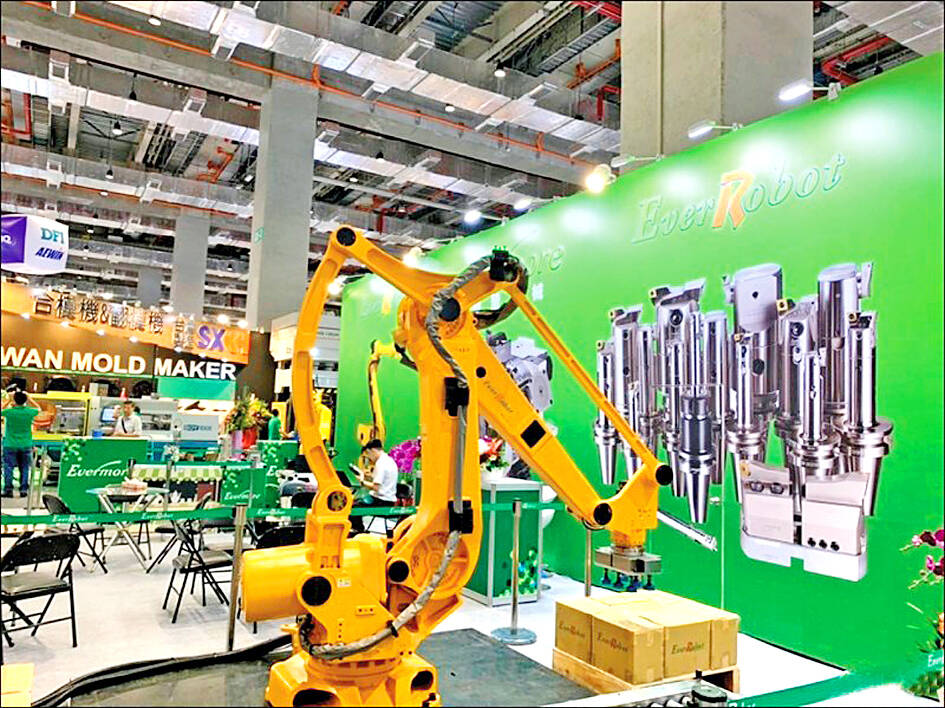
Photo: Lin Chin-hua, Taipei Times
The so-called specific factories — also known as special-registered factories — date back to the 1960s, when many small workshops operated out of living rooms during Taiwan’s early industrialization, he said.
The factories have long faced legal constraints related to land use, environmental protection and fire safety, leaving them on the margins of formal industrial policy, he said
However, following amendments to the Factory Management and Counseling Act (工廠管理輔導法) in 2019, the government has promoted the legalization of such factories and integrated them into the formal industrial ecosystem as key targets for policy support and transformation, Ho said.
Many traditional manufacturers are accustomed to self-financing and have historically found government applications cumbersome, Taiwan Special Factory Union chairman Yeh Chen-fu (葉振福) said.
However, amid volatile global economic conditions and intensifying competition, companies that use government resources for upgrades would be better positioned to improve product quality and long-term competitiveness, Yeh said.
Zee Da Shen Machinery Co (日大興機械) in Taoyuan, which has qualified for the subsidies, said that exchange-rate fluctuations had previously cut its orders by about 20 percent, while its traditional die-changing process took two days and relied heavily on skilled welders — a major challenge amid labor shortages.
However, after adopting domestically developed smart die-changing and automated welding systems, along with machine networking technologies, the company reduced die-change time to 15 minutes, Zee Da Shen said.
The upgrade has helped it enter a European electronics supply chain, with nearly NT$8 million in additional annual output projected, the company said.

Netherlands-based semiconductor equipment supplier ASML Holding NV yesterday said that it is planning to hire an additional 1,000 people in Taiwan this year in response to growing demand from clients. ASML had previously planned to recruit 600 people this year, but that the plan has been adjusted upward, ASML vice president and ASML Taiwan general manager Grace Wang (汪佳慧) told reporters. ASML has a workforce of more than 4,500 in Taiwan, accounting for about 10 percent of its global total, Wang said. This year’s recruitment campaign would focus on adding people in the customer support, manufacturing and supply chain domains to assist ASML

UNDER MICROSCOPE: Taiwan detained three people who allegedly conspired to buy servers in Taiwan and export them using fraudulent documentation, prosecutors said Nvidia Corp chief executive officer Jensen Huang (黃仁勳) on Saturday urged Super Micro Computer Inc to tighten up on compliance after Taiwan detained three people this week for allegedly making fraudulent declarations about artificial intelligence (AI) servers made by its US partner. The development marked the nation’s first crackdown on semiconductor smuggling, which grew after the US slapped restrictions on exports of high-end chips such as Nvidia AI accelerators to China. Nvidia is “rigorous” in explaining regulations to all of its partners, Huang told reporters after arriving in Taipei. “Ultimately Super Micro has to run their own company,” he said in response to
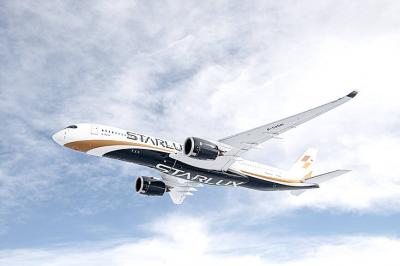
Starlux Airlines Co (星宇航空) today unveiled a long-haul network expansion plan at a shareholders’ meeting in Taipei, including direct flights to Barcelona, Spain, and Zurich, Switzerland, as well as a service connecting Taipei, Sydney and New Zealand. Starlux is to become the first Taiwanese carrier to offer non-stop services to the two European cities, while the inaugural oceanic route is expected to expand transit opportunities within the Australia-New Zealand market, Starlux said. Flight services to Chicago, Dallas, Washington and New York are under evaluation, the airline added. Prior to the shareholders’ meeting, the airline earlier this year announced that it would be
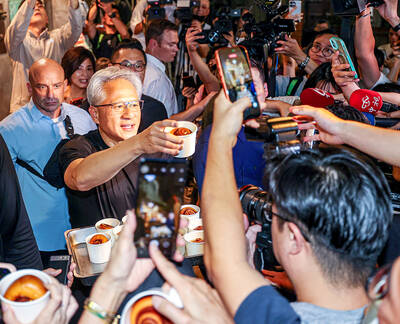
Nvidia Corp yesterday announced that CEO Jensen Huang (黃仁勳) would attend an employee meeting in Taipei tomorrow to celebrate the launch of the company’s Taiwan headquarters project. Huang would attend a gathering at the site of Nvidia’s planned headquarters in Beitou Shilin Technology Park (北投士林科技園區), the company said in a statement. After arriving in Taiwan on Saturday last week, Huang told reporters that he plans to meet with Quanta Computer Inc (廣達) chairman Barry Lam (林百里) and Taiwan Semiconductor Manufacturing Co (TSMC, 台積電) chairman C.C. Wei (魏哲家), and would attend the groundbreaking ceremony for Nvidia’s Taiwan headquarters tomorrow. Nvidia has not yet applied


 RSS
RSS