


Citibank expects investment activity across the Asia-Pacific region to strengthen further this year, supported by resilient equity markets, accelerating artificial intelligence (AI) investment and rising cross-border capital flows, the global bank’s senior executives said yesterday.
Kenneth Chow, Asia Co-Head of ECM, told an online news conference that investor sentiment has turned more forward-looking after a strong rally in regional equities.
“We think this is going to be a better year and everyone is busy,” Chow said, pointing to broad-based gains across Asia-Pacific stock markets and renewed global risk appetite.
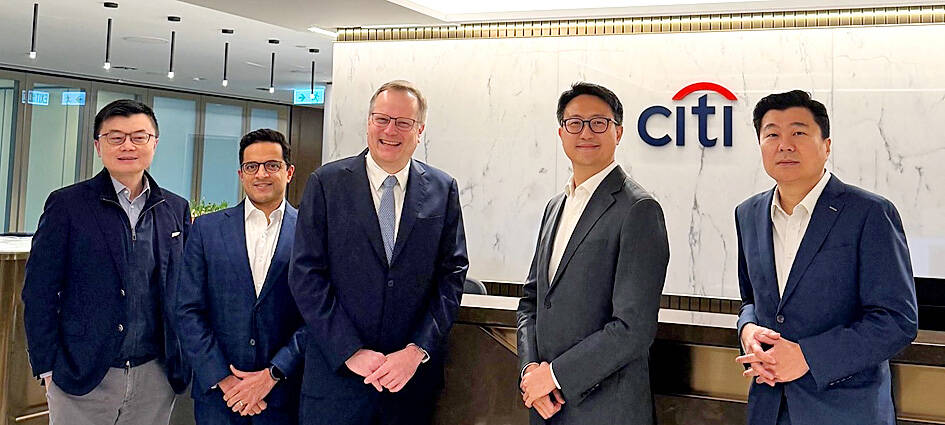
Photo courtesy of Citibank
Citi sees Taiwan as a major driver of financing activity this year, citing its concentration of globally competitive technology companies at the core of the AI hardware supply chain.
The bank expects another strong year for fundraising by Taiwanese firms, particularly through convertible bonds and global depositary receipts, as companies ramp up capital spending to meet surging AI-related demand.
“Taiwan is a strategic market for Citi,” Chow said, adding that international investor participation has increased in Taiwanese deals, reflecting confidence in the sector’s long-term growth prospects.
Citi has raised more than US$30 billion for Taiwanese clients since 2020 from global capital markets to support their growth.
Equity markets across Asia-Pacific delivered standout performance last year, with the regional equity index rising about 25 percent, outperforming both the US and Europe, Citi said.
South Korea led gains with an increase of roughly 76 percent, driven by its deep exposure to the AI supply chain. Hong Kong followed with a 28 percent rise as international funds returned to the market.
Investor preferences are also shifting, with growing appetite for companies that are not yet profitable, but are positioned to generate earnings within next three to five years, Chow said.
Competition for initial public offerings has intensified, particularly in Taiwan, Hong Kong, Japan and South Korea, all of which are benefiting from the AI investment cycle, he said.
Jan Metzger, Asia Co-Head of Investment Banking, said that overall deal activity has rebounded sharply.
Mergers and acquisitions deal value in the region rose 30 percent year-on-year to more than US$913 billion, while funds raised through equity and equity-linked offerings climbed 27 percent to US$294 billion, he said.
Primary bond issuance increased 23 percent.
AI-related supply chain activity has expanded rapidly across Greater China, Japan and South Korea, especially in hardware-focused segments, Metzger said.
“We are looking at companies with fundamental hardware technologies, which is a more exciting space than it’s been in a really long time,” he said, adding that Citi expects deal momentum to carry into this year.
Ho-Yin Lee, Asia Co-Head of Technology & Communications, Investment Banking, said that companies are upgrading facilities while stepping up research-and-development spending.
Tight memory supply and rising prices, partly driven by data-center demand, are expected to fuel further capital needs, he said.
Growing demand for private and public cloud services would require substantial financing as AI applications move toward broader commercial adoption, Lee added.

Singapore-based ride-hailing and delivery giant Grab Holdings Ltd has applied for regulatory approval to acquire the Taiwan operations of Germany-based Delivery Hero SE's Foodpanda in a deal valued at about US$600 million. Grab submitted the filing to the Fair Trade Commission on Friday last week, with the transaction subject to regulatory review and approval, the company said in a statement yesterday. Its independent governance structure would help foster a healthy and competitive market in Taiwan if the deal is approved, Grab said. Grab, which is listed on the NASDAQ, said in the filing that US-based Uber Technologies Inc holds about 13 percent of

The domestic unit of the Chinese-owned, Dutch-headquartered chipmaker Nexperia BV will soon be able to produce semiconductors locally within China, according to two company sources. Nexperia is at the center of a global tug-of-war over critical semiconductor technology, with a Dutch court in February ordering a probe into alleged mismanagement at the company. The geopolitical tussle has disrupted supply chains, with some carmakers reportedly forced to cut production due to chip shortages. Local production would allow Nexperia’s domestic arm, Nexperia Semiconductors (China) Ltd (安世半導體中國), to bypass restrictions in place since October on the supply of silicon wafers — etched with tiny components to

Taiwan Semiconductor Manufacturing Co (TSMC, 台積電) yesterday received government approval to deploy its advanced 3-nanometer (3nm) process at its second fab currently under construction in Japan, the Ministry of Economic Affairs said in a news release. The ministry green-lit the plan for the facility in Kumamoto, which is scheduled to start installing equipment and come online in 2028 with a monthly production capacity of 15,000 12-inch wafers, the ministry said. The Department of Investment Review in June 2024 authorized a US$5.26 billion investment for the facility, slated to manufacture 6- to 12nm chips, significantly less advanced than 3nm process. At a meeting with

Taiwan’s food delivery market could undergo a major shift if Singapore-based Grab Holdings Ltd completes its planned acquisition of Delivery Hero SE’s Foodpanda business in Taiwan, industry experts said. Grab on Monday last week announced it would acquire Foodpanda’s Taiwan operations for US$600 million. The deal is expected to be finalized in the second half of this year, with Grab aiming to complete user migration to its platform by the first half of next year. A duopoly between Uber Eats and Foodpanda dominates Taiwan’s delivery market, a structure that has remained intact since the Fair Trade Commission (FTC) blocked Uber Technologies Inc’s


 RSS
RSS