


The runaway success of the Switch 2 console drove up Nintendo Co’s net profit by more than 50 percent in the nine months to December, the Japanese video game giant said yesterday.
However, a global memorychip shortage, created by massive demand for artificial intelligence (AI) hardware, threatens to push up manufacturing costs for the Super Mario maker.
The Switch 2 became the world’s fastest-selling games console after launching to a fan frenzy last summer.
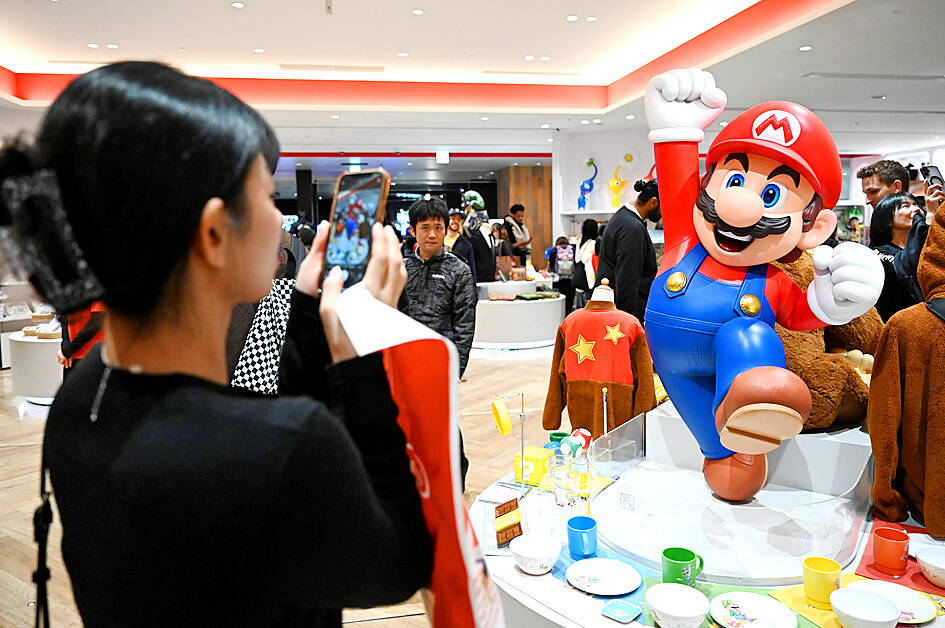
Photo: AFP
It is the successor to the original Switch, which soared in popularity during the pandemic when games such as Animal Crossing struck a chord during long COVID-19 lockdowns.
Both are hybrid devices that can be connected to a TV or used on-the-go.
“Nintendo Switch 2 got off to a good start following its launch on June 5 and unit sales continued to grow through the holiday season,” Nintendo said.
In the April-to-December period, net profit jumped 51.3 percent year-on-year to ¥358.9 billion (US$2.3 billion), it said, and revenue nearly doubled on-year to ¥1.9 trillion.
It sold nearly 17.4 million Switch 2 devices during the nine-month period.
However, the Kyoto-based company kept its annual unit sales target for the Switch 2 steady at 19 million, and also held its full-year net profit forecast of ¥350 billion.
Soaring prices for memory microchips — used in games consoles as well as cellphones, laptops and other electronics — is set to be a headwind.
Their prices have ballooned as chipmakers focus on meeting the huge demands of fast-growing numbers of AI data centers.
“Nintendo and other console manufacturers are publicly keeping quiet about the impact of the shortage,” gaming industry consultant Serkan Toto said.
However, “users can forget the past when consoles always became cheaper in tandem with component costs falling over time,” with price hikes potentially on the cards this year, he said.
Krysta Yang of the Nintendo-focused Kit and Krysta Podcast said that a Switch 2 price increase “is not out of the question,” but that Nintendo “would likely exhaust all other options” beforehand.
A lack of heavy-hitting first-party new games for the Switch 2 in coming months also risks hindering growth, although third-party titles such as Resident Evil Requiem should help fill the gap, she said.
Nintendo said it planned to release Mario Tennis Fever this month and Pokemon Pokopia next month.
While the company is diversifying into movies and theme parks, consoles remain at the core of its business.
The Switch 1 has sold 155.37 million units — overtaking the Nintendo DS to become its best-selling hardware of all time.

Singapore-based ride-hailing and delivery giant Grab Holdings Ltd has applied for regulatory approval to acquire the Taiwan operations of Germany-based Delivery Hero SE's Foodpanda in a deal valued at about US$600 million. Grab submitted the filing to the Fair Trade Commission on Friday last week, with the transaction subject to regulatory review and approval, the company said in a statement yesterday. Its independent governance structure would help foster a healthy and competitive market in Taiwan if the deal is approved, Grab said. Grab, which is listed on the NASDAQ, said in the filing that US-based Uber Technologies Inc holds about 13 percent of

The domestic unit of the Chinese-owned, Dutch-headquartered chipmaker Nexperia BV will soon be able to produce semiconductors locally within China, according to two company sources. Nexperia is at the center of a global tug-of-war over critical semiconductor technology, with a Dutch court in February ordering a probe into alleged mismanagement at the company. The geopolitical tussle has disrupted supply chains, with some carmakers reportedly forced to cut production due to chip shortages. Local production would allow Nexperia’s domestic arm, Nexperia Semiconductors (China) Ltd (安世半導體中國), to bypass restrictions in place since October on the supply of silicon wafers — etched with tiny components to

Taiwan Semiconductor Manufacturing Co (TSMC, 台積電) yesterday received government approval to deploy its advanced 3-nanometer (3nm) process at its second fab currently under construction in Japan, the Ministry of Economic Affairs said in a news release. The ministry green-lit the plan for the facility in Kumamoto, which is scheduled to start installing equipment and come online in 2028 with a monthly production capacity of 15,000 12-inch wafers, the ministry said. The Department of Investment Review in June 2024 authorized a US$5.26 billion investment for the facility, slated to manufacture 6- to 12nm chips, significantly less advanced than 3nm process. At a meeting with

Taiwan’s food delivery market could undergo a major shift if Singapore-based Grab Holdings Ltd completes its planned acquisition of Delivery Hero SE’s Foodpanda business in Taiwan, industry experts said. Grab on Monday last week announced it would acquire Foodpanda’s Taiwan operations for US$600 million. The deal is expected to be finalized in the second half of this year, with Grab aiming to complete user migration to its platform by the first half of next year. A duopoly between Uber Eats and Foodpanda dominates Taiwan’s delivery market, a structure that has remained intact since the Fair Trade Commission (FTC) blocked Uber Technologies Inc’s


 RSS
RSS