


South Korea posted its highest-ever exports for the month of January, official data showed yesterday, fuelled by a global artificial intelligence (AI) boom heavily reliant on chips made in the country.
The total value of last month’s exports was US$65.8 billion, a 33.9 percent rise year-on-year, South Korean Ministry of Trade, Industry and Resources said in a statement, marking the first time they surpassed a US$60 billion threshold for the month.
Home to the world’s leading memory-chip makers, South Korean products have become crucial to AI infrastructure. Technology giants Samsung Electronics Co and SK Hynix Inc both posted record quarterly operating profits in the October-December period.
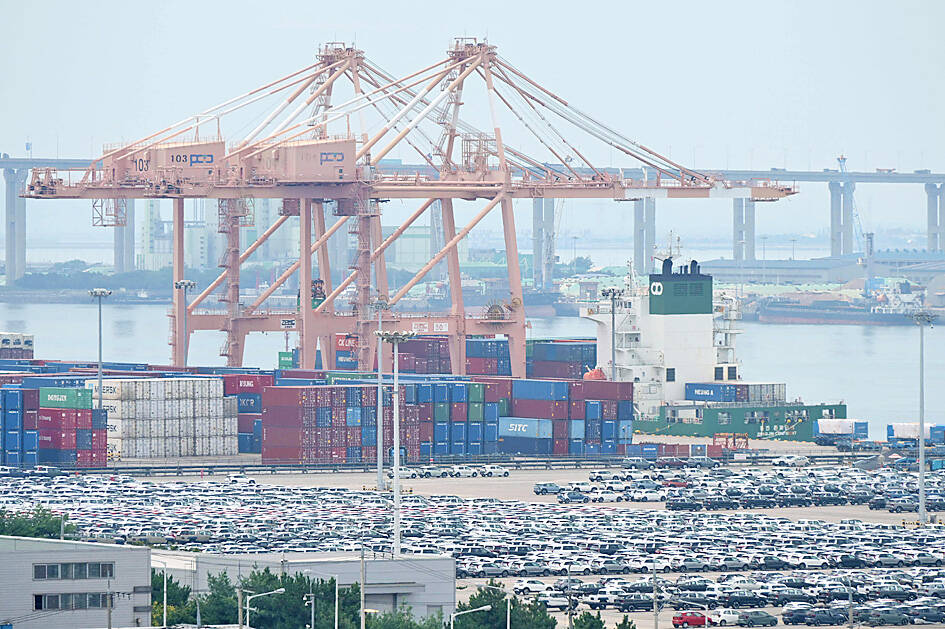
Photo: Shin Yong-ju, AFP
“Semiconductor exports came in at US$20.5 billion, a 102.7 percent increase” year-on-year, the ministry said, the second-highest monthly chips exports.
The record was set a month earlier, when the country exported chips worth US$20.8 billion.
Automobile exports increased 21.7 percent year-on-year to US$6 billon thanks to the strong performance of hybrid and electric cars, it said.
The data comes as Seoul is scrambling to respond to US President Donald Trump’s announcement earlier last week that he was raising tariffs on South Korean goods to 25 percent from 15 percent, accusing the South Korean legislature of not having ratified their trade deal.
Seoul and Washington struck a deal in October last year, with Seoul pledging investment in the US in exchange for slicing tariffs from 25 to 15 percent.
Seoul’s presidential office insisted in November last year that the deal does not require parliamentary approval, arguing it represents a memorandum of understanding rather than a binding legal document.
South Korean Minister of Trade, Industry and Resources Kim Jung-kwan met his US counterpart Howard Lutnick in Washington following the hike announcement and returned to Seoul on Saturday.
“There was considerable disappointment (from the US) over the fact that the special bill remains pending in the National Assembly,” Kim told reporters at the airport, adding that talks would continue.

Singapore-based ride-hailing and delivery giant Grab Holdings Ltd has applied for regulatory approval to acquire the Taiwan operations of Germany-based Delivery Hero SE's Foodpanda in a deal valued at about US$600 million. Grab submitted the filing to the Fair Trade Commission on Friday last week, with the transaction subject to regulatory review and approval, the company said in a statement yesterday. Its independent governance structure would help foster a healthy and competitive market in Taiwan if the deal is approved, Grab said. Grab, which is listed on the NASDAQ, said in the filing that US-based Uber Technologies Inc holds about 13 percent of

The domestic unit of the Chinese-owned, Dutch-headquartered chipmaker Nexperia BV will soon be able to produce semiconductors locally within China, according to two company sources. Nexperia is at the center of a global tug-of-war over critical semiconductor technology, with a Dutch court in February ordering a probe into alleged mismanagement at the company. The geopolitical tussle has disrupted supply chains, with some carmakers reportedly forced to cut production due to chip shortages. Local production would allow Nexperia’s domestic arm, Nexperia Semiconductors (China) Ltd (安世半導體中國), to bypass restrictions in place since October on the supply of silicon wafers — etched with tiny components to

Taiwan Semiconductor Manufacturing Co (TSMC, 台積電) yesterday received government approval to deploy its advanced 3-nanometer (3nm) process at its second fab currently under construction in Japan, the Ministry of Economic Affairs said in a news release. The ministry green-lit the plan for the facility in Kumamoto, which is scheduled to start installing equipment and come online in 2028 with a monthly production capacity of 15,000 12-inch wafers, the ministry said. The Department of Investment Review in June 2024 authorized a US$5.26 billion investment for the facility, slated to manufacture 6- to 12nm chips, significantly less advanced than 3nm process. At a meeting with

Taiwan’s food delivery market could undergo a major shift if Singapore-based Grab Holdings Ltd completes its planned acquisition of Delivery Hero SE’s Foodpanda business in Taiwan, industry experts said. Grab on Monday last week announced it would acquire Foodpanda’s Taiwan operations for US$600 million. The deal is expected to be finalized in the second half of this year, with Grab aiming to complete user migration to its platform by the first half of next year. A duopoly between Uber Eats and Foodpanda dominates Taiwan’s delivery market, a structure that has remained intact since the Fair Trade Commission (FTC) blocked Uber Technologies Inc’s


 RSS
RSS