


Quadriplegic and bedridden in a prefabricated home, 36-year-old Li Xia (黎夏) can only move one finger and one toe — yet he runs a high-tech farm in southwestern China using sensors, cameras and a computer.
Li, who has a genetic degenerative condition that progressively weakens muscles, relies on a ventilator permanently connected to his windpipe to breathe, but grows celery with the help of his 62-year-old mother.
From his bed, he operates four greenhouses that lie 10m away via a program he created and a computer screen hanging above him on an adjustable arm.
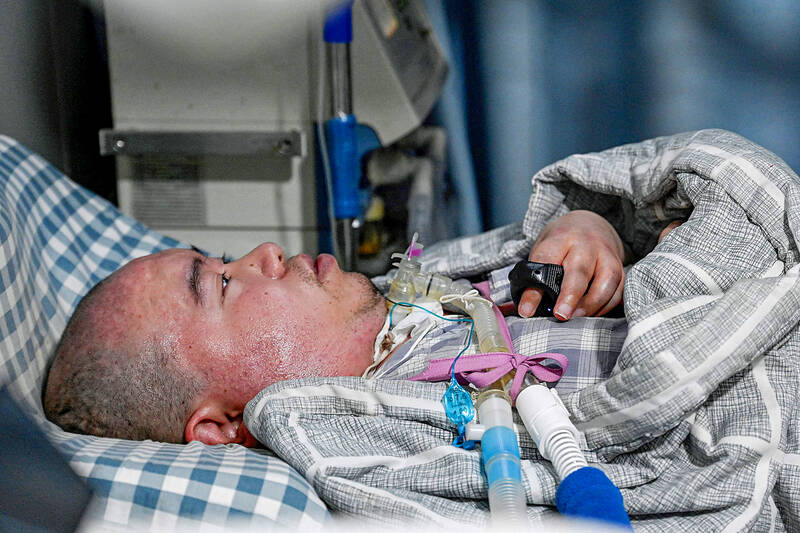
Photo: AF
“Through this microcomputer and the program I developed, and a mobile app, I can monitor various data points from the farm, such as temperature, humidity, nutrient solution concentration and pH levels,” Li told reporters. “With the cameras, I can see if the water pump is working or if the fans are running.”
With the one finger he is able to move, he controls the on-screen cursor using a trackball.
“To click, I use a flex sensor attached to my toe,” Li said from his home in Shiping village, near the southwestern city of Chongqing.
Duchenne muscular dystrophy, which he has, is an incurable genetic disease that affects almost exclusively males, at a rate of one in 5,000 births.
Over the years, it causes muscles to weaken, increasing the risk of falls, before paralysis sets in, affecting cardiac activity and breathing.
Until the early 2000s, boys with the condition rarely lived beyond their teens, but with comprehensive care, survival into the 30s and even 40s is possible.
Li, who was once able to get around in a wheelchair, experienced a sudden medical crisis in 2020 when he was 30 years old. He fell into a coma, became incontinent and quadriplegic.
“I was devastated, but after a few months, I pulled myself together and looked for things that made sense,” he said.
He discovered hydroponics, an innovative cultivation technique by which vegetables are grown not in soil, but in a solution of water enriched with essential nutrients.
Partially automated, it requires little manual labor, allows for crops to be precisely controlled and ensures good yields.
“I grew up in the countryside, so I’ve always been in contact with seeds, soil and vegetables,” Li said. “I also love digital technologies and programming. I realized I could combine the two.”
Li taught himself computer programming and learned how to design a circuit board.
His case is in many ways similar to others with severe neuromotor disorders, such as British physicist and cosmologist Stephen Hawking, who was confined to a wheelchair and could only communicate through a voice synthesizer.
Or Jean-Dominique Bauby, who was paralyzed after a stroke and authored his 1997 book The Diving Bell and the Butterfly by blinking his left eye, the only movement he could still control.
For the farm tasks involving manual labor, Li is reliant on his mother, Wu Dimei (吳弟美).
“She is my arms and legs, and I am her brain,” he said.
Li explains what needs to be done and supervises her work in the greenhouses via a video link to his smartphone.
Wu operates tools, measures out fertilizer, installs equipment and connects cables.
In addition to farm work, she provides for her son day and night, including cooking and cleaning the ventilation tube in his windpipe.
“I don’t have time to rest,” Wu told reporters.
Even with the help of her daughter, who regularly helps bathe her brother, Wu only sleeps three to five hours a night.
“But it’s worth it,” said Wu, who is divorced. “It may not seem like it, but our family is quite happy.”
They mainly rely on the income of Li’s sister, who works, and their mother’s pension.
Li said he saw the high-tech farm as a “niche” with “great prospects,” and hoped to provide his family with a livelihood.
“If I succeed, it would allow me to fulfil a dream, but also to earn money and improve our living conditions,” he said.
They moved to a prefabricated portable home in 2022, and his celery is sold to a local supermarket chain.
“We’re not making a profit yet, but my dream is to expand this farm, turn it into a successful business, produce more and earn more,” said Li, who embarked on his venture in 2022. “My motivation is to see our vegetables grow, be harvested, sold and end up on people’s plates.”
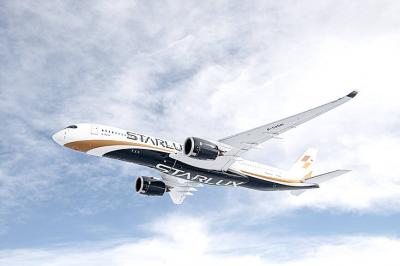
Starlux Airlines Co (星宇航空) today unveiled a long-haul network expansion plan at a shareholders’ meeting in Taipei, including direct flights to Barcelona, Spain, and Zurich, Switzerland, as well as a service connecting Taipei, Sydney and New Zealand. Starlux is to become the first Taiwanese carrier to offer non-stop services to the two European cities, while the inaugural oceanic route is expected to expand transit opportunities within the Australia-New Zealand market, Starlux said. Flight services to Chicago, Dallas, Washington and New York are under evaluation, the airline added. Prior to the shareholders’ meeting, the airline earlier this year announced that it would be

Netherlands-based semiconductor equipment supplier ASML Holding NV yesterday said that it is planning to hire an additional 1,000 people in Taiwan this year in response to growing demand from clients. ASML had previously planned to recruit 600 people this year, but that the plan has been adjusted upward, ASML vice president and ASML Taiwan general manager Grace Wang (汪佳慧) told reporters. ASML has a workforce of more than 4,500 in Taiwan, accounting for about 10 percent of its global total, Wang said. This year’s recruitment campaign would focus on adding people in the customer support, manufacturing and supply chain domains to assist ASML

UNDER MICROSCOPE: Taiwan detained three people who allegedly conspired to buy servers in Taiwan and export them using fraudulent documentation, prosecutors said Nvidia Corp chief executive officer Jensen Huang (黃仁勳) on Saturday urged Super Micro Computer Inc to tighten up on compliance after Taiwan detained three people this week for allegedly making fraudulent declarations about artificial intelligence (AI) servers made by its US partner. The development marked the nation’s first crackdown on semiconductor smuggling, which grew after the US slapped restrictions on exports of high-end chips such as Nvidia AI accelerators to China. Nvidia is “rigorous” in explaining regulations to all of its partners, Huang told reporters after arriving in Taipei. “Ultimately Super Micro has to run their own company,” he said in response to
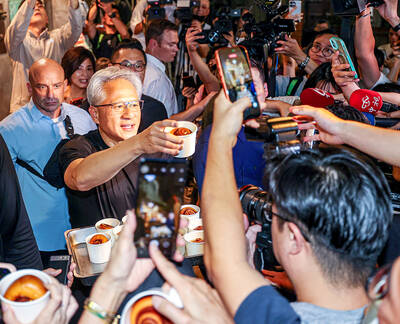
Nvidia Corp yesterday announced that CEO Jensen Huang (黃仁勳) would attend an employee meeting in Taipei tomorrow to celebrate the launch of the company’s Taiwan headquarters project. Huang would attend a gathering at the site of Nvidia’s planned headquarters in Beitou Shilin Technology Park (北投士林科技園區), the company said in a statement. After arriving in Taiwan on Saturday last week, Huang told reporters that he plans to meet with Quanta Computer Inc (廣達) chairman Barry Lam (林百里) and Taiwan Semiconductor Manufacturing Co (TSMC, 台積電) chairman C.C. Wei (魏哲家), and would attend the groundbreaking ceremony for Nvidia’s Taiwan headquarters tomorrow. Nvidia has not yet applied


 RSS
RSS