


The world’s largest tech firms show no signs of easing up on artificial intelligence (AI) spending, a record wave that’s propelling hardware providers like Samsung Electronics Co and SK Hynix Inc. That is even as doubts persist about the staying power of AI demand to justify all that capital.
Meta Platforms Inc on Wednesday revealed ambitions to spend as much as US$135 billion this year — one of the biggest planned outlays of the business sphere. Its suppliers have responded in kind: Yesterday, SK Hynix said it plans a “considerable increase” in capital expenditure, and Samsung said it is ratcheting up spending on its memory production capacity.
Meta, Microsoft and fellow hyperscalers such as Amazon.com Inc and Alphabet Inc, are driving a wave of global spending on chips, servers and computers that’s firing up hardware suppliers around the world, particularly in Asia. A procession of industry linchpins’ results this week further underscored how voracious the appetite for AI hardware has grown — and how that’s likely to extend well into this year.
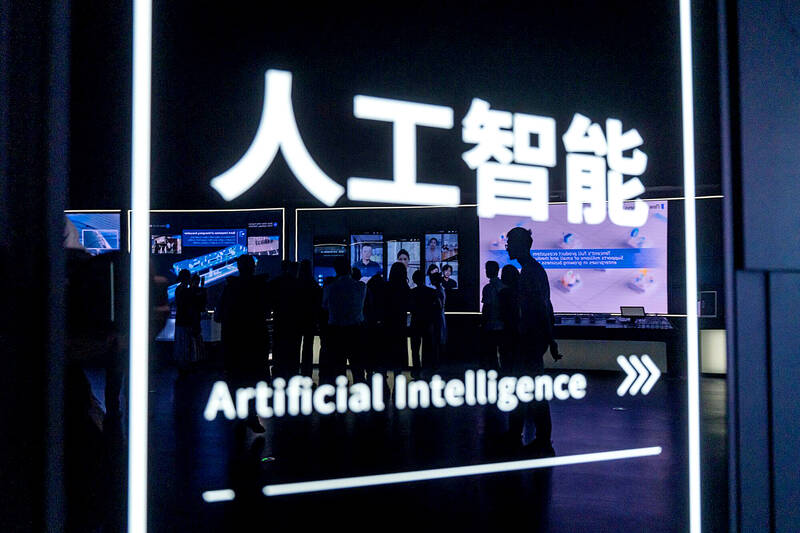
Photo: Qilai Shen, Bloomberg
Ratcheting spending by hyperscalers reflects growing use cases for AI, CLSA Securities Korea Ltd research head Sanjeev Rana said, adding that “the companies are spending real money on real stuff.”
“We are in unchartered territory in terms of valuations, share prices, the demand cycle,” he said. “Everything is unprecedented.”
At the same time, that enormous demand is worsening a global chip demand-supply imbalance that threatens to disrupt industries from smartphones and electronics to car-making.
While the appetite for Nvidia and Advanced Micro Devices Inc accelerators needed to develop and operate AI has long outstripped supply, investors are growing increasingly concerned about a similar deficit in more basic memory.
Memory supply cannot keep pace with demand, SK Hynix’s DRAM marketing head Park Joon-deok said on a conference call yesterday. “Most customers are struggling to secure memory volumes and are persistently demanding increased supply.”
The availability of semiconductors will be a big bottleneck to growth for companies including Tesla Inc, and may necessitate building a Tesla TeraFab — a factory that can make logic and memory chips and provide packaging, chief executive officer Elon Musk said in a recent podcast with X Prize Foundation founder Peter Diamandis.
“We’re going to hit a chip wall if we don’t do the fab,” Musk said. “We’ve got two choices: hit the chip wall or make a fab.”
Tesla will spend US$20 billion this year on pursuits including AI, self-driving vehicles and robotics and plow another US$2 billion into Musk’s xAI start-up.
Memory manufacturers are reallocating production lines toward lucrative high-bandwidth memory (HBM) to satisfy the needs of AI data centers. Because HBM requires about three times the wafer capacity of standard DRAM for the same amount of memory, this shift has reduced supply for the consumer electronics industry. The resulting shortage is threatening double-digit price hikes for PC makers and smaller electronics companies.
Even while companies are spending hundreds of billions of dollars on data centers, concerns about the strength of end-demand for AI persist, however. Microsoft’s capital expenditure grew a larger-than-anticipated 66 percent in the quarter, but its Azure cloud-computing unit posted a 38 percent revenue gain — one percentage point slower than the prior three months.
On the other hand, Meta chief Mark Zuckerberg talked about “a major AI acceleration” that’s been brewing within the tech industry for over a year. “I expect our first models will be good, but more importantly, we’ll show the rapid trajectory that we’re on,” he said on Wednesday’s earnings call.
In Asia, attention is on the race for leadership in next-generation HBM4, which is set to be integrated with Nvidia’s upcoming flagship Rubin processors. Samsung plans to start shipments of its next-generation HBM4 next month — a key step in its bid to catch up with SK Hynix in the lucrative segment. Samsung is close to obtaining certification from Nvidia for the latest version of its AI memory chip.

Cairo’s new monorail slices across the city skyline, running above the familiar chaos of blaring horns and aging buses’ exhaust fumes that mark rush hour below. The US$4.5 billion monorail, opened this month, is among Egypt’s most prominent new transport projects, part of a debt-funded infrastructure drive criticized for sapping state finances while bringing limited benefits to most of the country’s 109 million people. “It feels like you’re in a different country,” said Ramy Sayed, a restaurant manager, aboard a driverless Innovia 300 train. “No noise, no traffic, we’re not used to this.” The eastern line runs 56km from the bustling middle-class

Taiwanese firms have increased investment in the Philippines in recent years as Manila’s ties with Washington deepen and global supply chains continue to shift away from China, an expert at the Chung-Hua Institution for Economic Research (CIER, 中華經濟研究院) said yesterday. The Philippines had not been among Taiwanese investors’ top choices in Southeast Asia, CIER Taiwan ASEAN Studies Center director Kristy Hsu (徐遵慈) said at a seminar in Taipei. However, Taiwan’s investment in the country has grown significantly since the COVID-19 pandemic, reaching US $257 million last year, a high in recent years, she said. Although Taiwan’s total investment in the Philippines still lags

Intel Corp regards Taiwan Semiconductor Manufacturing Co (TSMC, 台積電) as a longstanding partner, as the US chipmaker would continue outsourcing production of advanced chips to TSMC, Intel chief executive officer Lip-Bu Tan (陳立武) said yesterday. “I don’t look at people as competitors. I look at the collaboration... Nvidia is also, you know, a good friend,” Tan told a news conference following his keynote speech at the Computex trade show in Taipei. “It’s a very trusted partnership for us... We are a big, top customer for them, and we’re going to continue doing that,” he said, referring to TSMC, the world’s largest foundry

Artificial intelligence (AI) agents would supplant smartphones as the center of people’s digital lives, fundamentally reshaping personal devices and driving a major computing upgrade cycle, Qualcomm Inc CEO Cristiano Amon said yesterday. In his keynote speech for this year’s Computex trade show in Taipei, Amon said that the rise of "agentic AI" — AI systems capable of reasoning, planning and carrying out tasks autonomously — would transform how people interact with technology across phones, PCs, vehicles and wearable devices. Describing the technology as the next major evolution in computing, Amon said that "2026 is the year of agents.” For decades, smartphones have sat


 RSS
RSS