


Technology products are no longer purely commercial goods, but are closely intertwined with geopolitical competition and cooperation, Pegatron Corp chairman Tung Tzu-hsien (童子賢) said yesterday, citing media reports that China might allow the import of Nvidia Corp’s H200 artificial intelligence (AI) chips.
Global technology and industrial development are increasingly shaped by geopolitics, with chips, AI and semiconductor equipment serving as bargaining chips between national economies, Tung told reporters on the sidelines of the Taipei Game Show.
Technology was once a force that improved people’s lives and promoted cross-border cooperation, but is increasingly used as a tool in geopolitical negotiations, he said.
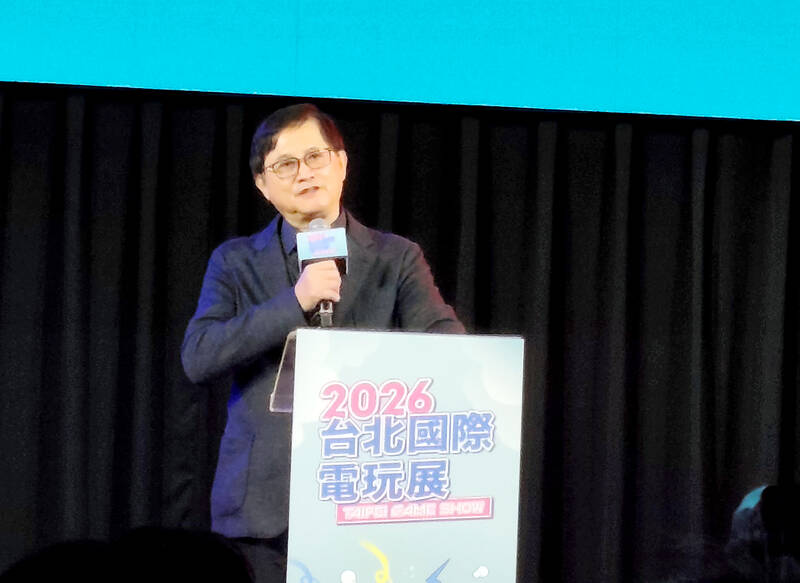
Photo: CNA
Under former US president Joe Biden, Washington adopted a technology containment strategy toward China, while US President Donald Trump’s approach is that “everything can be negotiated with money,” with market access increasingly tied to economic conditions, Tung said.
Taking the possible sale of H200 chips in China as an example, he said that shipments would be subject to a so-called “toll,” requiring US companies to pay a 25 percent export tax to the US government.
Shipment volumes would be capped, he added.
China has signaled its response, with reports indicating that exports of H200 chips would be allowed only on a limited basis and restricted to companies such as Alibaba Group Holding Ltd (阿里巴巴), Tencent Holdings Ltd (騰訊) and ByteDance Ltd (字節跳動), Tung said.
Chinese authorities would simultaneously encourage the adoption of domestically developed systems to reduce reliance on foreign high-end semiconductors, he said.
Tung’s remarks came on the same day after Nvidia chief executive Jensen Huang (黃仁勳) expressed optimism that Beijing would permit the sale of the H200 chips to Chinese buyers.
“The actual license for H200 is being finalized,” Huang said. “I’m hoping ... the Chinese government would allow Nvidia to sell [the] H200, so they have to decide, and I’m looking forward to a favorable decision.”
Taiwan Semiconductor Manufacturing Co (TSMC, 台積電) founder Morris Chang (張忠謀) once said “globalization is dead” as the global trade development faced rising competition between the US and China, as well as the growing threats of protectionist measures worldwide.
Tung yesterday said the recent developments do not herald the end of globalization, but rather that technology and trade have become increasingly shaped by geopolitics.
With Taiwan’s technology sector caught in the middle of the US-China rivalry, the era of simply “making good products and doing business happily” is over, he said.
Companies must navigate more cautiously in the increasingly complex environment and find the best path forward, he added.
Trump’s recent decision to raise tariffs on South Korea to 25 percent from the previously agreed 15 percent reflects his governing style of frequently adjusting policy in a short period of time, he said.
It was not only directed at South Korea, but served as a signal to other countries engaged in trade negotiations with Washington, he said.
While demand for advanced chips used in servers and AI applications remains strong, Taiwan must proceed cautiously amid potential challenges, he added.
Additional reporting by AFP

Netherlands-based semiconductor equipment supplier ASML Holding NV yesterday said that it is planning to hire an additional 1,000 people in Taiwan this year in response to growing demand from clients. ASML had previously planned to recruit 600 people this year, but that the plan has been adjusted upward, ASML vice president and ASML Taiwan general manager Grace Wang (汪佳慧) told reporters. ASML has a workforce of more than 4,500 in Taiwan, accounting for about 10 percent of its global total, Wang said. This year’s recruitment campaign would focus on adding people in the customer support, manufacturing and supply chain domains to assist ASML

UNDER MICROSCOPE: Taiwan detained three people who allegedly conspired to buy servers in Taiwan and export them using fraudulent documentation, prosecutors said Nvidia Corp chief executive officer Jensen Huang (黃仁勳) on Saturday urged Super Micro Computer Inc to tighten up on compliance after Taiwan detained three people this week for allegedly making fraudulent declarations about artificial intelligence (AI) servers made by its US partner. The development marked the nation’s first crackdown on semiconductor smuggling, which grew after the US slapped restrictions on exports of high-end chips such as Nvidia AI accelerators to China. Nvidia is “rigorous” in explaining regulations to all of its partners, Huang told reporters after arriving in Taipei. “Ultimately Super Micro has to run their own company,” he said in response to

Nvidia Corp yesterday announced that CEO Jensen Huang (黃仁勳) would attend an employee meeting in Taipei tomorrow to celebrate the launch of the company’s Taiwan headquarters project. Huang would attend a gathering at the site of Nvidia’s planned headquarters in Beitou Shilin Technology Park (北投士林科技園區), the company said in a statement. After arriving in Taiwan on Saturday last week, Huang told reporters that he plans to meet with Quanta Computer Inc (廣達) chairman Barry Lam (林百里) and Taiwan Semiconductor Manufacturing Co (TSMC, 台積電) chairman C.C. Wei (魏哲家), and would attend the groundbreaking ceremony for Nvidia’s Taiwan headquarters tomorrow. Nvidia has not yet applied
Huawei Technologies Co (華為) said it has come up with a new pathway to shorten its gap with industry leader Taiwan Semiconductor Manufacturing Co (TSMC, 台積電), potentially achieving a breakthrough in making advanced semiconductors without cutting-edge equipment. Right now there is about a five-year gap between what TSMC is capable of and what Huawei, together with its manufacturing partner Semiconductor Manufacturing International Corp (中芯), can produce. Huawei is to start making 1.4-nanometer chips by 2031 with its own “LogicFolding” technology, Huawei semiconductor chief He Tingbo (何庭波) said in a rare public appearance during a chip conference yesterday, while TSMC has


 RSS
RSS