


India and the EU have agreed on a free-trade agreement, Indian Prime Minister Narendra Modi said yesterday, capping nearly two decades of negotiations.
“This free-trade agreement will strengthen confidence of investors, business in India,” Modi said in remarks at an energy event.
The pact would boost trade and global supply chains, while improving India’s manufacturing and services sectors, he said.
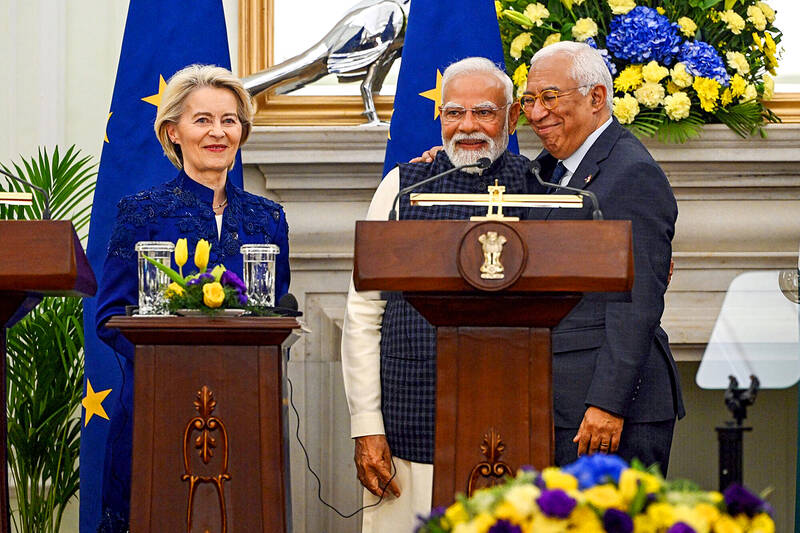
Photo: Bloomberg
European Commission President Ursula von der Leyen and European Council President Antonio Costa were in New Delhi to announce the deal later yesterday.
The EU, despite long clashing with Indian officials over trade matters, is focused on shedding its economic reliance on the US and China. India is similarly trying to shake its protectionist reputation and offset a 50 percent tariff imposed by the US, while at the same time balance its ties with Russia.
Nations are increasingly willing to “bury the hatchet” given the “atmosphere of uncertainty” around the trade policies of US President Donald Trump, said Amitendu Palit, the research lead on trade and economics at the Institute of South Asian Studies.
“Diversification is absolutely essential,” Palit said. “That is the name of the game.”
The agreement would lower tariffs on most consumer and industrial goods traded between India and EU members, although it is expected to exclude some agricultural products.
The EU would also get enhanced market access for its auto exports subject to a cap.
The pact is expected to be formally signed after legal vetting, which would likely take about six months.
The deal is also required to be ratified by the European Parliament.
Modi’s announcement comes weeks after India signed trade deals with New Zealand and Oman. Just days earlier, the EU polished off a separate, long-gestating trade deal with the Mercosur bloc of South American countries — another pact meant to help the EU pivot away from the US and China, although EU lawmakers have yet to ratify it.
Modi is also trying to find new markets for a country Trump once dubbed the “tariff king.”
Yesterday’s agreement marked Modi’s fourth trade deal since May last year, also including an agreement with the UK.
Modi is seeking partnerships with the Mercosur bloc, Chile, Peru and the Gulf Cooperation Council, hoping to secure strategic resources and increase India’s global footprint.
The EU-India deal could give India, Asia’s third-largest economy, a competitive edge in the export of labor-intensive goods hit hard by Trump’s tariffs, including apparel and footwear.
More broadly, it could boost the country’s exports to the EU to about US$50 billion by 2031, according to a report by Madhavi Arora, lead economist at Emkay Global Financial Services Ltd.
Arora singled out pharmaceutical, textiles and chemicals as sectors likely to benefit.
For the EU, the agreement would mean access to one of the world’s fastest-growing economies, with a market of more than 1.4 billion people.
However, the deal would not offer as much market access for European goods as the one the EU recently reached with the Mercosur countries — Argentina, Brazil, Uruguay and Paraguay.
Still, “in a world where the transatlantic relationship is fundamentally broken and trusted partners are hard to come by, this is a pretty big win for the EU,” said Garima Mohan, an Indo-Pacific specialist who focuses on EU-India ties at the Washington-based German Marshall Fund. “It signals the EU’s shift to a more geopolitical, pragmatic stance.”
Bilateral trade between the EU and India stood at US$136.5 billion in India’s fiscal year through March last year, with the EU making up more than 17 percent of India’s total exports, official data showed.
India is the EU’s ninth-largest trading partner.

Cairo’s new monorail slices across the city skyline, running above the familiar chaos of blaring horns and aging buses’ exhaust fumes that mark rush hour below. The US$4.5 billion monorail, opened this month, is among Egypt’s most prominent new transport projects, part of a debt-funded infrastructure drive criticized for sapping state finances while bringing limited benefits to most of the country’s 109 million people. “It feels like you’re in a different country,” said Ramy Sayed, a restaurant manager, aboard a driverless Innovia 300 train. “No noise, no traffic, we’re not used to this.” The eastern line runs 56km from the bustling middle-class
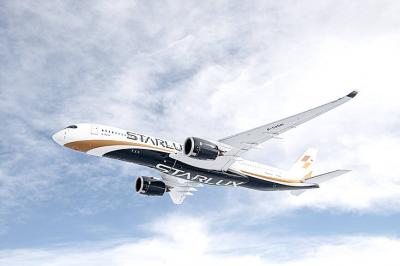
Starlux Airlines Co (星宇航空) today unveiled a long-haul network expansion plan at a shareholders’ meeting in Taipei, including direct flights to Barcelona, Spain, and Zurich, Switzerland, as well as a service connecting Taipei, Sydney and New Zealand. Starlux is to become the first Taiwanese carrier to offer non-stop services to the two European cities, while the inaugural oceanic route is expected to expand transit opportunities within the Australia-New Zealand market, Starlux said. Flight services to Chicago, Dallas, Washington and New York are under evaluation, the airline added. Prior to the shareholders’ meeting, the airline earlier this year announced that it would be
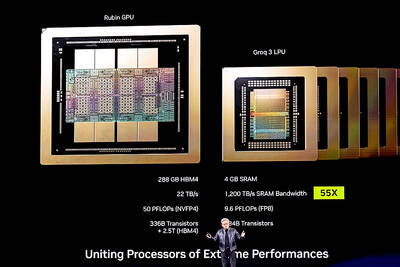
Taiwanese prosecutors suspect that three people successfully smuggled at least one shipment of Nvidia Corp artificial intelligence (AI) chips to China after first exporting them to Japan, people familiar with the matter said. The trio was detained last week by the Keelung District Prosecutors’ Office for allegedly falsifying documents related to exports of Super Micro Computer Inc servers containing advanced Nvidia chips, which the US has barred from sale to China without a license from Washington. The move marked Taiwan’s first public crackdown on AI chip diversion after years of pressure from the US to take a more active role in curtailing
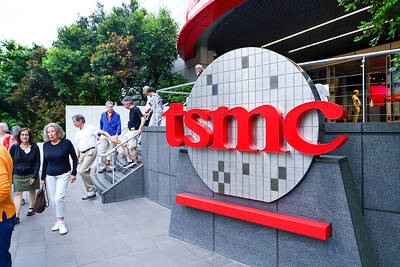
Taiwan Semiconductor Manufacturing Co (TSMC, 台積電) employee bonuses are likely to grow more than 30 percent this year, in line with the past few years as the company’s profits continue to set new records, an anonymous source cited TSMC chairman C.C. Wei (魏哲家) as saying yesterday. TSMC, the world’s largest contract chipmaker, is committed to taking care of its workers, the source said, citing Wei’s meeting with employees yesterday morning. Wei also expressed gratitude to employees for their contribution to the company’s improving bottom line, the source added. Since 2023, TSMC’s employee bonuses have grown at an annual rate of


 RSS
RSS