


As artificial intelligence (AI) threatens to upends job markets in countries around the world, Nvidia Corp chief executive officer Jensen Huang (黃仁勳) brushed off longer term concerns and made the case that skilled vocational workers are seeing increasing demand now.
Plumbers, electricians and construction workers are going to be able to command “six-figure salaries,” thanks to demand to build data centers that run and train AI, he said in an interview with BlackRock Inc CEO Larry Fink at the World Economic Forum in Davos, Switzerland yesterday. The technology will require one of the biggest infrastructure buildouts in history, with trillions of dollars in new investment, Huang said.
“We’re seeing quite a significant boom in this area. Salaries have gone up nearly double,” Huang said. “Everybody should be able to make a great living. You don’t need to have a PhD in computer science to do so.”
.jpg)
Photo: Fabrice Coffrini, AFP
Huang’s comments echo remarks made at Davos on Tuesday by Palantir Technologies Inc CEO Alex Karp, who praised workers with “vocational training” and said AI would create more local jobs and largely eliminate the need for mass immigration. Coreweave Inc’s Michael Intrator also touched on the “physicality” of the AI boom at a panel later yesterday, with the data center firm’s CEO describing the need for growing numbers of plumbers, electricians and carpenters.
Nvidia, the leading maker of chips that help power and run the latest AI models, has benefited from the huge rush to build data centers. The company is on track to generate almost US$200 billion in data center chip sales for last year, according to an average analyst estimate compiled by Bloomberg. To date, the bulk of its revenue comes from the biggest data center builders — Microsoft Corp, Meta Platforms Inc, Amazon.com Inc and Alphabet Inc — but it’s striking deals with a growing number of smaller data center operators. Tech firms have committed to spend a combined US$500 billion in data center leases in the coming years.
AI’s impact on the job market is already being felt. Anthropic PBC CEO Dario Amodei has warned about a “white-collar bloodbath” that could wipe out 50 percent of entry-level jobs. The company’s Claude AI is gaining attention for its coding abilities, a feature that could displace more junior programmers.
“We’re entering a world where the junior-level software engineers — maybe many of the tasks of the more senior-level software engineers — are starting to be done most of the way by AI systems. Now that’s going to go further,” Amodei said in an interview at Bloomberg House in Davos on Tuesday. While he believes the good from the technology will outweigh the bad, high unemployment and underemployment are a risk that needs to be mitigated.
“There’s going to be unfortunately a whole class of people who are, across a lot of industries, going to have a hard time coping,” he said.
Fink yesterday noticeably avoided probing Huang on sensitive topics, most notably China. Nvidia’s sales to the country are controversial, and the company is waiting to hear whether it will be able to sell its chips to the country and in what quantities. Just yesterday, Amodei called shipping Nvidia chips into China similar to selling nuclear weapons to North Korea.
Huang is expected to visit China at the end of this month as he works to reopen a crucial market for the company’s AI chips. It’s a pivotal time for the business, after the US moved to ease limits on chip exports to China it’s had in place since 2022. Nvidia is still blocked from shipping the top-of-the-line chips to the country, stymying Beijing’s ability to innovate beyond the cutting-edge of AI, but will be able to ship older-generation H200 AI chips.
Meanwhile, a key Republican lawmaker scheduled a committee vote yesterday for a bill that would give Congress power over AI chip exports, despite pushback from White House AI czar David Sacks, among others.
Representative Brian Mast of Florida, chair of the House Foreign Affairs Committee, introduced the "AI Overwatch Act" last month after US President Donald Trump greenlighted shipments of Nvidia's powerful H200 AI chips to China.
The legislation would give the House Foreign Affairs Committee and the Senate Banking Committee 30 days to review and potentially block licenses issued to export advanced AI chips to China and other adversaries. One source said the act's odds of passage increased after a coordinated media campaign last week against the bill.
The legislation would ensure "our cutting-edge AI chips cannot be used by the Chinese military," Mast said at a hearing last week titled, "Winning the AI Arms Race against the Chinese Communist Party."If the bill moves out of committee, it must pass in both the full Senate and the House, and then must be signed by the US president.
Additional reporting by Reuters
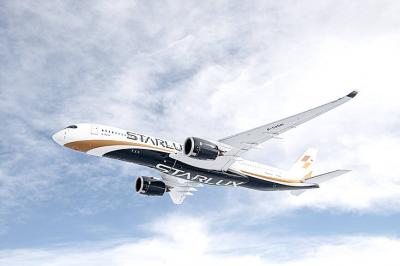
Starlux Airlines Co (星宇航空) today unveiled a long-haul network expansion plan at a shareholders’ meeting in Taipei, including direct flights to Barcelona, Spain, and Zurich, Switzerland, as well as a service connecting Taipei, Sydney and New Zealand. Starlux is to become the first Taiwanese carrier to offer non-stop services to the two European cities, while the inaugural oceanic route is expected to expand transit opportunities within the Australia-New Zealand market, Starlux said. Flight services to Chicago, Dallas, Washington and New York are under evaluation, the airline added. Prior to the shareholders’ meeting, the airline earlier this year announced that it would be

Netherlands-based semiconductor equipment supplier ASML Holding NV yesterday said that it is planning to hire an additional 1,000 people in Taiwan this year in response to growing demand from clients. ASML had previously planned to recruit 600 people this year, but that the plan has been adjusted upward, ASML vice president and ASML Taiwan general manager Grace Wang (汪佳慧) told reporters. ASML has a workforce of more than 4,500 in Taiwan, accounting for about 10 percent of its global total, Wang said. This year’s recruitment campaign would focus on adding people in the customer support, manufacturing and supply chain domains to assist ASML

UNDER MICROSCOPE: Taiwan detained three people who allegedly conspired to buy servers in Taiwan and export them using fraudulent documentation, prosecutors said Nvidia Corp chief executive officer Jensen Huang (黃仁勳) on Saturday urged Super Micro Computer Inc to tighten up on compliance after Taiwan detained three people this week for allegedly making fraudulent declarations about artificial intelligence (AI) servers made by its US partner. The development marked the nation’s first crackdown on semiconductor smuggling, which grew after the US slapped restrictions on exports of high-end chips such as Nvidia AI accelerators to China. Nvidia is “rigorous” in explaining regulations to all of its partners, Huang told reporters after arriving in Taipei. “Ultimately Super Micro has to run their own company,” he said in response to

Nvidia Corp yesterday announced that CEO Jensen Huang (黃仁勳) would attend an employee meeting in Taipei tomorrow to celebrate the launch of the company’s Taiwan headquarters project. Huang would attend a gathering at the site of Nvidia’s planned headquarters in Beitou Shilin Technology Park (北投士林科技園區), the company said in a statement. After arriving in Taiwan on Saturday last week, Huang told reporters that he plans to meet with Quanta Computer Inc (廣達) chairman Barry Lam (林百里) and Taiwan Semiconductor Manufacturing Co (TSMC, 台積電) chairman C.C. Wei (魏哲家), and would attend the groundbreaking ceremony for Nvidia’s Taiwan headquarters tomorrow. Nvidia has not yet applied


 RSS
RSS