


Taiwan’s GDP is forecast to grow 5.3 percent year-on-year this year, as the nation’s non-electronics industries are expected to benefit from the latest Taiwan-US trade deal, which lowers US tariffs on Taiwanese goods to 15 percent from 20 percent, Yuanta Securities Investment Consulting Co (元大投顧) said in a report.
Other factors — such as Taiwan Semiconductor Manufacturing Co’s (TSMC, 台積電) better-than-expected financial results and outlook, as well as the US applying a zero percent Section 232 tariff on Taiwanese semiconductors used in the US data centers and US-made products — also allowed Yuanta to raise GDP growth forecast from its previous estimate of 4.61 percent, the company said.
Yuanta’s forecast is higher than a market consensus of 3.8 percent growth forecast, the report issued on Friday said.
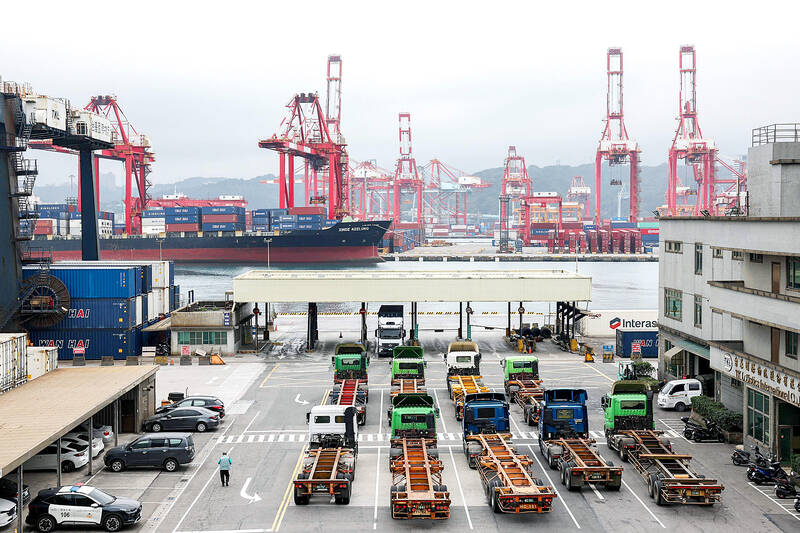
Photo: I-Hwa Cheng, AFP
Standard Chartered PLC last week predicted 3.8 percent growth for Taiwan this year, while the central bank and Asian Development Bank last month projected expansions of 3.67 percent and 4 percent respectively.
The Directorate-General of Budget, Accounting and Statistics in November pitched its GDP growth forecast for this year at 3.54 percent, but the agency is widely expected to revise upward its estimate later this month after the latest government data showed Taiwan’s exports and trade surplus hit record highs for last year.
The latest trade deal aligns Taiwan’s tariff rates with those of its major trading partners such as Japan and South Korea, and is lower than the current US tariff rates on China, Yuanta said.
Furthermore, certain products, like semiconductors and related products, auto parts, and wood and related products, receive most-favored-nation status, which means that even if US trade policies change in the future, the competitiveness of Taiwanese goods would remain unchanged, indicating less uncertainty for businesses, it said.
As most Taiwanese electronics exports to the US are currently exempt from tariffs, the trade deal would help boost the export competitiveness of Taiwan’s non-electronics industries and boost this year’s economic growth by 0.08 percentage points, it added.
TSMC at its earnings conference last week forecast a compound annual growth rate of 40 percent for related artificial intelligence (AI) revenue from this year to 2029, which affirmed a sustained, structural AI demand, Yuanta said.
In addition, TSMC’s upward revision of this year’s AI shipment growth forecast from 33 percent to 43 percent is expected to add an additional 4 percentage points to Taiwan’s export growth this year, thereby boosting this year’s GDP growth by 0.64 percentage points, it said.
Meanwhile, the US’ semiconductor tariffs under Section 232 of the Trade Expansion Act of 1962 pose no substantial negative impact on Taiwan’s economy, while reducing uncertainty about US future policies on semiconductor tariffs, Yuanta said.
POWERING UP: PSUs for AI servers made up about 50% of Delta’s total server PSU revenue during the first three quarters of last year, the company said Power supply and electronic components maker Delta Electronics Inc (台達電) reported record-high revenue of NT$161.61 billion (US$5.11 billion) for last quarter and said it remains positive about this quarter. Last quarter’s figure was up 7.6 percent from the previous quarter and 41.51 percent higher than a year earlier, and largely in line with Yuanta Securities Investment Consulting Co’s (元大投顧) forecast of NT$160 billion. Delta’s annual revenue last year rose 31.76 percent year-on-year to NT$554.89 billion, also a record high for the company. Its strong performance reflected continued demand for high-performance power solutions and advanced liquid-cooling products used in artificial intelligence (AI) data centers,
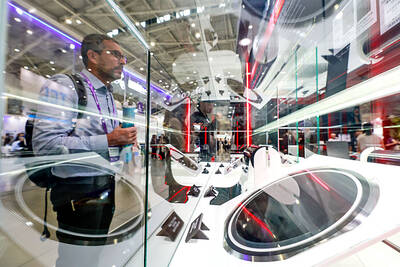
SIZE MATTERS: TSMC started phasing out 8-inch wafer production last year, while Samsung is more aggressively retiring 8-inch capacity, TrendForce said Chipmakers are expected to raise prices of 8-inch wafers by up to 20 percent this year on concern over supply constraints as major contract chipmakers Taiwan Semiconductor Manufacturing Co (TSMC, 台積電) and Samsung Electronics Co gradually retire less advanced wafer capacity, TrendForce Corp (集邦科技) said yesterday. It is the first significant across-the-board price hike since a global semiconductor correction in 2023, the Taipei-based market researcher said in a report. Global 8-inch wafer capacity slid 0.3 percent year-on-year last year, although 8-inch wafer prices still hovered at relatively stable levels throughout the year, TrendForce said. The downward trend is expected to continue this year,
‘BASICALLY A BAN’: Sources said the wording governing H200 imports from officials was severe, but added that the regulations might change if the situation evolves Chinese customs authorities told customs agents this week that Nvidia Corp’s H200 artificial intelligence (AI) chips are not permitted to enter China, three people briefed on the matter said. Chinese government officials also summoned domestic technology companies to meetings on Tuesday, at which they were explicitly instructed not to purchase the chips unless necessary, two of the people and a third source said. “The wording from the officials is so severe that it is basically a ban for now, though this might change in the future should things evolve,” one of the people said. The H200, Nvidia’s second-most powerful AI chip, is one

A proposed billionaires’ tax in California has ignited a political uproar in Silicon Valley, with tech titans threatening to leave the state while California Governor Gavin Newsom of the Democratic Party maneuvers to defeat a levy that he fears would lead to an exodus of wealth. A technology mecca, California has more billionaires than any other US state — a few hundred, by some estimates. About half its personal income tax revenue, a financial backbone in the nearly US$350 billion budget, comes from the top 1 percent of earners. A large healthcare union is attempting to place a proposal before


 RSS
RSS