


The nation’s two refiners yesterday said they would raise gasoline prices by NT$0.8 per liter and diesel prices by NT$0.9 a liter this week, after lowering prices for both by NT$0.2 per liter each the previous week.
The price adjustments came as international crude oil prices rose last week due to political turmoil in Iran, CPC Corp, Taiwan (台灣中油) and Formosa Petrochemical Corp (台塑石化) said in separate statements.
Effective today, gasoline prices at CPC and Formosa stations are to increase to NT$27.2, NT$28.7 and NT$30.7 per liter for 92, 95 and 98-octane unleaded gasoline respectively, the companies said.
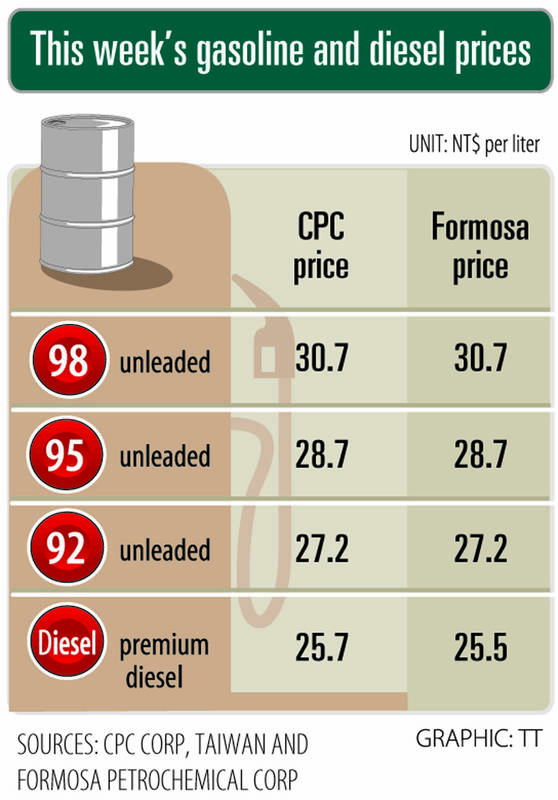
The price of premium diesel is to rise to NT$25.7 per liter at CPC stations and NT$25.5 at Formosa pumps, they said.
While developments in Iran remain the main drivers of prices on the oil market, concerns over imminent US military action against Iran have subsided, the companies said.
Brent crude oil futures — the international oil benchmark — last week rose 1.25 percent to settle at US$64.13 per barrel on the Intercontinental Exchange.
West Texas Intermediate crude oil futures — the US oil benchmark — gained 0.54 percent to US$59.44 per barrel on the New York Mercantile Exchange.

HORMUZ ISSUE: The US president said he expected crude prices to drop at the end of the war, which he called a ‘minor excursion’ that could continue ‘for a little while’ The United Arab Emirates (UAE) and Kuwait started reducing oil production, as the near-closure of the crucial Strait of Hormuz ripples through energy markets and affects global supply. Abu Dhabi National Oil Co (ADNOC) is “managing offshore production levels to address storage requirements,” the company said in a statement, without giving details. Kuwait Petroleum Corp said it was lowering production at its oil fields and refineries after “Iranian threats against safe passage of ships through the Strait of Hormuz.” The war in the Middle East has all but closed Hormuz, the narrow waterway linking the Persian Gulf to the open seas,

Nanya Technology Corp (南亞科技) yesterday said the DRAM supply crunch could extend through 2028, as the artificial intelligence (AI) boom has led the world’s major memory makers to dramatically reduce production of standard DRAM and allocate a significant portion of their capacity for high-bandwidth memory (HBM) chips. The most severe supply constraints would stretch to the first half of next year due to “very limited” increases in new DRAM capacity worldwide, Nanya Technology president Lee Pei-ing (李培瑛) told a news briefing. The company plans to increase monthly 12-inch wafer capacity to 20,000 in the first half of 2028 after a

Taiwan has enough crude oil reserves for more than 100 days and sufficient natural gas reserves for more than 11 days, both above the regulatory safety requirement, Minister of Economic Affairs Kung Ming-hsin (龔明鑫) said yesterday, adding that the government would prioritize domestic price stability as conflicts in the Middle East continue. Overall, energy supply for this month is secure, and the government is continuing efforts to ensure sufficient supply for next month, Kung told reporters after meeting with representatives from business groups at the ministry in Taipei. The ministry has been holding daily cross-ministry meetings at the Executive Yuan to ensure

RATIONING: The proposal would give the Trump administration ample leverage to negotiate investments in the US as it decides how many chips to give each country US officials are debating a new regulatory framework for exporting artificial intelligence (AI) chips and are considering requiring foreign nations to invest in US AI data centers or security guarantees as a condition for granting exports of 200,000 chips or more, according to a document seen by Reuters. The rules are not yet final and could change. They would be the first attempt to regulate the flow of AI chips to US allies and partners since US President Donald Trump’s administration said it rescinded its predecessor’s so-called AI diffusion rules. Those rules sought to keep a significant amount of AI


 RSS
RSS