


Taiwanese business groups yesterday welcomed the outcome of the trade talks with the US, saying the agreement injects much-needed certainty into corporate planning even as risks persist from Washington’s evolving tariff and technology policies.
The Taipei-based Chinese National Association of Industry and Commerce (CNAIC, 工商協進會) said that securing tariff treatment on par with Japan, South Korea and the EU is critical to maintaining Taiwan’s global competitiveness in the high-tech industry.
The group urged policymakers to clearly separate corporate investment decisions from government-backed guarantees.
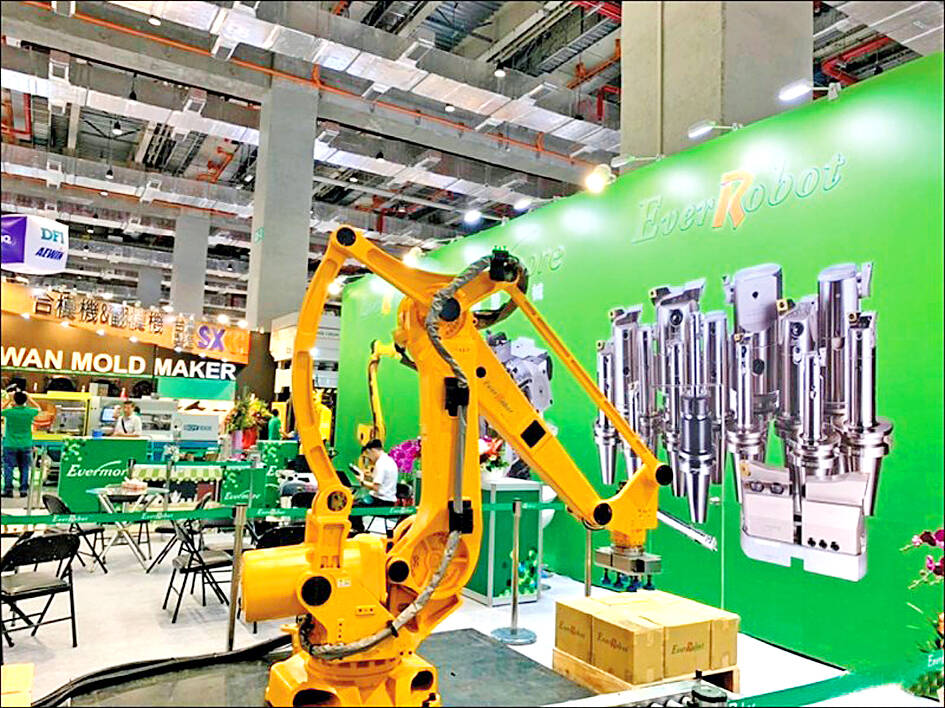
Photo: Lin Chin-hua, Taipei Times
Authorities should enhance incentives under existing “Invest Taiwan” programs, while encouraging overseas cooperation, it said.
“Such steps are needed to ensure that core technologies and research-and-development capabilities remain rooted in Taiwan and to address concerns over industrial hollowing out,” it said.
Regarding a separate US$250 billion in government credit guarantees, CNAIC urged officials to swiftly coordinate with the financial sector to establish transparent, project-based standards for credit support.
That would provide more concrete backing for companies expanding abroad and help mitigate cross-border operational risks, it said.
Beyond tariff arrangements, CNAIC said the business community hoped the government would accelerate complementary measures to support Taiwan-US operations, including a bilateral agreement to avoid double taxation and greater visa flexibility for Taiwanese professional and technical personnel.
Such moves would help reduce tax burdens and administrative costs for firms operating in the US, it said.
Another business group, the Taiwan Association of Machinery Industry (台灣機械公會), agreed, saying the tariff deal would help boost local machinery exports to the US.
The agreement put local machinery manufacturers on an equal footing with their Japanese and South Korean rivals, with a 15 percent tariff rate and no additional stacking tariffs, the association said in a statement.
That was a significant reduction from the 20 percent levy on Taiwanese goods announced by US President Donald Trump’s administration in August last year, higher than the 15 percent imposed on Japan and South Korea.
“The association believes Taiwan’s machinery industry will benefit from the lower tariffs and ship more goods to the US, adding strength to the industry’s recent recovery,” the statement said.
Taiwan’s machinery goods exports expanded 9.1 percent year-on-year last year, it said.
Since Taiwan was also granted the “most favored nation” status with duties on auto parts and timber capped at 15 percent under Section 232 of the US Trade Expansion Act, that would help stimulate purchases of machinery tools and related components from US customers and significantly drive exports, it said.
Machinery tool exports last year dipped to US$2 billion, the weakest since the global financial crisis in 2009, it said.
Consultancy firm PwC Taiwan said that the agreement effectively locks in tariff treatment for Taiwanese exports to the US, giving companies greater certainty when planning operations and investment.
Still, PwC cautioned that expanded semiconductor investment could accelerate supply-chain shifts and it remains unclear whether Washington might tighten export controls on advanced chips and artificial intelligence-related technologies following the deal.
Deloitte & Touche Taiwan warned that while the agreement has eased some of the tariff pressure facing Taiwanese companies, US trade policy remains fluid.
The US has signaled it would continue to assess the effectiveness of the measures and would not rule out expanding the scope of semiconductor tariffs in the future.
Semiconductor companies will need to closely monitor policy developments, the pace of Taiwanese investments in the US and the buildout of US semiconductor clusters, Deloitte said.
More broadly, uncertainty is growing over whether the trade agreement could trigger further upstream and downstream integration or prompt shifts in supply-chain locations, potentially reshaping Taiwan’s deeply entrenched semiconductor ecosystem, it said.
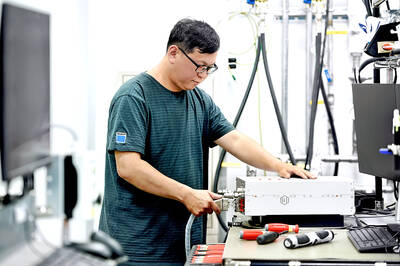
SEMICONDUCTORS: The German laser and plasma generator company will expand its local services as its specialized offerings support Taiwan’s semiconductor industries Trumpf SE + Co KG, a global leader in supplying laser technology and plasma generators used in chip production, is expanding its investments in Taiwan in an effort to deeply integrate into the global semiconductor supply chain in the pursuit of growth. The company, headquartered in Ditzingen, Germany, has invested significantly in a newly inaugurated regional technical center for plasma generators in Taoyuan, its latest expansion in Taiwan after being engaged in various industries for more than 25 years. The center, the first of its kind Trumpf built outside Germany, aims to serve customers from Taiwan, Japan, Southeast Asia and South Korea,

Gasoline and diesel prices at domestic fuel stations are to fall NT$0.2 per liter this week, down for a second consecutive week, CPC Corp, Taiwan (台灣中油) and Formosa Petrochemical Corp (台塑石化) announced yesterday. Effective today, gasoline prices at CPC and Formosa stations are to drop to NT$26.4, NT$27.9 and NT$29.9 per liter for 92, 95 and 98-octane unleaded gasoline respectively, the companies said in separate statements. The price of premium diesel is to fall to NT$24.8 per liter at CPC stations and NT$24.6 at Formosa pumps, they said. The price adjustments came even as international crude oil prices rose last week, as traders
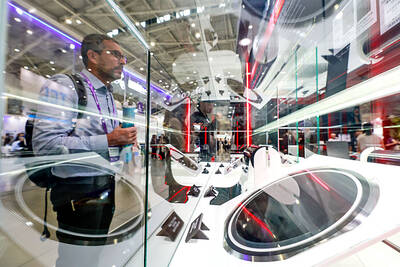
SIZE MATTERS: TSMC started phasing out 8-inch wafer production last year, while Samsung is more aggressively retiring 8-inch capacity, TrendForce said Chipmakers are expected to raise prices of 8-inch wafers by up to 20 percent this year on concern over supply constraints as major contract chipmakers Taiwan Semiconductor Manufacturing Co (TSMC, 台積電) and Samsung Electronics Co gradually retire less advanced wafer capacity, TrendForce Corp (集邦科技) said yesterday. It is the first significant across-the-board price hike since a global semiconductor correction in 2023, the Taipei-based market researcher said in a report. Global 8-inch wafer capacity slid 0.3 percent year-on-year last year, although 8-inch wafer prices still hovered at relatively stable levels throughout the year, TrendForce said. The downward trend is expected to continue this year,
POWERING UP: PSUs for AI servers made up about 50% of Delta’s total server PSU revenue during the first three quarters of last year, the company said Power supply and electronic components maker Delta Electronics Inc (台達電) reported record-high revenue of NT$161.61 billion (US$5.11 billion) for last quarter and said it remains positive about this quarter. Last quarter’s figure was up 7.6 percent from the previous quarter and 41.51 percent higher than a year earlier, and largely in line with Yuanta Securities Investment Consulting Co’s (元大投顧) forecast of NT$160 billion. Delta’s annual revenue last year rose 31.76 percent year-on-year to NT$554.89 billion, also a record high for the company. Its strong performance reflected continued demand for high-performance power solutions and advanced liquid-cooling products used in artificial intelligence (AI) data centers,


 RSS
RSS