


Local manufacturers, particularly traditional industries and small and medium-sized enterprises, should benefit from the lower US tariffs, as Taiwan gains an equal footing with competitors in Japan and South Korea, Minister of Economic Affairs Kung Ming-hsin (龔明鑫) told reporters yesterday.
After concluding the trade negotiations with Taiwan on Thursday, Washington agreed to lower tariffs on Taiwanese goods to 15 percent from the 20 percent that US President Donald Trump’s administration announced in August last year, without stacking them on existing duties, the Executive Yuan said.
As Taiwan does not have a free-trade agreement with the US, its tariff structure has long been at a disadvantage, while Japan and South Korea have largely enjoyed zero-tariff treatment, Kung said.
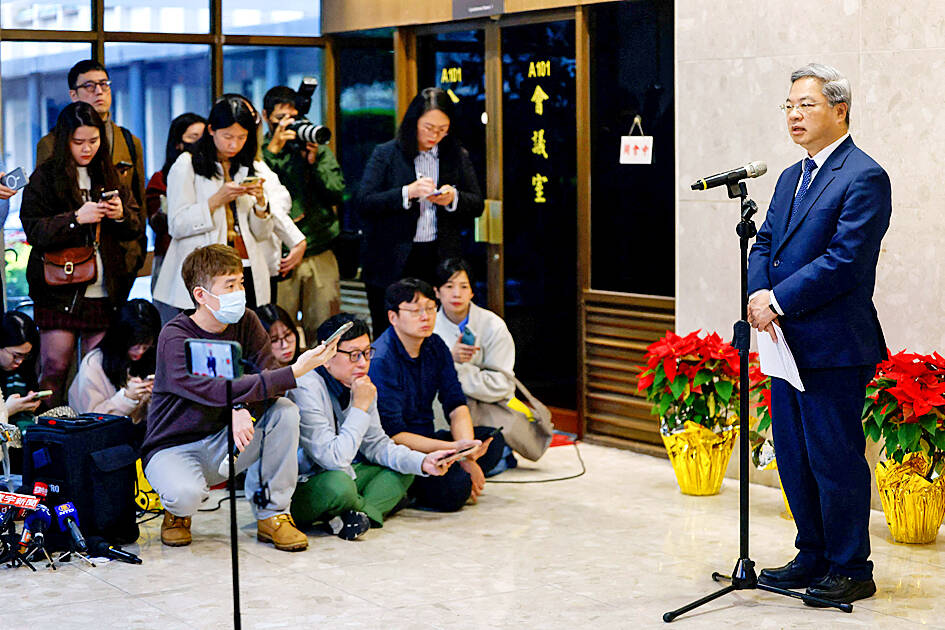
Photo: Ann Wang, Reuters
The deal places Taiwan on par with Japan and South Korea, as all three are now subject to a 15 percent tariff, he said.
For example, the machine tool industry used to face a duty of up to 4 percent on top of the 20 percent imposed in August, he said.
The outcome also helped stabilize industry expectations regarding the results of the US’ Section 232 investigation, Kung said.
Information and communications technology (ICT) manufacturers were afraid that they could face high tariffs after being included in the Section 232 investigation, but the new deal would allow most ICT products to continue to enjoy tariff exemptions, he said.
ICT products accounted for more than 80 percent of Taiwan’s total exports to the US in 2024, a share that is likely to rise further, he said.
Overall, Taiwan would enjoy a relatively stable tariff framework and will not only compete on equal footing with peers in other countries, but also gain more advantageous conditions for some product categories, Kung said.
Based on the agreement, Taiwan is to invest up to US$250 billion in the US, mostly in semiconductors, he said.
However, the ministry is not worried that this would lead to offshoring of the semiconductor industry, he added.
About 85 percent of advanced chips deploying 5-nanometer or more sophisticated process technologies would still be produced in Taiwan by 2030, and only 15 percent would be made in the US, he said.
By 2036, the split between Taiwan and the US is projected to shift to 80 percent and 20 percent, he said.
This means Taiwan would remain the world’s most important production base for artificial intelligence (AI) chips, while the US would serve as the primary market for AI applications and data centers, the minister said.
Taiwan is also to provide credit guarantees of up to US$250 billion to support companies investing in the US.
Meanwhile, US companies are also expected to expand investment in Taiwan, targeting defense, drones, smart robots, quantum technology and biotechnology, in addition to chips and AI, Kung said.
The investments would not only help complete Taiwan’s semiconductor and AI ecosystem, but also address gaps in areas such as memory, materials and equipment, where the US has comparative strengths, he said.
Both sides aim to build a more complete and resilient supply chain system to achieve a win-win outcome over the long term, he added.
On whether the government would adjust the NT$46 billion in special budget originally earmarked for traditional industries, he said that industrial financial support is not limited to short-term relief.
The government will continue to engage with industry associations and business groups to ensure that companies can accelerate upgrading efforts under the new trade framework, he said.

HORMUZ ISSUE: The US president said he expected crude prices to drop at the end of the war, which he called a ‘minor excursion’ that could continue ‘for a little while’ The United Arab Emirates (UAE) and Kuwait started reducing oil production, as the near-closure of the crucial Strait of Hormuz ripples through energy markets and affects global supply. Abu Dhabi National Oil Co (ADNOC) is “managing offshore production levels to address storage requirements,” the company said in a statement, without giving details. Kuwait Petroleum Corp said it was lowering production at its oil fields and refineries after “Iranian threats against safe passage of ships through the Strait of Hormuz.” The war in the Middle East has all but closed Hormuz, the narrow waterway linking the Persian Gulf to the open seas,

RATIONING: The proposal would give the Trump administration ample leverage to negotiate investments in the US as it decides how many chips to give each country US officials are debating a new regulatory framework for exporting artificial intelligence (AI) chips and are considering requiring foreign nations to invest in US AI data centers or security guarantees as a condition for granting exports of 200,000 chips or more, according to a document seen by Reuters. The rules are not yet final and could change. They would be the first attempt to regulate the flow of AI chips to US allies and partners since US President Donald Trump’s administration said it rescinded its predecessor’s so-called AI diffusion rules. Those rules sought to keep a significant amount of AI

Apple Inc increased iPhone production in India by about 53 percent last year and now makes a quarter of its marquee devices there, reflecting the US company’s efforts to avoid tariffs on China. The company assembled about 55 million iPhones in India last year, up from 36 million a year earlier, people familiar with the matter said, asking not to be named because the numbers aren’t public. Apple makes about 220 million to 230 million iPhones a year globally, with India’s share of the total increasing rapidly. Apple has accelerated its expansion in the world’s most populous country in recent years, bolstered

A new worry has been rippling across the stock market lately: Entire businesses, not just their employees, might be thrown out of work. While most economists say fears of an artificial intelligence (AI) job apocalypse are overblown, seismic shifts have happened in the past after big tech breakthroughs. The IT revolution of the 1990s led to a surge in productivity that sped up the US economy for several years. It also rendered companies or even industries largely redundant — from travel agents and stockbrokers to classified advertising and newspapers, or video rental stores. Economists expect AI would deliver higher productivity,


 RSS
RSS