


Speculation surrounding Taiwan Semiconductor Manufacturing Co.’s (TSMC, 台積電) potential expansion in the US should not be overinterpreted, as structural and economic constraints mean such moves are unlikely to weaken Taiwan’s central role in advanced chipmaking in the near future, experts said.
A recent report by The New York Times said Washington and Taipei had nearly finalized trade talks under which TSMC would be asked to add five more chip facilities in Arizona, nearly doubling its previously stated investment there.
Although TSMC did not confirm or deny the report at its earnings conference yesterday, it has fueled concerns in Taiwan about the island’s diminishing strategic importance amid rising geopolitical tensions.
Photo: CNA
However, analysts told CNA such concerns overlook timelines and fundamental industry realities.
Tech commentator Owen Lin (林宏文) said TSMC’s US investments have always been long-term in nature. Even the previously announced US$165 billion commitment in Arizona was understood as a roughly 10-year plan, as many TSMC sources had told him, given constraints such as infrastructure readiness, regulations and workforce availability.
“In semiconductors, fabs are not built simply by political declarations,” Lin said, adding that yield performance, talent availability and learning curves ultimately determine success.
Early reports of lower margins at TSMC’s US fabs, he noted, largely reflect initial ramp-up challenges rather than long-term profitability trends, making it misleading to draw conclusions from short-term data.
Lin also pointed out that the foreign media report did not specify a timeline for the additional facilities, saying the scale of TSMC’s US investment would matter more than headline numbers.
Once investment reaches a certain scale, he said, it could attract suppliers to follow, helping form a local semiconductor cluster. “No supplier is going to come to the US if there are only two fabs,” Lin said.
Meanwhile, Research Institute for Democracy, Society and Emerging Technology chief executive officer Jeremy Chang Chih-cheng (張智程) cited recent industry analyses indicating that manufacturing costs in the US can be more than double those in Taiwan due to the absence of a mature semiconductor cluster, saying advanced manufacturing there currently lacks economic rationality.
“At this stage, US manufacturing is driven mainly by security and political considerations,” Chang said, adding that overseas capacity is unlikely to replace Taiwan’s core role unless it becomes economically competitive — a threshold he said that has not been reached.
According to Chang, the key variable is whether the US can eventually develop a self-sustaining ecosystem comparable to Taiwan’s science park model, encompassing suppliers, skilled engineers, and research and development capabilities.
“TSMC is still primarily focused on meeting customer demand, and its decision to add capacity in the US should be seen as an outcome of that overarching priority,” Chang said.
TSMC yesterday projected its capital expenditure at between US$52 billion and US$56 billion this year, up 27-37 percent from US$40.9 billion last year.
About 60-80 percent of the spending will go toward advanced process development, TSMC chief financial officer Wendell Huang (黃仁昭) said.
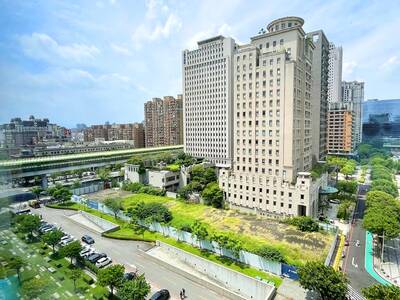
Taichung reported the steepest fall in completed home prices among the six special municipalities in the first quarter of this year, data compiled by Taiwan Realty Co (台灣房屋) showed yesterday. From January through last month, the average transaction price for completed homes in Taichung fell 8 percent from a year earlier to NT$299,000 (US$9,483) per ping (3.3m²), said Taiwan Realty, which compiled the data based on the government’s price registration platform. The decline could be attributed to many home buyers choosing relatively affordable used homes to live in themselves, instead of newly built homes in the city’s prime property market, Taiwan Realty
The government yesterday approved applications by Alphabet Inc’s Google to invest NT$27.08 billion (US$859.98 million) in Taiwan, the Ministry of Economic Affairs said in a statement. The Department of Investment Review approved two investments proposed by Google, with much of the funds to be used for data processing and electronic information supply services, as well as inventory procurement businesses in the semiconductor field, the ministry said. It marks the second consecutive year that Google has applied to increase its investment in Taiwan. Google plans to infuse NT$25.34 billion into Charter Investments Ltd (特許投資顧問) through its Singapore-based subsidiary Fructan Holdings Singapore Pte Ltd, and

JET JUICE: The war on Iran’s secondary effects have seen fuel prices skyrocket, knocking flight schedules down to earth in return as airlines struggle with costs Airline passengers should brace for more irritation in the next few months as carriers worldwide cancel flights and ground planes to cope with stratospheric increases in jet-fuel prices. Dutch flag carrier KLM is the latest company to cut its schedule, saying on Thursday that it would scrap 80 return flights at Amsterdam’s Schiphol Airport in the coming month. That puts it in the same league as United Airlines Holdings Inc, Deutsche Lufthansa AG and Cathay Pacific Airways Ltd, which have all pruned itineraries to mitigate costs. Global capacity for next month has been reduced by about 3 percentage points, with all
Micron Technology Inc is a driving force pushing the US Congress to pass legislation that would put new export restrictions on equipment its Chinese competitors use to make their chips, according to people familiar with the matter. A US House of Representatives panel yesterday was to vote on the “MATCH Act,” a bill designed to close gaps in restrictions on chipmaking equipment. It would also pressure foreign companies that sell equipment to Chinese chipmaking facilities to align with export curbs on US companies like Lam Research Corp and Applied Materials Inc. The bill targets facilities operated by China’s ChangXin Memory Technologies Inc


 RSS
RSS