


Taiwan and Phoenix, Arizona, yesterday signed a memorandum of understanding (MOU) aimed at expanding cooperation on start-up innovation in semiconductors and artificial intelligence (AI) applications.
Speaking at the signing ceremony in Taipei, Phoenix Mayor Kate Gallego highlighted her background in business administration, saying it ensures that she is able to support the growth of Taiwanese start-ups in her city.
“We’ll help you grow your business,” she said.
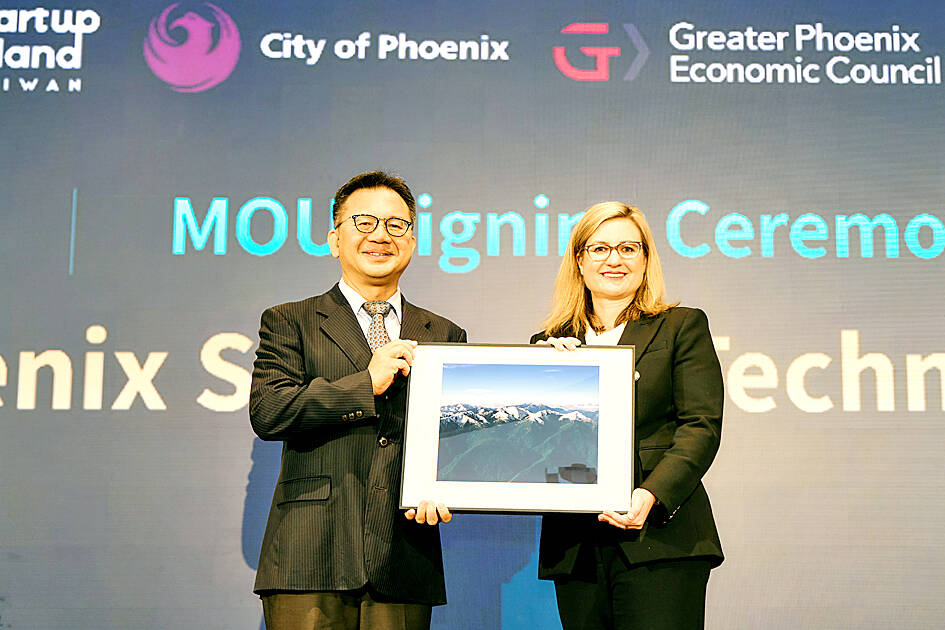
Photo courtesy of the National Development Council
“You’ll also, thanks to Taiwan Semiconductor Manufacturing Co (TSMC, 台積電) Arizona, have access to great Taiwanese food, Taiwanese banks, doctors who speak Mandarin,” she said. “It can be all the comforts of home, but access to the markets of the United States.”
Gallego cited JelloX Biotech Inc (捷絡生技), a Taiwanese start-up specializing in 3D digital pathology imaging and AI analysis platforms, as an example of successful operations in Phoenix.
Its technologies can be applied in a range of settings, including improving the efficiency of colon cancer detection, she said.
JelloX has begun operations at the Mayo Clinic Hospital in Phoenix, which offers a well-developed accelerator program, she added.
The agreement, titled the “Taiwan-Phoenix Strategic Technology Partnership,” was signed by Startup Island Taiwan, the Industrial Technology Research Institute, Phoenix, the Greater Phoenix Economic Council and Tesoro VC.
The MOU aims to help US start-ups connect with Taiwan’s semiconductor research and development (R&D) and manufacturing ecosystem, while supporting Taiwanese start-ups in using Phoenix as a foothold and launchpad to enter the US market, Startup Island Taiwan said.
It also seeks to encourage start-ups from both sides to participate in accelerators, incubators and soft-landing programs.
Startup Island Taiwan is a partnership between the government and a group of start-ups aimed at helping Taiwanese start-ups boost their international presence.
The initiative is to focus on AI, semiconductors and advanced packaging, physical AI intelligent systems, advanced manufacturing, photonics, dual-use technologies, and AI-enabled healthcare applications, Startup Island Taiwan said.
The new MOU builds on an earlier agreement signed in 2023 between Startup Island Taiwan and the Greater Phoenix Economic Council, which focused on facilitating information exchanges on industry and investment projects, organizing joint business missions, promoting soft-landing opportunities for Taiwanese start-ups and advancing joint initiatives.
Targeted fields under that agreement included cybersecurity, green energy technology, 5G, information and communications technology, and semiconductors.
National Development Council Deputy Minister Jan Fang-guan (詹方冠) said the successful expansion of several Taiwanese start-ups in Phoenix since 2024 demonstrates that “combining Taiwan’s R&D power with Phoenix’s market and clinical environment is a win-win strategy.”
Phoenix is home to two TSMC wafer fabs, with four more planned under a US$165 billion investment package — the largest single foreign direct investment in US history.
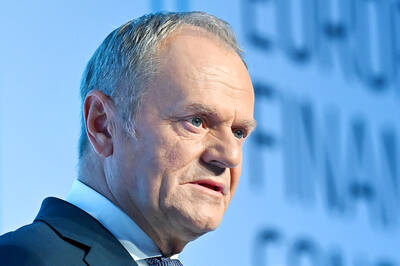
Poland is betting on a flood of investments and technology transfers from Taiwanese companies to reengineer its US$1 trillion economy. Polish Prime Minister Donald Tusk said yesterday that Poland will no longer be “just an assembly hub” as it pursues further investments from the likes of Foxconn Technology Group (富士康). The firm, whose full name is Hon Hai Precision Industry Co (鴻海精密), last month agreed to build electric vehicles (EVs) in the European Union nation and now could be a partner in a semiconductor venture, he said. The government’s aim is to boost manufacturing and the country’s high-tech chops in an era
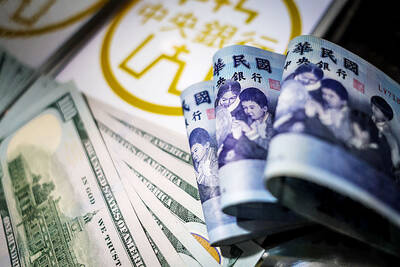
Taiwan remained the sixth-largest net creditor nation in the world last year, despite a fall of more than 10 percent in its net international investment position (NIIP) over the year, the central bank said yesterday. The NIIP is the difference between a country’s external financial assets and its external financial liabilities. Taiwan’s external financial assets hit US$3.27 trillion at the end of last year, up US$275.75 billion or 9.2 percent from a year earlier, the central bank said in its annual NIIP report. The growth largely reflected an increase in holdings of overseas marketable securities by residents in Taiwan, as well as a
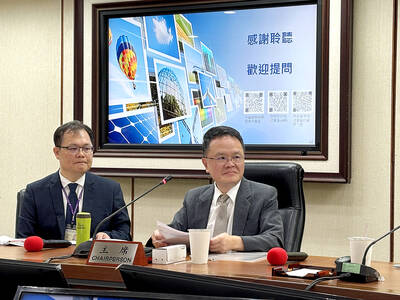
BAD FAITH LITIGATION? The two companies, owned by a California-based private equity firm, could be seeking licensing fees or a settlement payout with the suit Taiwan Intellectual Property Office (TIPO) Director-General Liao Cheng-wei (廖承威) said yesterday he suspected that two firms suing contract chipmaker Taiwan Semiconductor Manufacturing Co (TSMC, 台積電) for patent infringement are “patent trolls.” A patent troll refers to a company that buys patents not for manufacturing products, but to sue other companies for compensation, accusing them of using its patents. Patent trolls, formally called Non-Practicing Entities or Patent Assertion Entities, were responsible for more than 50 percent of lawsuits in the US last year, costing targeted businesses tens of billions of US dollars a year, according to the US-based LegalCharity Web site. Asked whether

RESTRICTION BREACH: ASML said that it denies ‘unfounded rumors regarding non-compliance with export controls concerning China,’ and enforces controls strictly US Secretary of Commerce Howard Lutnick in a series of recent meetings outlined concerns to Dutch chip-equipment giant ASML Holding NV’s senior leaders that one of its top-of-the-line machines might have made its way into China, in violation of US-led export restrictions. In the meetings, Lutnick expressed concern to ASML executives over the company’s extreme ultraviolet lithography (EUV) machines, people familiar with the talks said. EUV systems are used by firms such as Taiwan Semiconductor Manufacturing Co (台積電) to manufacture processors for the likes of Nvidia Corp and Apple Inc. ASML has never been allowed to ship them to China because of curbs


 RSS
RSS