


The US has imposed a 25 percent tariff on imports of certain advanced semiconductors, a key step in an agreement blessed by US President Donald Trump allowing Nvidia Corp to ship Taiwan-made H200 artificial intelligence (AI) processors to China.
Under an order Trump signed on Wednesday, the US government would collect the duty on the chips as they are shipped to the US before final shipment to Chinese customers and other foreign markets.
Nvidia relies on Taiwan Semiconductor Manufacturing Co (TSMC, 台積電) to produce the chips it designs, including the H200 that was cleared for sale to China by Trump last month.
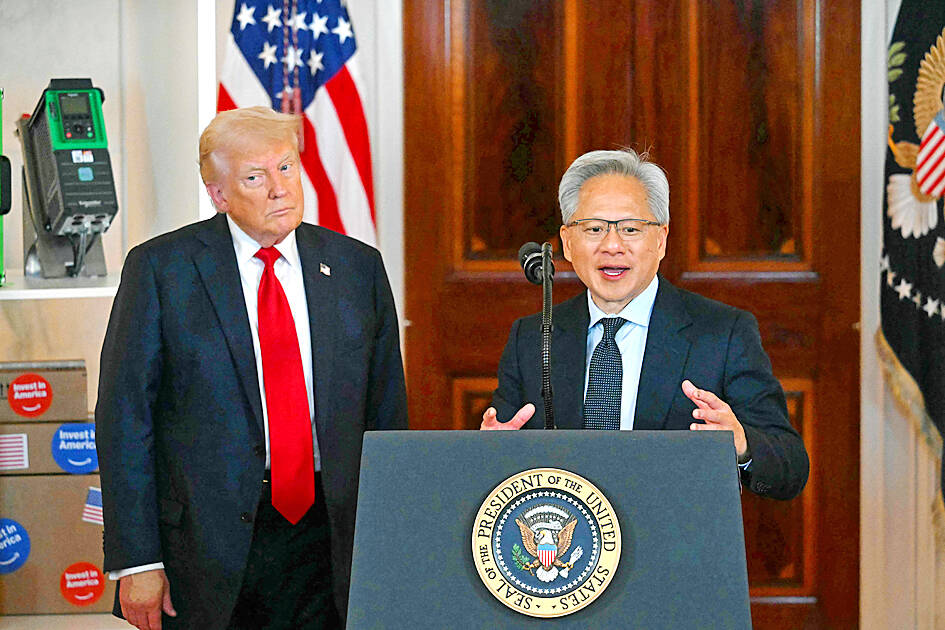
Photo: AFP
“It’s not the highest level, but it’s a very good level, and China wants them, and other people want them, and we’re going to be making 25 percent of the sale of those chips, basically,” Trump told reporters on Wednesday at a signing ceremony.
The US president is holding off for now on applying tariffs to a broader swath of foreign-made chips, following an investigation under Section 232 of the Trade Expansion Act that found they harm US national security.
Instead, Trump directed US Secretary of Commerce Howard Lutnick and US Trade Representative Jamieson Greer to “pursue negotiation of agreements” on imports and to report back in 90 days, according to the proclamation he signed.
Trump might announce new tariffs and an accompanying offset program to incentivize domestic manufacturing “in the near future,” a White House fact sheet said.
The 25 percent tariff applies to “a very narrow category of semiconductors that are an important element of my administration’s AI and technology policies,” the proclamation said.
That includes the H200 and Advanced Micro Devices Inc’s MI325X, according to the fact sheet.
There is an exception for those chips that are imported to support the build-out of the US technology supply chain, it said.
Trump signed the measure a day after the US Bureau of Industry and Security eased its criteria for securing licenses to export H200 chips to China.
That surcharge is a condition Trump required in exchange for allowing Nvidia to sell in China. The US must still take additional actions before Nvidia can send the chips to China, including the approval of export licenses by the bureau. That process can take weeks or months and it is unclear when it would conclude.
Taiwanese products have generally faced a 20 percent tariff upon entering the US, although semiconductors have been spared as US Department of Commerce officials conduct a national security investigation into whether new levies should be applied across the chip sector. Trump has yet to follow on imposing tariffs, as negotiations with Taiwan and major technology companies continue.
Top Taiwanese officials on Wednesday traveled to Washington for talks on finalizing a deal to lower its overall tariff rate to 15 percent and expand TSMC production facilities in the US, people familiar with the matter said.

Cairo’s new monorail slices across the city skyline, running above the familiar chaos of blaring horns and aging buses’ exhaust fumes that mark rush hour below. The US$4.5 billion monorail, opened this month, is among Egypt’s most prominent new transport projects, part of a debt-funded infrastructure drive criticized for sapping state finances while bringing limited benefits to most of the country’s 109 million people. “It feels like you’re in a different country,” said Ramy Sayed, a restaurant manager, aboard a driverless Innovia 300 train. “No noise, no traffic, we’re not used to this.” The eastern line runs 56km from the bustling middle-class

Taiwanese firms have increased investment in the Philippines in recent years as Manila’s ties with Washington deepen and global supply chains continue to shift away from China, an expert at the Chung-Hua Institution for Economic Research (CIER, 中華經濟研究院) said yesterday. The Philippines had not been among Taiwanese investors’ top choices in Southeast Asia, CIER Taiwan ASEAN Studies Center director Kristy Hsu (徐遵慈) said at a seminar in Taipei. However, Taiwan’s investment in the country has grown significantly since the COVID-19 pandemic, reaching US $257 million last year, a high in recent years, she said. Although Taiwan’s total investment in the Philippines still lags

Intel Corp regards Taiwan Semiconductor Manufacturing Co (TSMC, 台積電) as a longstanding partner, as the US chipmaker would continue outsourcing production of advanced chips to TSMC, Intel chief executive officer Lip-Bu Tan (陳立武) said yesterday. “I don’t look at people as competitors. I look at the collaboration... Nvidia is also, you know, a good friend,” Tan told a news conference following his keynote speech at the Computex trade show in Taipei. “It’s a very trusted partnership for us... We are a big, top customer for them, and we’re going to continue doing that,” he said, referring to TSMC, the world’s largest foundry
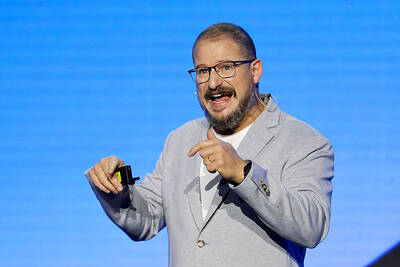
Artificial intelligence (AI) agents would supplant smartphones as the center of people’s digital lives, fundamentally reshaping personal devices and driving a major computing upgrade cycle, Qualcomm Inc CEO Cristiano Amon said yesterday. In his keynote speech for this year’s Computex trade show in Taipei, Amon said that the rise of "agentic AI" — AI systems capable of reasoning, planning and carrying out tasks autonomously — would transform how people interact with technology across phones, PCs, vehicles and wearable devices. Describing the technology as the next major evolution in computing, Amon said that "2026 is the year of agents.” For decades, smartphones have sat


 RSS
RSS