


Credit card spending in November last year rose 2.91 percent year-on-year to NT$396.7 billion (US$12.56 billion), with cumulative spending in the first 11 months of last year up 6.26 percent to NT$4.533 trillion, a record high for the period, Financial Supervisory Commission data showed yesterday.
However, spending in November was NT$56.7 billion less than the previous month’s NT$453.4 billion, as October spending was buoyed by department store anniversary sales and increased travel, shopping and dining opportunities during the Mid-Autumn Festival, Double Ten National Day and Retrocession Day holidays, the commission said.
With several card issuers promoting co-branded cards and the number of merchants accepting cards for sales continuing to increase, full-year credit card spending for last year could reach a new high, it said.

Photo courtesy of CTBC Bank Co
Taiwan’s credit card spending was NT$4.686 trillion in 2024, a new record, FSC data showed.
As of the end of November last year, Taiwan had 60.42 million credit cards in circulation issued by 32 financial institutions, the commission said in a statement.
The number of merchants accepting cards for transactions increased by 3,771 stores from a year earlier to 196,000 stores, it said.
The balance of revolving credit was NT$117.78 billion and the undue balance of installment was NT$198.84 billion, the commission said.
The nonperforming ratio of credit card debt remained unchanged at 0.25 percent on average, it added.
CTBC Bank Co (中國信託銀行) led all banks in terms of credit card spending at NT$72.45 billion, followed by Cathay United Bank Co (國泰世華銀行) at NT$69.31 billion, commission data showed.
Taipei Fubon Commercial Bank Co (台北富邦銀行) ranked third with spending of NT$51.15 billion, ahead of E.Sun Commercial Bank Ltd (玉山銀行) at NT$48.43 billion and Taishin International Bank Co (台新銀行) at NT$43.36 billion, data showed.
CTBC was the biggest issuer of new credit cards among local banks in November last year as it continued to promote a new co-branded credit card with food conglomerate Uni-President Enterprises Corp (統一企業). The bank issued 132,555 cards in the month, or 27.32 percent of the 485,113 cards issued in Taiwan, data showed.
Cathay United came in second in new card issuance at 59,075 cards, followed by E.Sun at 52,421, Taishin at 43,518 and Taiwan Rakuten Card Inc (台灣樂天) at 41,717, data showed.
Meanwhile, Taipei Fubon led its peers in canceling cards that had not been used for more than a year, with 158,575 cards canceled in November last year, followed by CTBC at 91,773 and E.Sun at 78,685, the commission said.
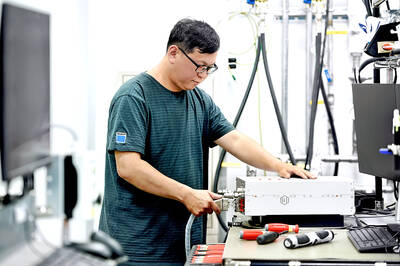
SEMICONDUCTORS: The German laser and plasma generator company will expand its local services as its specialized offerings support Taiwan’s semiconductor industries Trumpf SE + Co KG, a global leader in supplying laser technology and plasma generators used in chip production, is expanding its investments in Taiwan in an effort to deeply integrate into the global semiconductor supply chain in the pursuit of growth. The company, headquartered in Ditzingen, Germany, has invested significantly in a newly inaugurated regional technical center for plasma generators in Taoyuan, its latest expansion in Taiwan after being engaged in various industries for more than 25 years. The center, the first of its kind Trumpf built outside Germany, aims to serve customers from Taiwan, Japan, Southeast Asia and South Korea,

Gasoline and diesel prices at domestic fuel stations are to fall NT$0.2 per liter this week, down for a second consecutive week, CPC Corp, Taiwan (台灣中油) and Formosa Petrochemical Corp (台塑石化) announced yesterday. Effective today, gasoline prices at CPC and Formosa stations are to drop to NT$26.4, NT$27.9 and NT$29.9 per liter for 92, 95 and 98-octane unleaded gasoline respectively, the companies said in separate statements. The price of premium diesel is to fall to NT$24.8 per liter at CPC stations and NT$24.6 at Formosa pumps, they said. The price adjustments came even as international crude oil prices rose last week, as traders

SIZE MATTERS: TSMC started phasing out 8-inch wafer production last year, while Samsung is more aggressively retiring 8-inch capacity, TrendForce said Chipmakers are expected to raise prices of 8-inch wafers by up to 20 percent this year on concern over supply constraints as major contract chipmakers Taiwan Semiconductor Manufacturing Co (TSMC, 台積電) and Samsung Electronics Co gradually retire less advanced wafer capacity, TrendForce Corp (集邦科技) said yesterday. It is the first significant across-the-board price hike since a global semiconductor correction in 2023, the Taipei-based market researcher said in a report. Global 8-inch wafer capacity slid 0.3 percent year-on-year last year, although 8-inch wafer prices still hovered at relatively stable levels throughout the year, TrendForce said. The downward trend is expected to continue this year,
Taiwan Semiconductor Manufacturing Co (TSMC, 台積電), which supplies advanced chips to Nvidia Corp and Apple Inc, yesterday reported NT$1.046 trillion (US$33.1 billion) in revenue for last quarter, driven by constantly strong demand for artificial intelligence (AI) chips, falling in the upper end of its forecast. Based on TSMC’s financial guidance, revenue would expand about 22 percent sequentially to the range from US$32.2 billion to US$33.4 billion during the final quarter of 2024, it told investors in October last year. Last year in total, revenue jumped 31.61 percent to NT$3.81 trillion, compared with NT$2.89 trillion generated in the year before, according to


 RSS
RSS