


Institutional Shareholder Services (ISS), the world’s leading proxy advisory firm, on Thursday last week released a report recommending that all E.Sun Financial Holding Co (E.Sun FHC, 玉山金控) shareholders vote for the proposed acquisition of Mercuries Life Insurance Co (三商美邦人壽) at the extraordinary general meeting scheduled for Friday next week.
ISS is a globally recognized neutral research institution that institutional investors consult when voting on resolutions at shareholder meetings. Its research methodology and voting guidelines are highly regarded internationally; consequently, an ISS recommendation carries significant weight in shaping the voting decisions of institutional shareholders.
In its in-depth analysis of the transaction data and regulatory compliance, ISS said that the acquisition demonstrates exceptional professionalism across several international mergers and acquisitions benchmarks.
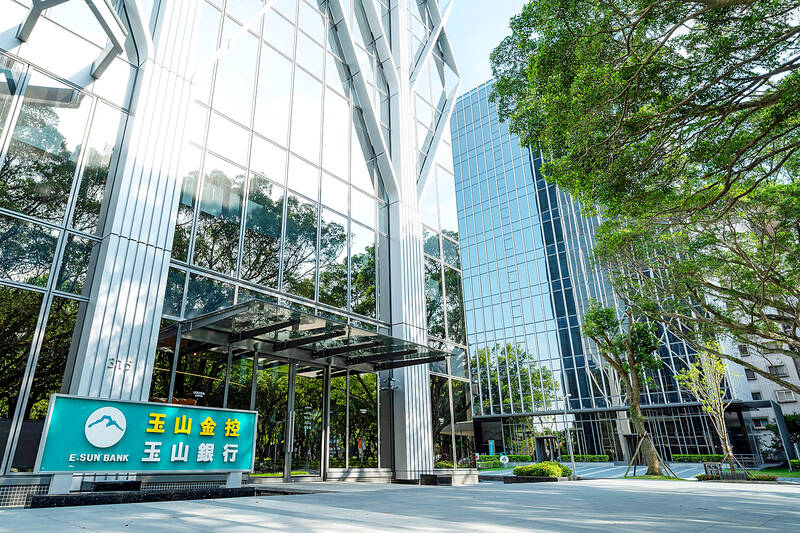
Photo courtesy of E.Sun Financial Holding Co
ISS said that the transaction possesses deep strategic rationale, and is expected to effectively integrate the resources of both parties, expanding E.Sun FHC’s footprint and profit potential across diversified financial sectors, including banking and insurance.
The report also highlights that the exchange ratio — 0.2486 shares of E.Sun FHC common stock for every share of Mercuries Life Insurance common stock — was appraised by independent third-party institutions and falls within the recommended range, representing a fair and reasonable price.
For shareholders who dissent from the acquisition, the proposal provides a statutory right of dissent (share buyback request). That provides an exit mechanism that safeguards shareholder choice and investment interests.
Foreign institutional investors hold approximately 30 percent of E.Sun FHC, including major global entities such as Vanguard Group Inc, BlackRock Inc, Norges Bank and GIC. The ISS report is viewed as a key indicator for global funds and is expected to build strong consensus among foreign shareholders.
Since the formal announcement of the acquisition on Nov. 5 last year, the market has responded favorably. As of Tuesday last week, the share prices of E.Sun FHC and Mercuries Life Insurance have risen by 11.2 percent and 11.6 percent respectively, outperforming the TAIEX’s gain of 8.7 percent over the same period.
E.Sun FHC’s management team emphasized that combining the company’s stable operational foundation with Mercuries Life Insurance’s business advantages would create a financial holding company with greater resilience and economies of scale.
E.Sun FHC said it invites all shareholders to participate in the upcoming extraordinary general meeting.
Chairman Joseph Huang (黃男州) and the management team traveled to London, Hong Kong and Singapore to meet with major foreign investors and secure their support.
“With the completion of the asset management and life insurance portfolio, E.Sun FHC will officially enter the ‘FHC 2.0’ era,” Huang said. “This is not just an expansion of E.Sun’s footprint, but a transformation of our management philosophy. With the enhancement of our scale, capital and profitability, E.Sun — which is ‘Taiwan’s E.Sun’ today — will become ‘the World’s E.Sun’ tomorrow.”
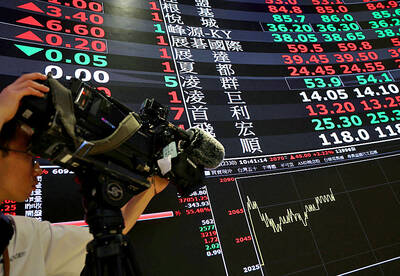
After several years flying high as Asia’s best Nvidia Corp proxy, Taiwan Semiconductor Manufacturing Co (TSMC, 台積電) is increasingly vying with other artificial intelligence (AI) stocks for investor attention. Stock traders are chasing a wider array of beneficiaries as mainstream usage of AI creates demand for hardware beyond the most-advanced chips TSMC makes for Nvidia. Subthemes from the deepening memory crunch to advances in robotics are also luring bids. At the same time, investment caps on single stocks are pushing funds to diversify, while retail investors long familiar with TSMC through its US depositary receipts are being offered a broader set of
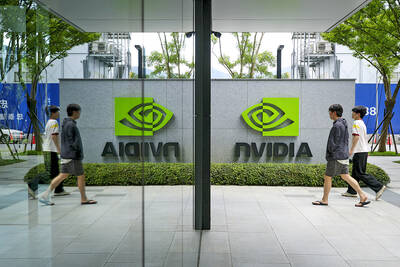
UNDER MICROSCOPE: Taiwan detained three people who allegedly conspired to buy servers in Taiwan and export them using fraudulent documentation, prosecutors said Nvidia Corp chief executive officer Jensen Huang (黃仁勳) on Saturday urged Super Micro Computer Inc to tighten up on compliance after Taiwan detained three people this week for allegedly making fraudulent declarations about artificial intelligence (AI) servers made by its US partner. The development marked the nation’s first crackdown on semiconductor smuggling, which grew after the US slapped restrictions on exports of high-end chips such as Nvidia AI accelerators to China. Nvidia is “rigorous” in explaining regulations to all of its partners, Huang told reporters after arriving in Taipei. “Ultimately Super Micro has to run their own company,” he said in response to
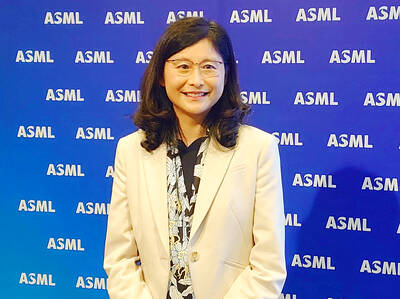
Netherlands-based semiconductor equipment supplier ASML Holding NV yesterday said that it is planning to hire an additional 1,000 people in Taiwan this year in response to growing demand from clients. ASML had previously planned to recruit 600 people this year, but that the plan has been adjusted upward, ASML vice president and ASML Taiwan general manager Grace Wang (汪佳慧) told reporters. ASML has a workforce of more than 4,500 in Taiwan, accounting for about 10 percent of its global total, Wang said. This year’s recruitment campaign would focus on adding people in the customer support, manufacturing and supply chain domains to assist ASML
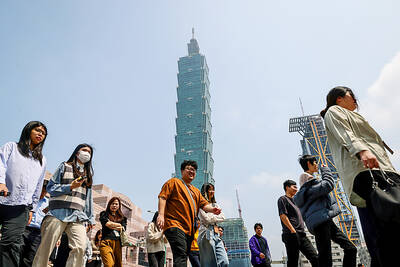
TECH RELIANCE: Growth is increasingly reflecting an unequal K-shaped distribution, where technology sectors outperform and other industries struggle, an expert said Standard Chartered Bank has significantly raised its forecast for Taiwan’s economic growth to 9.5 percent this year, up from 7.6 percent previously, citing surging artificial intelligence (AI) demand driving exports, semiconductor production and investment. The upgrade reflects a sustained AI supercycle that continues to fuel demand for advanced chips and technology infrastructure, which form the backbone of Taiwan’s exports, the bank said in a report this week. “We raise our 2026 growth forecast to reflect a much stronger-than-expected first-quarter GDP figure,” Standard Chartered senior economist for greater China and Asia Tommy Wu (胡東安) said in the report. Driven largely by a 35.3 percent


 RSS
RSS