


US Secretary of the Treasury Scott Bessent will urge Group of Seven nations and others to step up their efforts to reduce reliance on critical minerals from China when he hosts a dozen top finance officials today, a senior US official said.
The meeting, which kicks off with a dinner yesterday evening, will include finance ministers or cabinet ministers from the G7 advanced economies, the European Union, Australia, India, South Korea and Mexico, said the official who was not authorized to speak publicly.
Together, the grouping accounts for 60 percent of global demand for critical minerals.
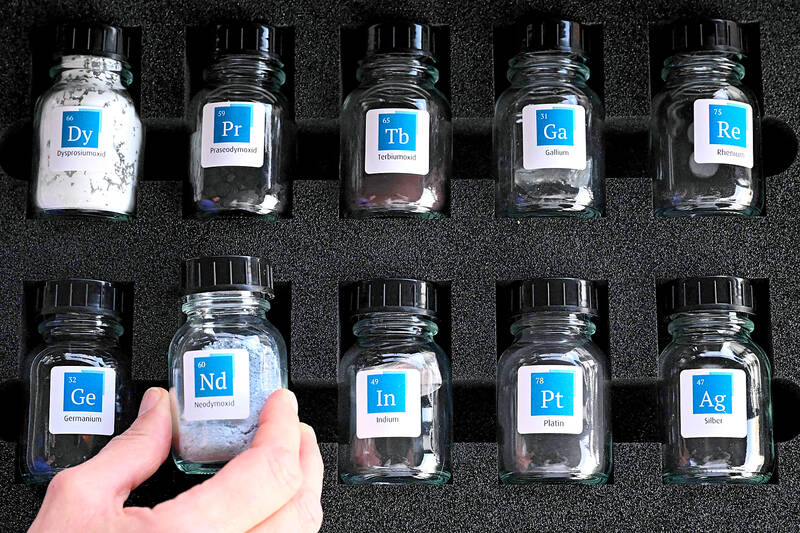
Photo: Kirill Kudryavtsev, AFP
“Urgency is the theme of the day. It’s a very big undertaking. There’s a lot of different angles, a lot of different countries involved and we really just need to move faster,” the official said.
Bessent on Friday told Reuters that he had been pressing for a separate meeting on the issue since a G7 leaders summit in Canada in June, where he delivered a rare earths presentation to gathered heads of state from the US, Britain, Japan, Canada, Germany, France, Italy and the European Union.
Leaders agreed to an action plan at the summit to secure their supply chains and boost their economies, but Bessent has grown frustrated about the lack of urgency demonstrated by attendees, the official said.
Aside from Japan, which took action after China abruptly cut off its critical minerals supplies in 2010, G7 members remain heavily dependent on critical minerals from China, which has threatened to impose strict export controls.
China dominates the critical minerals supply chain, refining between 47 percent and 87 percent of copper, lithium, cobalt, graphite and rare earths, according to the International Energy Agency. These minerals are used in defense technologies, semiconductors, renewable energy components, batteries and refining processes.
The US is expected to issue a statement after the meeting, but no specific joint action is likely, the official added.
“The United States is in the posture of calling everyone together, showing leadership, sharing what we have in mind going forward,” the official said. “We’re ready to move with those who feel a similar level of urgency ... and others can join as they come to the realization of how serious this is.”
The official gave no details on what further steps were planned by US President Donald Trump’s administration, which is pushing forward to boost domestic production and reduce reliance on China through agreements with Australia, Ukraine and other producers.
The US signed an agreement with Australia in October aimed at countering China’s dominance in critical minerals that includes an US$8.5 billion project pipeline. The deal leverages Australia’s proposed strategic reserve, which will supply metals like rare earths and lithium that are vulnerable to disruption.
The official said there had been progress, but more work was needed. “It’s not solved,” they added.
Canberra has said it has subsequently received interest from Europe, Japan, South Korea and Singapore.
Today’s meeting comes days after reports that China had begun restricting exports to Japanese companies of rare earths and powerful magnets containing them, as well as banning exports of dual-use items to the Japanese military.
The meeting was planned well before that action, US officials said. China was still living up to its commitments to purchase US soybeans and ship critical minerals to US firms.

HORMUZ ISSUE: The US president said he expected crude prices to drop at the end of the war, which he called a ‘minor excursion’ that could continue ‘for a little while’ The United Arab Emirates (UAE) and Kuwait started reducing oil production, as the near-closure of the crucial Strait of Hormuz ripples through energy markets and affects global supply. Abu Dhabi National Oil Co (ADNOC) is “managing offshore production levels to address storage requirements,” the company said in a statement, without giving details. Kuwait Petroleum Corp said it was lowering production at its oil fields and refineries after “Iranian threats against safe passage of ships through the Strait of Hormuz.” The war in the Middle East has all but closed Hormuz, the narrow waterway linking the Persian Gulf to the open seas,

RATIONING: The proposal would give the Trump administration ample leverage to negotiate investments in the US as it decides how many chips to give each country US officials are debating a new regulatory framework for exporting artificial intelligence (AI) chips and are considering requiring foreign nations to invest in US AI data centers or security guarantees as a condition for granting exports of 200,000 chips or more, according to a document seen by Reuters. The rules are not yet final and could change. They would be the first attempt to regulate the flow of AI chips to US allies and partners since US President Donald Trump’s administration said it rescinded its predecessor’s so-called AI diffusion rules. Those rules sought to keep a significant amount of AI

Apple Inc increased iPhone production in India by about 53 percent last year and now makes a quarter of its marquee devices there, reflecting the US company’s efforts to avoid tariffs on China. The company assembled about 55 million iPhones in India last year, up from 36 million a year earlier, people familiar with the matter said, asking not to be named because the numbers aren’t public. Apple makes about 220 million to 230 million iPhones a year globally, with India’s share of the total increasing rapidly. Apple has accelerated its expansion in the world’s most populous country in recent years, bolstered

A new worry has been rippling across the stock market lately: Entire businesses, not just their employees, might be thrown out of work. While most economists say fears of an artificial intelligence (AI) job apocalypse are overblown, seismic shifts have happened in the past after big tech breakthroughs. The IT revolution of the 1990s led to a surge in productivity that sped up the US economy for several years. It also rendered companies or even industries largely redundant — from travel agents and stockbrokers to classified advertising and newspapers, or video rental stores. Economists expect AI would deliver higher productivity,


 RSS
RSS