


South Korea’s government is more optimistic about the economy’s prospects than the central bank, striking a more upbeat tone as authorities move to further open the nation’s currency and financial markets to global investors.
In its economic growth strategy report for this year, the government forecast the economy would grow 2 percent, more than the Bank of Korea’s 1.8 percent estimate, the South Korean Ministry of Economy and Finance said in a statement Friday.
Consumer prices are predicted to rise 2.1 percent, the same pace as in last year, it added.
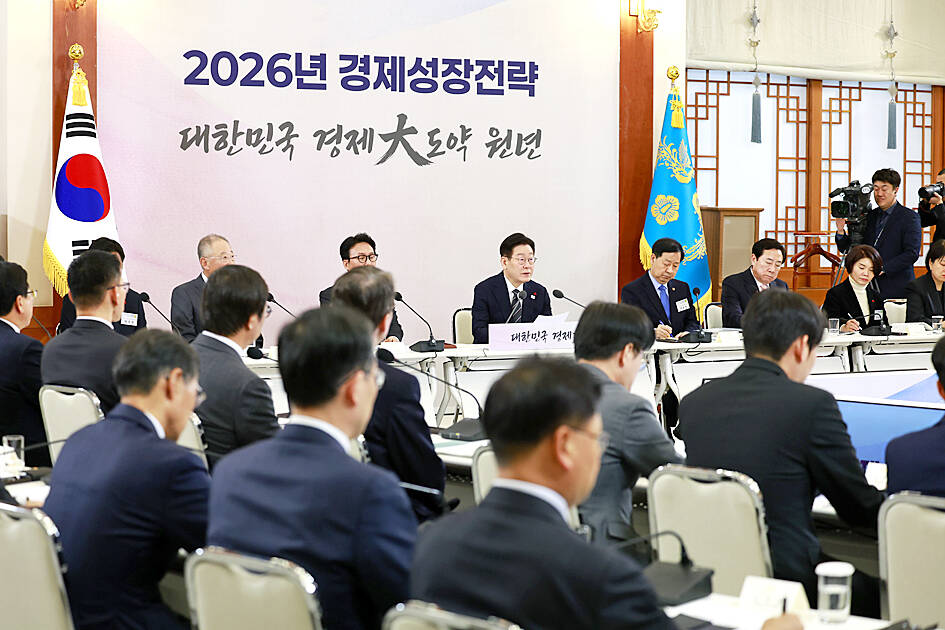
Photo: EPA
The brighter outlook is driven by firmer domestic consumption and stronger exports, led by semiconductors, while construction investment is expected to turn positive, First Vice Finance Minister Lee Hyoung-il said.
The government expects a current-account surplus of US$135 billion this year, up from an estimated US$118 billion last year, helped by improving trade terms as chip prices recover and energy costs ease.
Still, policymakers acknowledged longer-term constraints. The strategy warned that South Korea’s potential growth rate could fall toward 1 percent in the 2030s, and near zero in the following decade without structural reforms, underscoring the need to attract capital and boost productivity.
A central pillar for the plan is a sweeping overhaul of foreign-exchange market access.
The government said it would fully extend onshore foreign exchange trading to a 24-hour system from July, replacing the current structure that closes in the early hours of the morning, and improve links with overseas trading hubs and electronic currency platforms.
A roadmap to promote wider use of the won in international payments and offshore financial transactions would be finalized in the first half of the year.
The foreign exchange reforms are part of a broader push to attract foreign investment as South Korea pursues inclusion in global benchmarks such as MSCI Inc’s developed markets index. The government would complete its phased entry into the FTSE World Government Bond Index this year and continue efforts to align market infrastructure with international standards.
As part of those efforts, officials reiterated plans to establish a Korean sovereign wealth fund, with initial capital of about 20 trillion won (US$13.7 billion), drawing on government-held equity stakes and other assets. The fund would operate with independent decision-making and gradually expand its investment footprint, the strategy said.
With regards to financial stability, the government said it would maintain tight oversight of household debt while supporting growth, and is considering the creation of a dedicated real estate supervisory body.
Housing supply would be expanded alongside measures aimed at preventing the buildup of systemic risks tied to property prices and leverage.
The strategy reaffirmed the government’s industrial priorities, with artificial intelligence, semiconductors and advanced manufacturing positioned as key growth engines.
In digital finance, South Korea said it would move to formalize rules for stablecoins, including setting requirements for issuers and reserve assets, while pursuing the introduction of spot exchange-traded funds linked to digital assets, all steps aimed at bringing crypto markets further into the regulatory framework.
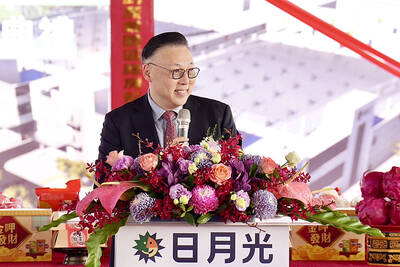
ENERGY ISSUES: The TSIA urged the government to increase natural gas and helium reserves to reduce the impact of the Middle East war on semiconductor supply stability Chip testing and packaging service provider ASE Technology Holding Co (日月光投控) yesterday said it planned to invest more than NT$100 billion (US$3.15 billion) in building a new advanced chip testing facility in Kaohsiung to keep up with customer demand driven by the artificial intelligence (AI) boom. That would be included in the company’s capital expenditure budget next year, ASE said. There is also room to raise this year’s capital spending budget from a record-high US$7 billion estimated three months ago, it added. ASE would have six factories under construction this year, another record-breaking number, ASE chief operating officer Tien Wu
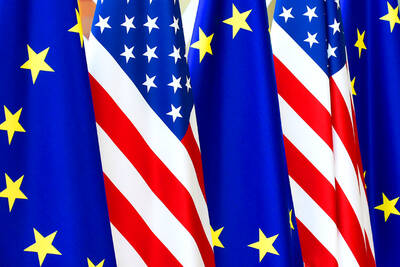
The EU and US are nearing an agreement to coordinate on producing and securing critical minerals, part of a push to break reliance on Chinese supplies. The potential deal would create incentives, such as minimum prices, that could advantage non-Chinese suppliers, according to a draft of an “action plan” seen by Bloomberg. The EU and US would also cooperate on standards, investments and joint projects, as well as coordinate on any supply disruptions by countries like China. The two sides are additionally seeking other “like-minded partners” to join a multicountry accord to help create these new critical mineral supply chains, which feed into

For weeks now, the global tech industry has been waiting for a major artificial intelligence (AI) launch from DeepSeek (深度求索), seen as a benchmark for China’s progress in the fast-moving field. More than a year has passed since the start-up put Chinese AI on the map in early last year with a low-cost chatbot that performed at a similar level to US rivals. However, despite reports and rumors about its imminent release, DeepSeek’s next-generation “V4” model is nowhere in sight. Speculation is also swirling over the geopolitical implications of which computer chips were chosen to train and power the new
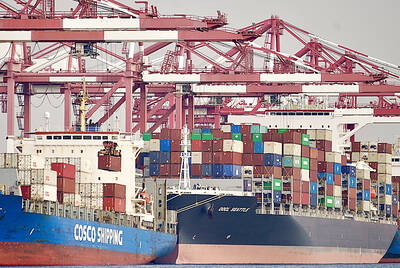
TECH WINNERS: Taiwan and South Korea reported robust trade, which suggests that they have critical advantages in the rapidly expanding AI supply chain, an official said Exports last month surged to a new high, as booming demand tied to artificial intelligence (AI) infrastructure fueled shipments of advanced technology components, underscoring the nation’s pivotal role in the global semiconductor supply chain. Outbound shipments climbed to US$80.18 billion, the highest ever for a single month, rising 61.8 percent from a year earlier and marking the 29th consecutive month of growth, the Ministry of Finance said yesterday. “The surge was driven primarily by global investment in AI infrastructure,” Department of Statistics Director-General Beatrice Tsai (蔡美娜) said. The mass production of next-generation AI computing systems has accelerated procurement across the semiconductor supply


 RSS
RSS