


Taiwan’s stock market set six record highs in 2025 and is aiming to overtake Canada to become the world’s sixth-largest equity market by capitalization, the Taiwan Stock Exchange (TWSE) said yesterday.
TWSE data showed that six key indicators reached all-time highs last year: the year-end benchmark index, average daily turnover, total market capitalization of listed firms, combined revenue of listed companies, funds raised through initial public offerings (IPOs), and securities transaction tax revenue.
Speaking at a news conference in Taipei, TWSE chairman Sherman Lin (林修銘) said global markets last year were shaped by rising geopolitical risks, intensifying trade protectionism and heightened volatility. Despite these challenges, Taiwan’s equity market demonstrated resilience and steady growth, he said.
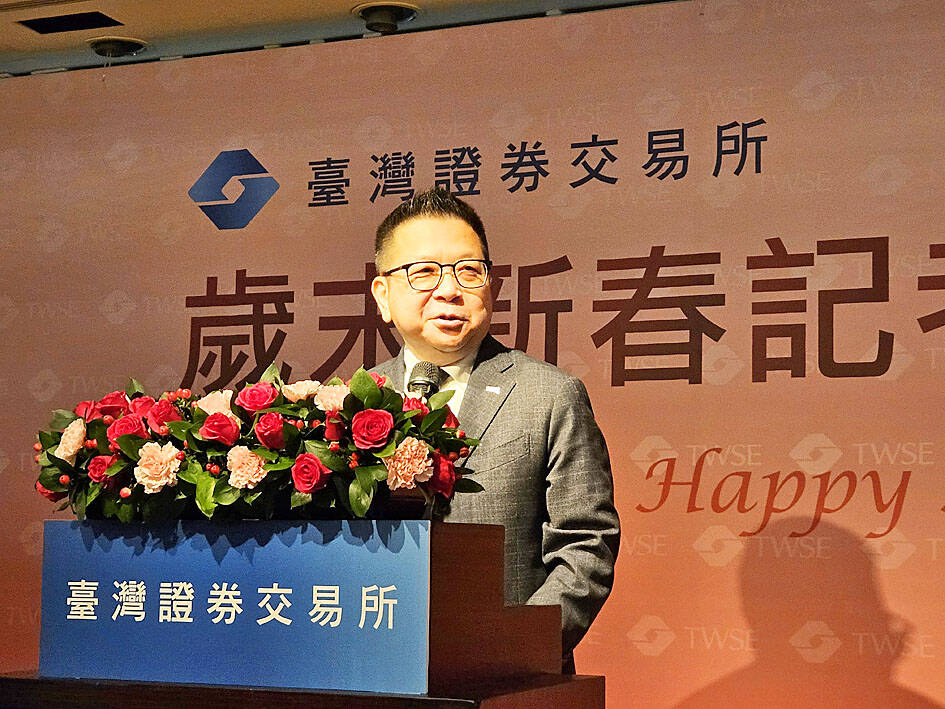
Photo: CNA
According to the TWSE, the TAIEX closed the final trading session of last year at 28,963.6 points, while average daily turnover reached a record NT$416 billion (US$13.17 billion).
A total of 45 companies applied to be listed last year, the highest number since 2008, while IPO fundraising climbed to a record NT$85 billion, the exchange said.
In the first 11 months of last year, total revenue generated by all listed companies hit a historic high of NT$42.89 trillion, the TWSE said.
Securities transaction tax revenue over the same period totaled NT$261.6 billion, with the full-year figure still being finalized but expected to set another record, it said.
By the end of last year, total market capitalization of listed companies stood at NT$94.36 trillion, placing Taiwan eighth globally by market value, the exchange said.
The rally extended into early this year, with the TAIEX breaking the 30,000-point threshold this week. As of Tuesday, total market capitalization had risen to NT$99.6 trillion, allowing Taiwan to overtake France and rank seventh worldwide, Lin said.
The exchange’s next goal is to surpass Canada, currently ranked sixth by market value, he said, adding that the gap between Taiwan’s stock market and Canada’s is about NT$15 trillion.
TWSE president Edith Lee (李愛玲) said the combined market capitalization of listed and over-the-counter companies has already reached NT$106.72 trillion, or about US$3.41 trillion, consolidating Taiwan’s position as the world’s seventh-largest equity market.
Lee added that if heavyweight stocks — particularly Taiwan Semiconductor Manufacturing Co (台積電) — continue to gain, Taiwan could move up another notch in the global rankings.
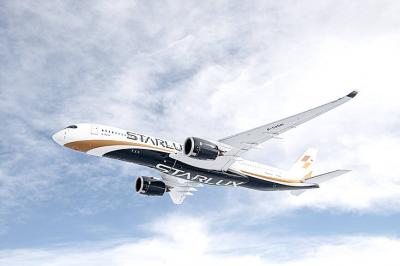
Starlux Airlines Co (星宇航空) today unveiled a long-haul network expansion plan at a shareholders’ meeting in Taipei, including direct flights to Barcelona, Spain, and Zurich, Switzerland, as well as a service connecting Taipei, Sydney and New Zealand. Starlux is to become the first Taiwanese carrier to offer non-stop services to the two European cities, while the inaugural oceanic route is expected to expand transit opportunities within the Australia-New Zealand market, Starlux said. Flight services to Chicago, Dallas, Washington and New York are under evaluation, the airline added. Prior to the shareholders’ meeting, the airline earlier this year announced that it would be

Cairo’s new monorail slices across the city skyline, running above the familiar chaos of blaring horns and aging buses’ exhaust fumes that mark rush hour below. The US$4.5 billion monorail, opened this month, is among Egypt’s most prominent new transport projects, part of a debt-funded infrastructure drive criticized for sapping state finances while bringing limited benefits to most of the country’s 109 million people. “It feels like you’re in a different country,” said Ramy Sayed, a restaurant manager, aboard a driverless Innovia 300 train. “No noise, no traffic, we’re not used to this.” The eastern line runs 56km from the bustling middle-class
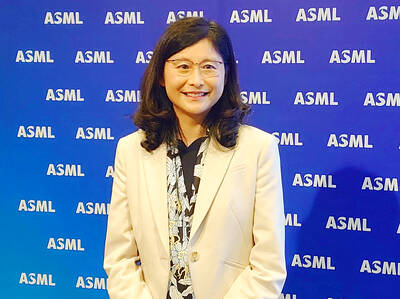
Netherlands-based semiconductor equipment supplier ASML Holding NV yesterday said that it is planning to hire an additional 1,000 people in Taiwan this year in response to growing demand from clients. ASML had previously planned to recruit 600 people this year, but that the plan has been adjusted upward, ASML vice president and ASML Taiwan general manager Grace Wang (汪佳慧) told reporters. ASML has a workforce of more than 4,500 in Taiwan, accounting for about 10 percent of its global total, Wang said. This year’s recruitment campaign would focus on adding people in the customer support, manufacturing and supply chain domains to assist ASML
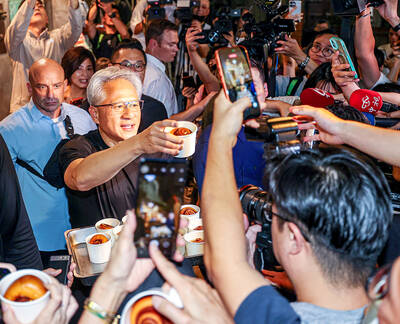
Nvidia Corp yesterday announced that CEO Jensen Huang (黃仁勳) would attend an employee meeting in Taipei tomorrow to celebrate the launch of the company’s Taiwan headquarters project. Huang would attend a gathering at the site of Nvidia’s planned headquarters in Beitou Shilin Technology Park (北投士林科技園區), the company said in a statement. After arriving in Taiwan on Saturday last week, Huang told reporters that he plans to meet with Quanta Computer Inc (廣達) chairman Barry Lam (林百里) and Taiwan Semiconductor Manufacturing Co (TSMC, 台積電) chairman C.C. Wei (魏哲家), and would attend the groundbreaking ceremony for Nvidia’s Taiwan headquarters tomorrow. Nvidia has not yet applied


 RSS
RSS