


Samsung Electronics Co expects memorychip supply shortages to raise prices across the electronics industry, including potentially among its own consumer products.
The South Korean company is the world’s largest memory maker, but even its portfolio is not immune to the surging cost of the component essential to everything from smartphones and laptops to connected home appliances and self-driving vehicles.
“There’s going to be issues around semiconductor supplies, and it’s going to affect everyone,” Samsung president and head of global marketing Lee Won-jin said in an interview at the CES trade show in Las Vegas. “Prices are going up even as we speak. Obviously, we don’t want to convey that burden to the consumers, but we’re going to be at a point where we have to actually consider repricing our products.”
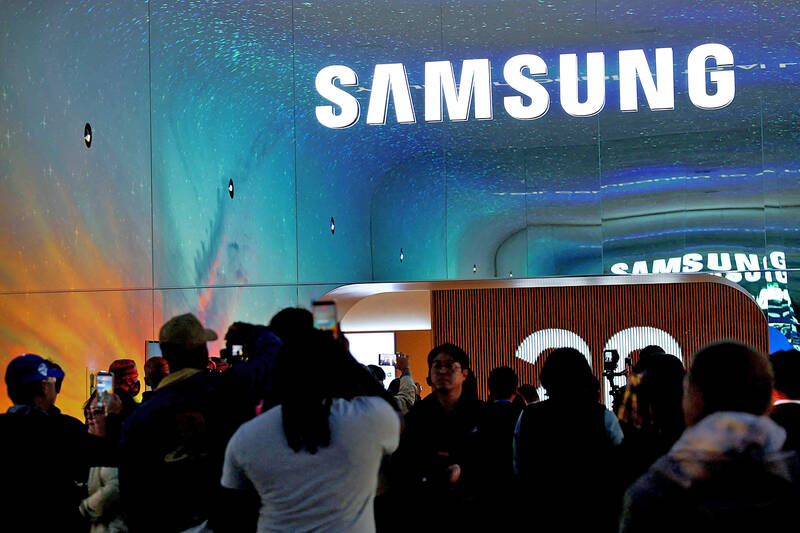
Photo: AFP
An artificial intelligence (AI) data center buildout boom has brought about unprecedented demand for high-bandwidth memory, a lucrative product that has lifted Samsung and fellow memory maker SK Hynix Inc’s stock prices to new highs, and dented production capacity for more conventional memory products. As a result, prices have soared for legacy DRAM used in more traditional servers as well as PCs and smartphones.
Counterpoint Research in November last year forecast a 50 percent price rise for memory modules through the second quarter of this year.
Samsung is better positioned than competitors who are unable to manufacture memory for their own products, and Lee sees the company outpacing the broader market.
“We’re more optimistic about the outlook of 2026 than what we experienced last year,” he said.
Samsung shares yesterday rose as much as 4 percent. The gains came just a day ahead of a preliminary earnings report.
Analysts polled by Bloomberg estimate Samsung’s earnings would more than double this year to a record high of about US$60 billion, on par with projections for Taiwan Semiconductor Manufacturing Co (TSMC, 台積電). Still, the South Korean firm’s market capitalization of US$560 billion is less than half that of TSMC, Asia’s most valuable company.
Research analysts are scrambling to raise price targets on TSMC shares, underscoring continued bullishness on the chipmaking giant after its record surge.
At least six brokerages, including Goldman Sachs Group Inc and Macquarie Group Ltd, have lifted projections on the Taipei-listed stock since the start of the year. JPMorgan Chase & Co hiked its target 24 percent to NT$2,100 in a report released yesterday, citing expectations of strong revenue growth and improving profitability.
“We expect 2026 to be another strong growth year for TSMC,” on expanding demand for the company’s most-advanced chipmaking technology and increased pricing, JPMorgan analyst Gokul Hariharan wrote in a note. “Gross margins should also see upside.”
TSMC is set to report results for last quarter next week. Analysts polled by Bloomberg expect sales to rise 18 percent from a year earlier, with its operating margin improving to a three-year high of more than 50 percent.


Taiwanese firms have increased investment in the Philippines in recent years as Manila’s ties with Washington deepen and global supply chains continue to shift away from China, an expert at the Chung-Hua Institution for Economic Research (CIER, 中華經濟研究院) said yesterday. The Philippines had not been among Taiwanese investors’ top choices in Southeast Asia, CIER Taiwan ASEAN Studies Center director Kristy Hsu (徐遵慈) said at a seminar in Taipei. However, Taiwan’s investment in the country has grown significantly since the COVID-19 pandemic, reaching US $257 million last year, a high in recent years, she said. Although Taiwan’s total investment in the Philippines still lags

Intel Corp regards Taiwan Semiconductor Manufacturing Co (TSMC, 台積電) as a longstanding partner, as the US chipmaker would continue outsourcing production of advanced chips to TSMC, Intel chief executive officer Lip-Bu Tan (陳立武) said yesterday. “I don’t look at people as competitors. I look at the collaboration... Nvidia is also, you know, a good friend,” Tan told a news conference following his keynote speech at the Computex trade show in Taipei. “It’s a very trusted partnership for us... We are a big, top customer for them, and we’re going to continue doing that,” he said, referring to TSMC, the world’s largest foundry

Hon Hai Precision Industry Co (鴻海精密) yesterday said it would work with US chipmaker Intel Corp to jointly develop and deploy next-generation artificial intelligence (AI) infrastructure and intelligent computing platforms in a move to capture booming demand for AI computing systems. Hon Hai, also known as Foxconn Technology Group (富士康), said in a statement that the partnership would combine its global manufacturing scale, system integration expertise and AI data center deployment capabilities with Intel’s strengths in processor architecture, silicon technologies and software ecosystem. The companies said they plan to work on equipment used in AI data centers, including server racks powered by

Artificial intelligence (AI) agents would supplant smartphones as the center of people’s digital lives, fundamentally reshaping personal devices and driving a major computing upgrade cycle, Qualcomm Inc CEO Cristiano Amon said yesterday. In his keynote speech for this year’s Computex trade show in Taipei, Amon said that the rise of "agentic AI" — AI systems capable of reasoning, planning and carrying out tasks autonomously — would transform how people interact with technology across phones, PCs, vehicles and wearable devices. Describing the technology as the next major evolution in computing, Amon said that "2026 is the year of agents.” For decades, smartphones have sat


 RSS
RSS