


PentaPro Materials Inc (宇川精材), which produces metal organic precursors used in advanced chip production, yesterday said it plans to invest NT$3 billion (US$95.17 million) in a new factory in Taiwan to meet rising demand.
The company’s main facility is approaching full capacity as customers continue to advance manufacturing process technologies to create smaller chips with more complicated architecture, PentaPro told a news conference in Taipei.
The company’s semiconductor precursors are high-purity chemical liquids used in chip manufacturing. They provide source materials for depositing thin films mainly using atomic layer deposition to form integrated circuits. The process is primarily used in the production of logic and memory chips smaller than 16 nanometers.

Photo: Chang Hui-wen, Taipei Times
PentaPro is a supplier to Taiwan Semiconductor Manufacturing Co (台積電), the world’s biggest contract chipmaker.
“Utilization of the existing factory is running in high gear now,” PentaPro co-CEO C.Y. Chen (陳建榮) said. “One of our major advantages is local supply. We are running out of space, so we have to build a second factory.”
Chipmakers prefer the local supply of semiconductor precursors, as the chemicals are primary chemical hazards and can only be transported through ocean shipping, a time-consuming practice compared with air freight for chips.
The new factory would have an installed capacity six to 10 times greater than the existing plant, when it enters operation in 2028, PentaPro said.
The company is collaborating with multiple customers to jointly develop new precursors and to produce them for customers on a contract basis, chairman and co-CEO Kuo Wen-che (郭文哲) said.
To cope with growing demand, PentaPro said it is revamping an older production line to produce advanced semiconductor precursors later this year.
It expects revenue this year to grow significantly higher than last year, thanks to strong customer demand and new capacity.
Cumulative revenue in the first 11 months of last year totaled NT$121 million, a dramatic increase from full-year revenue of NT$61 million in 2024, company data showed.
Semiconductor precursors accounted for more than 70 percent of the company’s revenue last year, PentaPro said.
However, the company lost NT$97 million in the first half of last year, or losses per share of NT$0.97, as additional costs for equipment purchases and technology adjustments dented the company’s gross margin, it said.
A smaller revenue scale was also a factor, PentaPro chief financial officer Joseph Chen (陳祖華) said.
The company swung into a monthly profit in November, as gross margin improved, he said.
PentaPro is scheduled to debut its shares on the Emerging Stock Board on Tuesday next week.

ENERGY ISSUES: The TSIA urged the government to increase natural gas and helium reserves to reduce the impact of the Middle East war on semiconductor supply stability Chip testing and packaging service provider ASE Technology Holding Co (日月光投控) yesterday said it planned to invest more than NT$100 billion (US$3.15 billion) in building a new advanced chip testing facility in Kaohsiung to keep up with customer demand driven by the artificial intelligence (AI) boom. That would be included in the company’s capital expenditure budget next year, ASE said. There is also room to raise this year’s capital spending budget from a record-high US$7 billion estimated three months ago, it added. ASE would have six factories under construction this year, another record-breaking number, ASE chief operating officer Tien Wu

The EU and US are nearing an agreement to coordinate on producing and securing critical minerals, part of a push to break reliance on Chinese supplies. The potential deal would create incentives, such as minimum prices, that could advantage non-Chinese suppliers, according to a draft of an “action plan” seen by Bloomberg. The EU and US would also cooperate on standards, investments and joint projects, as well as coordinate on any supply disruptions by countries like China. The two sides are additionally seeking other “like-minded partners” to join a multicountry accord to help create these new critical mineral supply chains, which feed into

For weeks now, the global tech industry has been waiting for a major artificial intelligence (AI) launch from DeepSeek (深度求索), seen as a benchmark for China’s progress in the fast-moving field. More than a year has passed since the start-up put Chinese AI on the map in early last year with a low-cost chatbot that performed at a similar level to US rivals. However, despite reports and rumors about its imminent release, DeepSeek’s next-generation “V4” model is nowhere in sight. Speculation is also swirling over the geopolitical implications of which computer chips were chosen to train and power the new
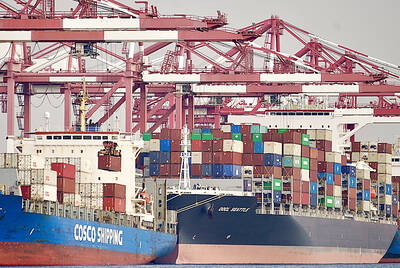
TECH WINNERS: Taiwan and South Korea reported robust trade, which suggests that they have critical advantages in the rapidly expanding AI supply chain, an official said Exports last month surged to a new high, as booming demand tied to artificial intelligence (AI) infrastructure fueled shipments of advanced technology components, underscoring the nation’s pivotal role in the global semiconductor supply chain. Outbound shipments climbed to US$80.18 billion, the highest ever for a single month, rising 61.8 percent from a year earlier and marking the 29th consecutive month of growth, the Ministry of Finance said yesterday. “The surge was driven primarily by global investment in AI infrastructure,” Department of Statistics Director-General Beatrice Tsai (蔡美娜) said. The mass production of next-generation AI computing systems has accelerated procurement across the semiconductor supply


 RSS
RSS