


Electric scooter brand and battery swapping services provider Gogoro Inc (睿能創意) has decided to expand its cooperation with British lubricant maker Castrol Holdings International Ltd in the Vietnamese market.
Gogoro told the Central News Agency in a phone interview yesterday that it is planning to launch e-scooter models catering to potential Vietnamese riders this year.
The company said it would authorize Castrol to market and sell these models in Vietnam, while Gogoro would assist with design and technologies used in new models, it said.
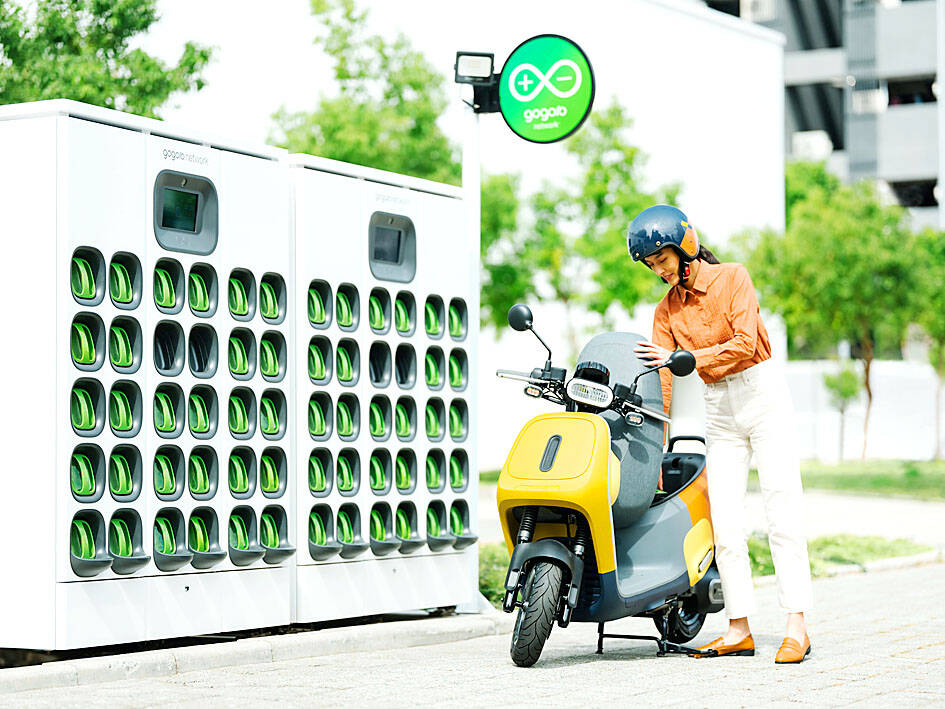
Photo courtesy of Gogoro Inc
The partnership followed an agreement signed by the two companies in February last year to set up a joint venture, leveraging the British company’s knowledge of the Vietnamese market.
Castrol has been in the Vietnamese market for decades, Gogoro said.
Since the February agreement was signed, Gogoro and Castrol have launched a pilot e-scooter logistics team in small areas in Vietnam and collected first-hand information from clients.
With 3 million two-wheel vehicle sales every year, Vietnam has great growth potential for Gogoro.
Furthermore, starting from July 1, Vietnam would ban gasoline-powered motorcycles from entering downtown Hanoi as part of its efforts to cut carbon emissions and improve air quality. Ho Chi Minh City is expected to follow, making the Vietnamese market more attractive to Gogoro.
Gogoro said Taiwan’s motorcycle market was affected by a slower global economy, with many consumers turning more cautious about their consumption of big-ticket items such as motorcycles.
In Taiwan, e-scooter sales fell 37.64 percent from a year earlier to 49,228 units last year, including 28,176 Gogoro units. Gogoro took a 3.98 percent share of the local motorcycle market, where 708,392 units were sold last year.
Gogoro chief executive officer Henry Chiang (姜家煒) said the brand is planning to unveil three new e-scooter models this year, and develop more advanced and competitive batteries to help the company’s energy business break even this year.
Chiang said Gogoro would continue to work hard to allow its energy service operations to create free cash flows next year and also aims for its vehicle business to break even in 2028.
In the first nine months of last year, Gogoro incurred US$60.03 million in net loss, compared with US$51.43 million in net loss a year earlier.

HORMUZ ISSUE: The US president said he expected crude prices to drop at the end of the war, which he called a ‘minor excursion’ that could continue ‘for a little while’ The United Arab Emirates (UAE) and Kuwait started reducing oil production, as the near-closure of the crucial Strait of Hormuz ripples through energy markets and affects global supply. Abu Dhabi National Oil Co (ADNOC) is “managing offshore production levels to address storage requirements,” the company said in a statement, without giving details. Kuwait Petroleum Corp said it was lowering production at its oil fields and refineries after “Iranian threats against safe passage of ships through the Strait of Hormuz.” The war in the Middle East has all but closed Hormuz, the narrow waterway linking the Persian Gulf to the open seas,

RATIONING: The proposal would give the Trump administration ample leverage to negotiate investments in the US as it decides how many chips to give each country US officials are debating a new regulatory framework for exporting artificial intelligence (AI) chips and are considering requiring foreign nations to invest in US AI data centers or security guarantees as a condition for granting exports of 200,000 chips or more, according to a document seen by Reuters. The rules are not yet final and could change. They would be the first attempt to regulate the flow of AI chips to US allies and partners since US President Donald Trump’s administration said it rescinded its predecessor’s so-called AI diffusion rules. Those rules sought to keep a significant amount of AI

Apple Inc increased iPhone production in India by about 53 percent last year and now makes a quarter of its marquee devices there, reflecting the US company’s efforts to avoid tariffs on China. The company assembled about 55 million iPhones in India last year, up from 36 million a year earlier, people familiar with the matter said, asking not to be named because the numbers aren’t public. Apple makes about 220 million to 230 million iPhones a year globally, with India’s share of the total increasing rapidly. Apple has accelerated its expansion in the world’s most populous country in recent years, bolstered

A new worry has been rippling across the stock market lately: Entire businesses, not just their employees, might be thrown out of work. While most economists say fears of an artificial intelligence (AI) job apocalypse are overblown, seismic shifts have happened in the past after big tech breakthroughs. The IT revolution of the 1990s led to a surge in productivity that sped up the US economy for several years. It also rendered companies or even industries largely redundant — from travel agents and stockbrokers to classified advertising and newspapers, or video rental stores. Economists expect AI would deliver higher productivity,


 RSS
RSS